Man-Centered Christianity (part 2)

** first read part 1

Jesus is our buddy, and God is our friend. Christ is hip, and church is cool. This sentiment is alive and well in today’s American Christianity, along with: God has a special plan for your life. You are very special to Him.

The problem with the Church today is that we are using God. Like Aladdin, we depend on our genie to help us live a meaningful and happy life. Afraid of hell, or guilty over sin? Pray a prayer, and Jesus takes care of it. Worry on the job, stress in your family situation? The Bible has the answer, its God’s guidebook for life. Longing for true acceptance and love? No one loves you like Jesus does! In the church we all love each other and look out for one another.

It takes a trained eye, but do you see how the above concerns all center around self and self-esteem? Perhaps its no wonder, then, that Jesus is also offered among evangelicals today, as one who can guarantee that you will get what you want, that you will get rich, that you will prosper, or that you will be healed.

How did we get here? Man-Centered Methodology including the Sinner’s Prayer

I suppose that there have always been such errors in the Church, after all we are human. But with the rise of the revivalist movement in the 1800s, an emphasis was placed on crafting evangelistic appeals tailored to the likes and dislikes of the audience. Charles Finney invented the altar call, and appealed to the human free will to come forward and make a commitment to Christ. Later evangelists continued to employ pragmatic methods in a largely parachurch context as they drew ever larger crowds together in large mass meetings around the country, and the world.

The pledge a new convert would make eventually was replaced by a prayer. And under Billy Sunday, the prayer was changed into the modern “sinner’s prayer”. Never before in the history of the church had such a method been used. Now sinners were directed to pray for personal salvation, rather than given counsel and encouraged to believe and thereafter commit/pledge to follow Christ with all their being. This subtle change in methodology, like the many that preceded, became a new tradition that bound countless evangelists and ministers for generations to follow.

From a personal prayer for salvation, the “sinner’s prayer” became employed en masse. Crowds were instructed to repeat this prayer if they wanted to be saved. And then came the religious tracts, which today overwhelmingly call for a prayer to be repeated. These prayers have given assurance to thousands, and have transformed our modern view of salvation.

While Scripture speaks of those who are “being saved”, most evangelicals view salvation in the past tense. While past evangelists exhorted converts to continue steadfastly in the faith, modern-day converts are promised that even the most damaging sins will not result in the loss of your salvation — the salvation they “received” upon their just completed recitation of the “sinner’s prayer”. Today, multitudes struggle over whether they “said the right words”, or truly “meant it”. And assurance is often given based on Rom. 10:13 and whether the person remembers a “time and a place” when they accepted Christ.

Whereas before converts would often come from churches where they had heard countless Scriptural sermons, and been given personal Scriptural counseling, before finally coming to repentance, today’s converts are given a few (often very few) verses, ripped from their context and strung together in the form of a “Roman’s Road”, or “The Four Spiritual Laws”. Earnest and biblical preaching has sometimes been turned into a well-crafted psychological appeal. Often times seekers are manipulated into just “trying” the prayer, or giving Jesus “a test drive”. In some fundamentalist circles, almost any means is employed to get people to repeat the magical, soul-saving, prayer — including putting a foot in people’s doors so they can’t shut it and so they have to hear the soul-winner’s quick appeal to pray this prayer.

Hold on a second, Bob! Where’s your proof, and aren’t you exaggerating a bit here? I knew someone was thinking that. You were, weren’t you?

In the next few days I will be reviewing a book which offers some historical background and proof for many of my assertions here. I’ll even be having a book give away (so stay tuned!). But at this point, I should insert a caveat. I do not think, that a “sinner’s prayer” experience is necessarily void of any merit. I think countless believers started believing in Christ right around the time they prayed that first prayer. The prayer didn’t save them, faith did; and the prayer was merely a vehicle by which to express their faith.

Problems with the “Sinner’s Prayer”

But at the same time I see some serious problems with this methodology. The “sinner’s prayer” can lead people to trust in an act they did as a means of salvation. They are saved because they prayed and did their part of Rom. 10:13 — they “called”, so God has to “save”. But salvation is not a mere transaction. And often the prayer is merely a recognition that you believe certain facts — the Gospel facts. No one is saved by believing facts, people must repent and trust Jesus alone for salvation.

Further, a “sinner’s prayer” gives people a false hope. Assurance is tied to the act, not to faith. And beyond that, it fosters a point-in-time prevailing view of salvation. It does not encourage people to take seriously the many Biblical warnings for those who do not persevere in faith.

And lastly, the “sinner’s prayer” fosters a self-orientation and a man-centered view of Christianity. Because God died to save people, people are important. I am important. My needs were met by God, so I should thank him and live for him. But still everything centers around me, even God is bowing down to serve me, having done all He could to save my soul.

Looks like these posts are turning into a series. Next time, I will discuss the theology of the “sinner’s prayer”, and Bible arguments against it. Then I will get into a Biblical view of eternal security/perseverance. And finally, Lord willing, I will explain what a God-centered Christianity looks like.AddThis Social Bookmark Button

Man-Centered Christianity?

Many times labels are a bit self-serving. After all, “I” am God-centered, Gospel-centered, Christ-centered, God-saturated, etc. etc. And of course you aren’t. Oh, and I’m orthodox, my beliefs are historical and Biblical, and Spurgeon agrees with my position! Labels are at the same time helpful. There is an orthodox position. History does matter, and gospel-centered does mean something.

Perhaps an aversion to any kind of theological pride in labels is behind recent blog discussion (by those Phil Johnson calls “post-evangelical”) centering on the question, “Can you be too God-Centered?” While some good points are raised concerning that question, from my vantage point the overwhelming problem in evangelicalism today is that far too many are man-centered.

I don’t want to merely throw out such a label in hopes of scoring points. And I realize no one will be standing in line to claim the label I’m describing here! But this is a very important issue, and I hope I can gain a hearing.

The problem I’m discussing is especially big among strict fundamentalists, yet it’s present among many more liberty-conscious evangelicals. From the TBN-watching Arminians, to even the staunchest, doctrine-loving Reformed — man-centered Christianity finds a home.

It’s sometimes overt, yet often dangerously subtle. And since we are all recipients of Adam’s sin nature (and the pride of our one-time father the devil), we would do well to at least explore whether perhaps we might have slipped into being too man-centered.

“I suddenly saw that someone could use all the language of evangelical Christianity, and yet the center was fundamentally the self, my need of salvation. And God is auxiliary to that….I also saw that quite a lot of evangelical Christianity can easily slip, can become centered in me and my need of salvation, and not in the glory of God.” — quoted in Tim Stafford, “God’s Missionary to Us”, Christianity Today, Dec. 9, 1996.

I read the above quote in John Piper’s book The Legacy of Sovereign Joy (pg. 118), and felt I just had to comment on it. Man-centeredness can be successfully cloaked in a religious and even conservative garb, and therefore it is even more dangerous.

So central to American revivalist evangelicalism, is man’s personal need for salvation. For many — the majority, I would say — in evangelicalism, the need of personal salvation brings them into the church, and is very soon taken care of. Then other needs find central place.

A wide segment of the church today emphasizes the emotional and physical needs of the congregation, straining to serve and help everyone become successful and happy. And another more Biblical (in my opinion) aim centers on the need to live a holy life and obey God’s commands. Serving the poor, reforming one’s own character, contributing to the common good by volunteering and giving to the church, sacrificing to reach the lost, these all are good things which become central. Even in worship, an emphasis on personal tastes and being accepted is quite common. Others stress a personal experience.

The danger in all of this, becomes the tendency to center everything around self. God saved me, so He deserves my love and praise. I want a better life, so I enjoy and benefit from teacher so-and-so’s practical teaching….

This can lead to lives that are not much different from the non-churched. God has a part, but He is not central. The here and now matters an awful lot, as does economical and emotional well-being. Helping each other, and feeling good about ourselves are essential.

But where is the light on the hill? How is this all that different from the world? Do you find a feel-good invitation in Scripture? Come follow Jesus, and there’s no cross to bear, and all your problems get fixed! God loves you so much he did everything just to help you. Shouldn’t you love such a God in return?

The problem with this is that we don’t need a great and glorious God to make it work. Its not all that different from secular health-and-wellness seminars, or the new age movement. Substitute yoga for God and you get about the same thing. Yoga can transform your life and give you real meaning and purpose….

All I’ve done here today has been to introduce the problem. I hope to explore what God-centered Christianity would look like. And I hope to point out how the popular methodology & doctrine concerning salvation has a profoundly negative impact with regards to this problem.

So for now, ask yourself: Am I too man-centered? And please, let me know if you think I’m off base in my assessment that this is 1) a widespread problem, and 2) this is a big problem.AddThis Social Bookmark Button

Jesus’ Demands — Fear Him Who Can Destroy Both Soul And Body in Hell (#11)

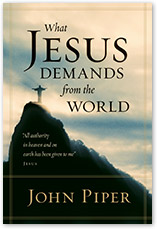
Click to orderNote: these are devotional posts based on John Piper’s new book What Jesus Demands from the World.

This post is number 11, because I started the series a while ago. If you like this post, check out the other posts in the series. But most importantly get the book (it’s also available to read online)!

Now, on the heels of demand #10 Rejoice and Leap for Joy, comes a more startling and sobering demand…

Demand #11 — Fear Him Who Can Destroy Both Soul And Body in Hell

And do not fear those who kill the body but cannot kill the soul. Rather fear him who can destroy both soul and body in hell. (Matthew 10:28)

But as for these enemies of mine, who did not want me to reign over them, bring them here and slaughter them before me. (Luke 19:27)

Then he will say to those on his left, “depart from me, you cursed, into the eternal fire prepared for the devil and his angels.” . . . And these will go away into eternal punishment, but the righteous into eternal life. (Matthew 25:41, 46)

The Awful Place Called Hell

It’s fashionable these days to downplay Hell. Many “evangelical” leaders are denying its existence, suggesting it is not eternal, or claiming there is no actual fire in Hell. Some claim it is a state of mind, or that hell is on earth.

In fact, this very Sunday, on Good Morning America, I heard an interview of an influential (former?) evangelical pastor who has changed his mind about hell, claiming it is here on earth, and a mere creation of superstitious man. ABC is going to be dedicating a 20/20 special this Friday to the topic of Hell. I can already guess their conclusions!

Sadly, these same evangelical leaders claim to be following the example of Jesus. But don’t they realize that Jesus didn’t share their view of Hell? Jesus spoke of hell more than anyone else in Scripture.

He refers to it as a terrible place to be feared. A place of “outer darkness” with “weeping and gnashing of teeth” (Matt. 8:12). He describes it as a “fiery furnace”, with “unquenchable fire” (Matt. 13:41, Mark 9:44). It is the “eternal fire prepared for the devil and his angels” (Matt. 25:41).

And worst of all, Hell is eternal. Jesus describes it as a place of “eternal punishment”. On this point let me quote John Piper,

This last description–“eternal punishment”–is especially heartrending and fearful because it is contrasted with “eternal life.” “These will go away into eternal punishment, but the righteous into eternal life.” In this contrast we hear the tragedy of loss as well as suffering and endlessness. Just as “eternal life” will be a never-ending experience of pleasure in God’s presence, so “eternal punishment” will be a never-ending experience of misery under God’s wrath (John 3:36; 5:24).

A Passive Hell ?

At this point, many a sincere believer tries to lessen the full effect of this teaching by claiming that Hell is “a mere natural consequence of bad choices”. People do consciously reject God’s free offer of salvation made in the gospel, and this choice does lead to hell. But Piper is quick to point out that such is not the whole story.

People make choices that lead to hell. But it is not the whole truth. Jesus says these choices are really deserving of hell. “Whoever says, ‘You fool!’ will be liable to [that is, guilty of, or deserving of] the hell of fire” (Matt. 5:22). That is why he calls hell “punishment” (Matt. 25:46). It is not a mere self-imposed natural consequence (like cigarette smoking leading to lung cancer); it is the penalty of God’s wrath (like a judge sentencing a criminal to hard labor).

The Biblical picture of hell, is of a just God pouring out righteous anger and wrath over sin. God sends people to hell, and Jesus is pictured in Revelation and Isaiah as the One Whose garments get stained with the blood of his enemies as He “tread(s) the winepress of the fury of the wrath of God the Almighty” (Rev. 19:15b with Is. 63:3 and Rev. 14:20).

Fear, But Don’t Fear

We are to fear God as a holy Judge indeed. So is Jesus calling us to a “life of anxiety that God is angry with us and is ready to punish us at the slightest misstep”? No! Piper highlights the very next few sentences which follow on the heels of Jesus’ admonition to fear God.

. . . Fear him who can destroy both soul and body in hell. Are not two sparrows sold for a penny? And not one of them will fall to the ground apart from your Father. But even the hairs of your head are all numbered. Fear not, therefore; you are of more value than many sparrows” (Matt. 10:29-31, emphasis added — compare also Luke 12:4-7).

Piper says,

In the same breath Jesus says, “Fear God who casts into hell” and “Do not fear because God is your Father who values you more than the sparrows and knows your smallest need.”. . . How does Jesus mean for us to experience these two truths about God–he is to be feared, and he is to be trusted? It won’t do to simply say that “fear of God” means “reverence for God” rather than “being afraid of him.” That does not fit with the words, “Fear him, who, after he has killed, has authority to cast into hell. Yes, I tell you, fear him!” (Luke 12:5) . . . The key is that God himself is the one who removes his wrath from us. Our peace does not come from our removing the God of wrath from our thinking, but from his removing his wrath from us. . . .

The Seriousness of Sin

There is a beautiful encouragement to trust God as a loving Father in this text, but there is also a serious warning about the seriousness of sin. Piper says that this demand of Jesus “teaches us to see sin as more serious than we ever dreamed”. That unforgiven sin leads to hell, makes sin serious indeed.

But I am so prone to excuse my sin, and I suspect you are too. Yet both of us enjoy casting stones at others. The key in appreciating the justness of Hell according to Piper is seeing God as He really is. Let me quote him now.

Therefore, the seriousness of sin arises from what it says about God. God is infinitely worthy and honorable. But sin says the opposite. Sin says that other things are more desirable and more worthy. How serious is this? The seriousness of a crime is determined, in part, by the dignity of the person and the office being dishonored. If the person is infinitely worthy and infinitely honorable and infinitely desirable and holds an office of infinite dignity and authority, then rebuffing him is an infinitely outrageous crime. Therefore it deserves an infinite punishment.

The Place of Fear

For us Christians, especially those of us who are conservative doctrinally, this article has so far been easy. We have applauded it from the peanut gallery. Hell is real, sinners need to fear God and accept the provisions made for them according to the Gospel. Amen.

But if you notice, Jesus is directing his remarks to his disciples. This is plain from both Matthew and Luke’s accounts. So what does this message have to speak to us?

While we don’t need to be continually fearing God as unbelievers, we do need to fear unbelief. Sin is in essence, unbelief. When we disbelieve God’s promises, we give in to the appeal of sin. The demand to fear God, is a call for us to realize how serious sin really is. Let me quote Piper at length on this point.

What then is left to fear? The answer is unbelief. For those who follow Jesus, fearing God means fearing the terrible prospect of not trusting the one who paid such a price for our peace. In other words, one of the means that God uses to keep us peacefully trusting in Jesus is the fear of what God would do to us if we did not believe. The reason we do not live in the discomfort of constant fear is because we believe. That is, we rest in the all sufficient work of Jesus and in our Father’s sovereign care. But at those moments when unbelief tempts us, a holy fear rises and warns us what a foolish thing it would be to distrust the one who loved us and gave his Son to die for our anxiety-free joy.

This message is not popular today. People would rather believe that once they commit to Christ, they are eternally secure and can coast through life. This is not necessarily true, as the abundant Scriptural warnings to persevere and “endure to the end” contest.

What trips up many on this point is that they conclude that if you believe it is potentially possible that you are not sincerely a believer, that you could possibly fall away from the faith (and thereby evidence that you never were a true believer), then the Christian life must just be all about our works. If we really have to fear God in this way, we must be continually depending on our efforts to keep believing.

It is true that some pervert the Biblical doctrine of perseverance into just such an introspective self-effort. But this is a perversion of the true doctrine. Piper says concerning fear: “This is the best effect of fear: It wakens us to our need for help and points us to the all-sufficient Redeemer, Jesus.” A true understanding of the perseverance of the saints will lead one to depend all the more on Jesus as our only sure hope of eternal life. Those who believe themselves beyond the possibility of falling (contrary to 1 Cor. 10:12), can tend to trust on their own work of believing in Christ and are tempted to not cling all the more earnestly to Christ day in and day out. For more on the idea of perseverance, check out these posts I have done on the topic.

So to conclude, we are to fear God because He can destroy us in Hell. Yet at the same time because of Jesus’ blessed sacrifice on our behalf, we don’t have to fear God as a distant and holy Judge, but we can lovingly trust him as a loving and caring Father. All praise to the Lamb for bringing us to God, and giving us such a wonderful relationship with our Heavenly Father.

—See all posts on, the Demands of JesusAddThis Social Bookmark Button

“With One Voice: Singleness, Dating & Marriage to the Glory of God” by Alex & Marni Chediak

I’ll get right to it. With One Voice: Singleness, Dating and Marriage to the Glory of God by Alex & Marni Chediak is one of the best books I’ve read in a while. Aside from skillful wordsmithing and intuitive organization, the book hits a home run when it comes to addressing the topic at hand.

There are not too many books out there which deal with how to find a mate, yet are written from a wholly Christian and Biblical perspective. And even then, some of the books which qualify as Biblical and Christian major on a specific dating (or anti-dating) method to the detriment of a well-rounded Christian philosophy of dating in general. This book provides just that: a distinctly Christian approach to the philosophy of singleness, dating, and marriage.

Alex Chediak, with the help of his wife Marni, begins the book by detailing the pervasive cultural changes which influence our view of dating. He shows how a changing job market has spread out families, and focused on the value of individuals in the marketplace. Technological and commercial advances have coupled with the increasingly personalized society to lure courtship from the parents’ front porch to the drive-in movie theater and eventually to live-in relationships. The Chediaks also highlight how the new concept of delayed adolescence gave room for today’s entertainment and me-oriented culture. One widespread result of these cultural changes is the tendency for young adults to remain single until they are almost 30. Confronted with these changes, which certainly threaten a Christian view of marriage and sexuality, Alex doesn’t just settle for an appeal to bring back the golden days of yesteryear. He calls such nostalgic responses “unwarranted and misplaced”, which often “fall short of addressing the heart issues”. Men have always been sinful. The Christian response should be to study culture with a view of applying Biblical principles in such a way as to redeem and confront it.

After setting the stage, the book goes on to emphasize that marriage should be normal. Excepting those gifted for lifelong singleness, marriage is God’s will for the Christian young person. That being the case, cross-gender relationships should not be all about fun and enjoyment, rather they should be intentionally focused on the reality of marriage. Before detailing how a single adult should go about finding a mate, Alex & Marni lay an important foundation by discussing a Biblical view of masculinity and femininity, and the concepts of leading and submitting. They do this, because one of the book’s primary themes is for singles to focus on becoming the right kind of person first, before looking for the right potential mate.

The wisdom of the Chediaks shine through in the final two chapters detailing how to “choose [a mate] wisely” and “proceed carefully” with your relationship. There is a wealth of wisdom available as they discuss objective and subjective considerations necessary in a prospective mate, and the intentional and careful progression of a relationship. There couldn’t be a more practical “how to” book for this process, yet at the same time the book gives plenty of space for a variety of methods to be used. Instead of a detailed prescription, the book offers an undergirding framework of Bibilical principles upon which to erect a healthy and successful, Biblically faithful relationship.

This book comes at the marriage issue from a Biblically faithful, conservative theology. It does not offer a theological defense of a complementarian view of masculinity and femininity. Nor does it defend the Biblical priority of marriage and denial of extra-marital sexual activity. Instead it assumes these views and aims to be very practical. This in good part forms the strength of the book. It helps you think Biblically about marriage and dating, and supports you in your quest for a godly mate. I wish I had such a book when I was thinking through my own dating philosophy. It would have saved me much time and grief in thinking through such things on my own!

There isn’t much to say by way of criticizing the book. Perhaps it could have brought up the influence of the romantic movement in the 1800s on society’s present view of dating and marriage. Also some of the statistics on page 22 are a little hard to follow. But all in all, this is a fantastic book. It is extremely easy to read, with large font and a well-written, fast moving arrangement. It is a short read, being only about 140 pages long; yet it will be an incredibly profitable read. I recommend the book to singles everywhere of any age, and also to youth pastors, pastors and parents. Indeed, there is much wisdom available even for those singles who feel especially frustrated in finding a mate. So by all means get this book, you’ll thank me later!

Note: you can learn more about the authors and the book here.

Disclaimer: This book was provided by the author. The reviewer was under no obligation to offer a positive review.

This book is available for purchase at the following sites: Westminster Bookstore, Amazon.com, or direct from Christian Focus.

Desiring God Book Sale

$5 Book Sale!I thought you all should know that Desiring God is having a special book sale for 2 days only. Tomorrow, June 27th through the 28th, every book at desiringgod.org will be priced at the incredibly low price of $5!

Just go to Desiring God’s online store to take advantage of this deal. Also, note it is an online deal only.

This is a great time to check out what Desiring God offers. Pick up one of Piper’s biography books, or order What Jesus Demands from the World. Purchase the recent ECPA Gold Medallion winning Don’t Waste Your Life. Or you can go for Piper’s earlier books, Let the Nations Be Glad and Desiring God. There are many more titles, so take advantage of the sale!