** this is part 3 in a series on man-centered Christianity, see part 1 & part 2.
Now I lay my fears to sleep
I prayed, now the Lord must keep.
Nothing to lose, everything to win
I prayed the prayer, now I’m in.
The above prayer is patently absurd. Yet many actually do think that praying the sinner’s prayer is what guarantees they will be saved. God’s hand is forced. Rom. 10:13 obligates Him to keep His promise. They have “called upon the name of the Lord”, and He must save them.
Often people are encouraged to give Jesus a try. Commit yourself to Jesus and you will enter a brand new and exciting life! It only takes a few minutes, don’t you want to know that you will spend eternity in Heaven? Just pray this prayer and mean it, and on the authority of the Bible I guarantee you will be saved! Come on, what have you got to lose?
Anyone will have to admit that this is extremely common. Some form of the above appeal commonly ends most evangelical messages. It is often employed at the end of 1-on-1 witnessing conversations. But put yourself in the shoes of the lost person. The promises of life change sound pretty good. I would like to be accepted and these people are really nice, after all. What would it hurt? Sure, I’ll pray this prayer.
Or think of the Hindu: I want to have the gods accept me. This Jesus must be a powerful god. If I can appease him, I’ll surely be better off. I’ll pray to him and worship him, just like my family worships their god of choice.
Or what about the Catholic: I pray to Mary all the time for acceptance. I never knew you could actually be sure of heaven. I’m not sure how this works, but maybe it will add to the merits my efforts have been giving me. I receive Jesus at communion, receiving him in this prayer makes sense. I hope this works, maybe I won’t have to keep going to confession. Here goes.
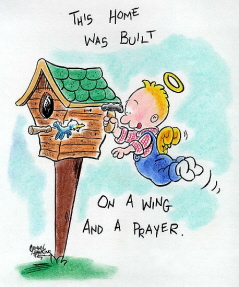 Many are simply building their spiritual lives on a wing and a prayer. They enter Christianity as if it were a club. They pray the prayer and gain acceptance. They hear messages about how they are to feel about themselves and about various Christian ethical concerns. They give to charity, and dress nicely for their church gatherings. They feel generally good about themselves, and if they doubt their salvation, they are often assured on the basis of having prayed the prayer, that God will save them, because He doesn’t lie. Doubt is of the devil, after all.
Certainly there are many examples of those who have savingly believed at the time of their sinner’s prayer experience. Many are genuinely converted and trust in Jesus alone, even though they employed a sinner’s prayer. I want to be careful as I critique this popular method. But please consider the following.
1) No one in the NT is ever instructed to pray for salvation, or to pray “to be saved”.
2) The Bible witness is clear: believing Jesus saves you. So then, as I’ve wondered before, what would the “sinner’s prayer” do? Only those who believe in Christ will even pray the prayer and mean it. If the belief is what saves, why is the prayer framed in such a way as to imply that the asking is what saves? Does asking for salvation save, or does believing Christ alone save?
3) Rom. 10:13 in context does not teach that a prayer for salvation results in salvation.
Rom. 10:13-14 “For everyone who calls on the name of the Lord will be saved. But how are they to call on him in whom they have not believed? And how are they to believe in him of whom they have never heard?”
This is absolutely clear, before the “call” there must be faith. How can they “call” if they haven’t believed?
4) Why is “call on the name of the Lord” so quickly assumed to be “called out unto the Lord for salvation”? There is no object of the prayer in view in the text. In fact, if you trace the concept of calling on the name of the Lord, you will find something completely different. Let’s do that quickly.
1 Cor. 1:2 speaks of the saints as being “those who in every place call upon the name of our Lord Jesus Christ”. 2 Tim. 2:22 also speaks of “those who call on the Lord from a pure heart”. In both of these places the idea is used as a descriptive term for those who are worshippers of Jesus. This again is seen in Acts 9:14. Also, “call” is a continuous present tense idea — not those who did call (for salvation), but those who do call.
The NT use follows a pervasive OT usage of this idea. In the OT the phrase is often used of praying to God in specific circumstances for help, but it also refers to a general concept of worship: “I will call upon the Lord…”. The wicked are those who do not call on the Lord (Ps. 14:4), but the righteous do. Sometimes God delivers them physically or spiritually after their calls for help (Ps. 116:13) and other times God’s deliverance provides the impetus for the believers to call upon him (Ps. 80:18). In one sense, calling is what believers do — they come to God for help. But in another, it is who they are, they are worshippers who call upon their God.
Everyone, then, who calls on God, who is a worshipper of God, who worships God now and continually, all of these can expect ultimate salvation. “Salvation” is often referring to ultimate salvation or glorification, not justification, remember.
5) Rom. 10:9 is also not a formula for salvation. Merely saying “Jesus is Lord” does not save. Vs. 9 follows the order of the OT quote given in vs. 8 (“The word is near you, in your mouth and in your heart”). Vs. 10 seems to explain the logical or chronological order: belief is first, which brings justification; confession follows that, even as ultimate salvation follows justification.
6) The concept of asking Jesus in one’s heart is also unbiblical and unhelpful. See this booklet [PDF] by Pastor Dennis Rokser of Duluth Bible Church. Or this article by Todd Friel, of Way of the Master Radio.
7) The repentant publican who says “Lord be merciful to me, a sinner” had his repentant believing heart before he verbalized his prayer. And the thief on the cross changed his mind about Jesus, and ceased railing against him, before he called on him for mercy.
As humans, a prayer is sometimes inevitable. We may feel like we need to do something. We will pray to be saved and forgiven, but Scripture testifies that it is faith that saves. Requiring a prayer or encouraging someone to ask for salvation, muddles the waters and can potentially confuse matters. Enduring faith in the substitutionary Lamb of God is what saves. Trusting a personal act (praying) doesn’t. Worse, this theology can lead to a wrong assumption that even unrepentant faith can demand things of God.
I understand that there may be questions and difficulty in accepting what I’ve said here. I welcome further interaction in the comments. This post is sort of an aside from my current series on man-centered Christianity. I think the self-centered focus that the sinner’s prayer promotes is a contributing factor in the pervasive problem of man-centeredness in the church. In the next post, we will show how a wrong view of eternal security is likewise contributing to this problem. Then we will be ready to see what a God-centered view really is.
Like this:
Like Loading...
 If you are like me you have 2 or 3 study Bibles filed away on a bookshelf somewhere. They rarely get used; and when they do, they aren’t much help. I don’t know why, but study Bibles always seem better on the bookstore shelf than they actually are.
 Before we jump in to the blog posts I’ve been spotting lately, let me remind you of Bob’s Blog Finds. In my sidebar you’ll notice that I show the last 10 posts I’ve shared from my blog reading. The posts I share there don’t always make it to these blogroll posts, but they are worth a read. You can