Artificial Heat

I came across an interesting article on global warming. Now, I am all for caring for the environment in a Biblically responsible way. We are called to steward God’s creation not abuse it.  

However, there has long seemed to be an ulterior agenda behind the scientific “consensus” concerning global warming. And I have never taken their claims too seriously.    One reason concerns the fact that the vast majority of greenhouse gases are purely wator vapor! Add to that the fact that one  giant volcanic explosion  (like that of Krakatoa), can in one instant launch more greenhouse gases into the atmosphere than all the pollution mankind has achieved in more than 100 years!

Well, here is the article from the Telegraph.    By reading it I learned several interesting facts, some of which I will list here below, and others  you  will only  see if you go read the article yourself (HT: Phil Johnson).

  • There was a global  warming period back in the Medieval Age  (from around 1000 to 1400 AD). This period had average temperatures well above our own. (For example, back then Norwegians could farm the soil in Greenland, today we cannot as it is under a layer of permafrost.)
  • This warm period has been edited out  in the United Nations’ most recent global warming report. This was achieved through an ingenious method of redefining terms and messing with data.
  • In the past half century, the sun has been warmer than it has been in the past 10,000 years plus! Certainly this fact could be seen as a big cause in the recent warmer temperatures! (We haven’t polluted the sun yet!)
  • “In 1988, James Hansen, a climatologist, told the US Congress that temperature would rise 0.3C by the end of the century (it rose 0.1C), and that sea level would rise several feet (no, one inch).”

∼striving for the unity of the faith for the glory of God∼ Eph. 4:3,13 “¢ Rom. 15:5-7

Jesus’ Demands: Repent (#2) & Come unto Me (#3)

I have started blogging through Jesus’ Demands as discussed in John Piper’s latest book What Jesus Demands from the World. On now to demands #2 & 3.
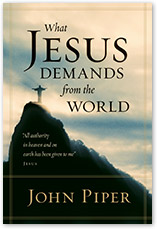
Click to orderDemand #2 — Repent

From that time Jesus began to preach, saying, “Repent, for the kingdom of heaven is at hand.” (Matt. 4:17)

I have not come to call the righteous but sinners to repentance. (Luke 5:32)

The time is fulfilled, and the kingdom of God is at hand; repent and believe in the gospel. (Mark 1:15)

Unless you repent, you will all likewise perish. (Luke 13:3, 5)

Jesus called everyone to repent—it was his first public demand. Piper pointed out that “repentance is an internal change of mind and heart rather than mere sorrow for sin or mere improvement of behavior.” He points to the two halves of the Greek word for repentance (metanoeo) for support. Meta signifies change and noeo is the word for the mind (and “its thoughts and perceptions and dispositions and purposes”). Luke 3:8 is very instructive as to the nature of repentance as it calls us to “bear fruits in keeping with repentance”. Thus, repentance is a change of mind and heart that happens inside of us and inevitably leads to new behavior.

Jesus demands we experience this inward change of heart. He calls sinners to repent. Sin, Piper argues, is “an assault on God.” And thus we must turn away from this attitude of enmity with God and submit to His will. Piper sums up the ideas inherent in repentance with the following sentence.

Repenting means experiencing a change of mind so that we can see God as true and beautiful and worthy of all our praise and all our obedience.

And repentance is universally needed. It is not just the bad people who stand in need of repentance but we all do. And if we don’t repent, Jesus says we will “all likewise perish”! This is serious. But this command to repent is not separated from God’s gracious offer of forgiveness. We are to “repent and believe in the gospel”. And this command is to go to every tribe, tongue, and nation (Luke 24:46-47).

Repentance has recently been redefined by “Free Grace” advocates and others who oppose a so-called “Lordship Salvation”. I won’t get into that here, but will point you to this post for a series of articles which explain and defend the correct definition of repentance well.

But before moving on, I think it is appropriate to ponder the full weight of this command. We are called to experience an inward change of heart which results in our relinquishing sin and relishing in Jesus. Are you, am I currently savoring the Savior? Repentance is an initial requirement for salvation. But it is more than that. It bears lasting fruit and so our continual response to the sin we so often fall back to, should be one of repentance. And just as God must grant repentance to those enslaved by sin (2 Tim. 2:24-26), so God must help us to experience a genuine sorrow over and internal change in reference to our sin. May he truly give us repentance and enable us to live lives that are pleasing to Him.

Demand #3 — Come unto Me

Come to me, all who labor and are heavy laden, and I will give you rest. (Matt. 11:28)

Jesus stood up and cried out, “If anyone thirsts, let him come to me and drink.” (John 7:37)

Jesus said to them, “I am the bread of life; whoever comes to me shall not hunger. ” (John 6:35)

You refuse to come to me that you may have life. (John 5:40)

Repentance seems so negative. And it is true Jesus calls us to leave self-glorifying sin. But Christ dose not call us to a “monastic” life of continual bitterness of spirit. He does not call us to a life of hopeless attempts to please a stern and unbending Lord. No, he came to give us joy.

…when God gives the radical change of new birth and repentance, Jesus himself becomes our supreme treasure. “His yoke is easy, and his burden is light.” Therefore, his demand that we come to him is not burdensome. It means coming to the one who has become everything to us. [I changed the formatting somewhat here.]

Jesus offers us “rest”, “water”, and “bread”. This is relief, quenched thirst, and spiritual nourishment. There is a sense that coming to Jesus is not easy. It is a “burden”. But the difficulty lies in this fallen world and not in Jesus. He even promises to help bear that burden.

Jesus desires, yea demands us to come. But so many don’t. Why is this? In Matt. 23:37 Jesus weeps because those in Jerusalem “would not” come to him. And in Jn. 5:40 Jesus points out that many “refuse to come”. People “refuse to come” because they do not want to come. Some would call this a “choice of free will” but Piper stresses that “Jesus would probably say it is the choice of a will enslaved to sin” (see John 8:34). Since we are all enslaved to sin, how can any come? Piper answers,

…God, in his great mercy, overcomes our resistance and draws us: “No one can come to me unless the Father who sent me draws him” (John 6:44). “No one can come to me unless it is granted him by the Father” (John 6:65). God grants the gift of new birth and repentance, which opens the eyes of the spiritually blind to the truth and beauty of Jesus. When this happens, all suicidal objections fall. We are finally free. And finally free from slavery, we come.

A few thoughts concerning this demand now come to mind. First, we should “never cease to praise and thank [God] for his sovereign grace” which draws us to Jesus. I know many who read this blog are yet to be convinced of Calvinism. I hope, however, that in reading this post you see that the Calvinist position on this point is cause for greater praise and wonder at the glory that God would choose us. It is not about being better than others, and it is not about belittling the need for evangelism. God regenerates us through the preached Gospel message, and Calvinists affirm that everyone who believes will truly be saved. But step back and see the wonder of God’s grace. After all, you could have been born as a Hindu in India, with little chance to be saved, or a Mayan Indian before Christ with almost no chance to be saved. Praise God for his undeserved goodness in drawing you to Himself.

Second, let us meditate on how good Jesus is. What a wonder that when he calls us to come, it is not like a frustrated Father calling us to face judgment, but rather that of a tender One who loves us and wants to meet our deepest needs! Jesus calls us to come and drink, eat, and find glorious rest and joy, even, in Him. And not for a little while but more and more for ever and ever! Praise Jesus for such wonderful news. Let us come, let us pray that God gives us more grace to come in an ever more true way. Let us pursue Jesus as our Supreme Treasure.

—See all posts on, the Demands of Jesus


∼striving for the unity of the faith for the glory of God∼ Eph. 4:3,13 “¢ Rom. 15:5-7

The Demands of Jesus—Introduction & #1

Click to orderIntroduction

Blogging can be so much more than mere fun. It can become a discipline. And it can even provide a measure of accountability.

That said, I plan to embark on a new venture with this blog. I intend to blog through the 50 demands that make up What Jesus Demands from the World, the new book by my pastor John Piper. I want to post devotional thoughts on each of these demands and intend to use the chapters in my personal Bible time. As such, I may post a demand a day. I can’t guarantee that this series will be finished in 50 days, however. I don’t want these posts to take away from my other blogging goals. But I think we will find them encouraging and challenging. But this series will be mostly for me—a discipline to post devotional thoughts regularly from my reading and meditating in God’s Word.

A word about the book, before I begin is in order. The chapters in the book are written in such a way as to be easy to read in one setting each. Thus they provide a perfect format for a devotional reading. With this book, Desiring God already has the entire book available to be read online for free! I would highly encourage you to read the introduction as it provides a great overview of the Gospel mission of Christ.

Today, there is a push to redefine the heart of the Gospel around the commands of Jesus to love God and your neighbors. Piper makes it clear, however, that the shadow of the cross is stamped all over the Gospels, and that Christ does not intend his commands to be able to impart life apart from a recognition of the centrality of the cross-work of Christ. So Piper tries to look behind each command and see the motivations given for it and the connection it has to the Gospel news of Christ’s substitutionary death and resurrection on our behalf. And as such, he hopes to show how the commands of Jesus are given to accomplish 2 purposes. These purposes are captured well in this quote: “The obedience he demands is [1] the fruit of his redeeming work and [2] the display of his personal glory.” So on now to…

Demand #1 — You Must Be Born Again

Jesus answered him, “Truly, truly, I say to you, unless one is born again, he cannot see the kingdom of God.” Nicodemus said to him, “How can a man be born when he is old? Can he enter a second time into his mother’s womb and be born? Jesus answered, “Truly, truly I say to you, unless one is born of water and the Spirit, he cannot enter the kingdom of God. That which is born of the flesh is flesh, and that which is born of the Spirit is spirit. Do not marvel that I said to you, ‘You must be born again.’ The wind blows where it wishes and you hear its sound, but you do not know where it comes from or where it goes. So it is with everyone who is born of the Spirit.” (John 3:3-8)

First, notice that without the new birth, no one can even see the kingdom of God. My Reformation Study Bible says it this way: “Without the grace of God, sinners cannot find the door, let alone force their way in.” Then notice that Jesus is amazed that Nicodemus did not understand what Jesus was meaning with the phrase “new birth”. This points us to look back to the Old Testament, in which Nicodemus would have been an expert, to find a reference to the new birth. We find such a reference in the new covenant promised blessing of a “new heart”.

I will sprinkle clean water on you, and you shall be clean from all your uncleannesses, and from all your idols I will cleanse you. And I will give you a new heart, and a new spirit I will put within you. And I will remove the heart of stone from your flesh and give you a heart of flesh. And I will put my Spirit within you, and cause you to walk in my statutes and be careful to obey my rules. You shall dwell in the land that I gave to your fathers, and you shall be my people, and I will be your God. (Ezek. 36:25-28; see also Is. 44:3)

The phrase “born of water and of the Spirit” describes the one new birth. This is clear because it is parallel to “born again” in vs. 3. Unless you are “born again” and unless you are “born of water and the Spirit” you cannot “see” or “enter” the kingdom of God. In light of the parallel to Ezek. 36 and also a similar parallel to Titus 3:5, we should see the water as referring to cleansing from sin and the spirit as the infusing of a new heart and spirit which accompanies the presence of the Holy Spirit in our lives now. Some try to make water refer to physical birth, but this is not how first century people would understand that. Others make it refer to baptism, and they are partly correct. Baptism is a rite which includes water. This hearkens back to the cleansing rituals in the OT ceremonial law. As Ezek. 36 shows (see also Is. 44:3), water is symbolic of cleansing. And Baptism is just that as well—symoblic of the spiritual cleansing we receive at the new birth.

To be born of the Spirit involves a dying to the past, and therefore it is only the Spirit that is spoken of in the subsequent verses; but it is essential that our past be recognised as needing cleansing and forgiveness. These two factors, water and spirit, are not strictly co-ordinate. Water is not an actual spiritual agency in the second birth; it is only a symbol. But in every true second birth there is a negative as well as a positive side, a renunciation of the past as well as a new life created. [quoted from Marcus Dods, “The Gospel of St. John”, The Expositor’s Greek Testament, vol. 1, ed. W. Robertson Nicoll (Hendrickson reprint, 2002) pg. 713]

Having looked a little closely at some of the parts, let us pause to take in the whole. Jesus says you need to be born. How many babies birth themselves? This is a passive action. Verse 8 indicates that the Spirit performs this new birth in a mysterious way, just as wind is mysterious. This new birth is referred to in John 1:12-13 where it is stressed that the birth happens: “not of blood, nor of the will of the flesh nor of the will of man, but of God.” In short, the new birth is an impartation of spiritual life which happens on the inside of our hearts and which only God can perform. Upon receiving this spiritual life we will believe in Jesus Christ as the rest of John 3 up to verse 21 shows. For a closer look at regeneration check out this earlier post.

To conclude, we are to be born again, yet we are unable to “just do it”, Nike style. This demand of Jesus indicates to us that we are sinful people in need of cleansing and rebirth which only God can provide. The good news is that Jesus came to enable us to see that kingdom and to purchase on the cross a grace to enable new birth to come to all who will believe. We can’t birth ourselves, but we can look to Jesus and be aware of our need for rebirth. We can follow on to know more of Jesus teaching, and this will culminate in spiritual rebirth.

To those of us who profess Christ, may this command remind us of our lowly estate apart from Christ. May it remind us that each day we depend on the Spirit to be continually blowing life on our dry dead bones, and that we need the Spirit’s work in us to be able to really see and appreciate the glorious realities of the Kingdom.

—See all posts on, the Demands of Jesus


∼striving for the unity of the faith for the glory of God∼ Eph. 4:3,13 “¢ Rom. 15:5-7

More on Music

Around here, we have been having quite the discussion on music lately! And that has been the case around the fundamentalist blogosphere for the most part, as well.

I just wanted to take this time to highlight a great post on the subject by Tom Pryde. It would be well worth your time to read his thoughts on this matter.

Let me give a few excerpts here, too, if I may.

The problem is that it really isn’t about drums, guitars, microphones, or any other atomistic element of the issue. The whole question is one of communication. Of course, it is true that this communication is heavily dependent upon cultural context, but this is hardly a justification for “anything goes.” The fact is that our culture can identify the emotional content of music more clearly than many would like to admit, and since we are not independent of our culture, it makes little sense to argue as if we are outside of it.

The fact is that the better the emotional expression fits both the message and the context, the more clearly, powerfully, and effectively the message will be conveyed. This is at least one very good reason to take music seriously. It is also true that musical communication is highly flexible and not at all precise. This means that context can heavily influence the nature of the emotional expression.

….

Proper corporate worship requires us to adapt to a form of expression that suits the whole, rather than our own individual tastes. If we fail to adapt, then we are left finding music that suits us, or we at least want the occasional use “our” kind of music. In both cases, the focus is wrong, and a deep misunderstanding of both music and worship is revealed. When my heart is right before God, the style of music matters far less than my own heart’s expression to God. If you need a particular style to “feel” worship, then there is a deeper problem in your worship.

For these reasons, at least (there are more reasons) a more conservative approach to corporate worship is essential. In the first place, it drives us to music that is less faddish and more enduring. In the second place, it drives us to music that is easily accepted by the entire congregation and is especially suited for congregational singing.

The careful reader will notice that I have not actually endorsed any style or approach to church music. Rather, I believe a principled approach will lead each Spirit-filled congregation to expressions of worship that are meaningful and communicative in their context.

Do go and read his post, there is much more on this over there. And while you’re at it, you may want to keep an eye on Brian McCrorie’s recent post on this subject too!


∼striving for the unity of the faith for the glory of God∼ Eph. 4:3,13 “¢ Rom. 15:5-7

A Rugged Cross, a Glorious Gospel, and the Ted Haggard Scandal

The Glory of the Gospel of Jesus ChristI was saddened to hear of the Ted Haggard fall this past week. And I must confess that when it became apparent that he was guilty, for a short while I may have sneered at him. But before long God gave me a prayer that Christ would be exalted in all of this. I believe that prayer is being answered, and Christ’s glory is being seen even in this sad scandal.

I would direct you to go read the letter that Ted wrote his church to confess his guilt. It seems to be a very sincere and true hearted expression of repentance. And then read the short note Ted’s wife read to their church. It is full of a faithful covenant love toward her fallen husband. The letters are both available to read here, compliments of Justin Taylor.

Many who would consider themselves more conservative theologically than Ted Haggard and his church, have had some reactions to all of this which might flow from some unChristian pride of heart. Many have deep-rooted convictions which result in some big methodological and philosophical differences with Haggard’s church. And so they have assumed that such a fall as Ted evidenced is par for the course. They have got what’s coming to them. That won’t happen to us.   Oh really? It has before and it will again, although sometimes theological conservatives can float under the radar, if you will.

And with such an outlook, pessimism would be expected. I admit I was quite pessimistic as to how this all would play out. But wonder of wonders, the Gospel is shining through. And the true unmistakable depth of Christianity is being revealed. Not only has Ted’s church handled the problem in a straightforward and Biblically faithful manner, Ted and his wife are evidencing repentance and forgiveness in their most  unmistakable hues.

This morning, with the above backdrop provided, I urge you to please read Tim Challies’ most recent post on this scandal (HT: Justin Taylor). He has written from the depths of his heart concerning the spiritual lessons for all of us in this mess.   The truth is we are just as messy as Ted Haggard, and but for the grace of God, the darkest sins of our heart would be exposed to and condemned by all as well. And God is the True Judge to fear, and so we should shudder in amazed awe at the wonder of his grace!

I wrote the following in response to Tim’s post. I placed it as a comment on his blog, but thought I would share it here. May these words not be mere talk, but may my heart and yours be raised from the squalor of the sin problems of this fallen world to the sublime grandeur of the Glorious Gospel revealed on that Old Rugged Cross.

Thank God for this post. Truly, it is an answer to prayer. I have prayed that Christ would be exalted even through the blatant ugliness of this whole affair, and I am sure others have as well.

I would like to just add one further level of thought. Yes, Ted is a sinner. Yes, we are too. And oh, we should let it sink in just how horrible we all really are. And yes, too, despite the assurances to the contrary by postmodern and liberal theologians, God’s wrath is suspended over us, and naught but grace stays His Holy Hand. And we are thus beckoned forcefully to thank God unceasingly for that grace.

But let us not forget Christ as the Reason for that grace. Let us be sure to lift Him up. And let us be sure to trumpet the Gospel as the unmistakably jaw-dropping truth that it is. That because of God giving up His only Son Jesus–the most Worthy and Holy Individual there is–He thereby offers to us–the most wicked and despicable, undeserving creatures there are–infinite and priceless grace. He places all of Ted’s black sins, and all the as yet unseen or unappreciated black sins of my own heart, and yours, on His Spotless Son–the Lamb of God–and then provides for people like Ted and you and me infinite Righteousness and Holiness. So that He not only restores us, even as Ted’s wife has been willing to restore her guilty husband, but that He raises us up to an unspeakable level of honor. We become joint heirs with Christ! By means of Jesus’ very blood, we inherit all of Jesus’ wealth!

Let us be shocked anew at the wonder of such an incredible message. Let us be amazed at the wonder of grace, as measured not only by the depths of our own sin but by the heights of the Glory of that Perfect Lamb Who was sacrificed on our behalf!

Worthy, Worthy is the Lamb! Glory be to our Great God and Saviour, the Lord Jesus Christ!


∼striving for the unity of the faith for the glory of God∼ Eph. 4:3,13 “¢ Rom. 15:5-7