Calvinism & Evangelism

Perhaps you are familiar with this parable concerning the difficulties of affirming both man’s free will and God’s all-encompassing sovereignty.

A sign above the door to Heaven boldly proclaims “Whosoever will may come!” However, once through Heaven’s gates, an astute observer will notice that the flip side of the sign says, “Only those predestined before the foundation of the world may enter.”

There is more than a little truth to this parable. The first sign deals with salvation from man’s perspective. To the awakened sinner, the first sign gives hope that if he will but look, he will live. Calvinism pulls the curtain back on the awakened sinner’s soul and sees God’s Spirit at work in regenerating the sinner, and granting him repentance and faith, due to the second sign.

As I see it, Calvinism deals mostly with what goes on behind the scenes, so to speak, in respect to salvation. But let me stress that Calvinism is not prying into secret areas of God’s will. No, Calvinism responds to numerous Scripture texts. While they don’t claim to understand everything, Calvinists are bound to believe the five points due to their regard for Scripture. This is not something they enjoy “making up from thin air” so to speak.

A proper understanding of man’s part and God’s part in salvation will do much to help us sort through the sticky issues surrounding Calvinism and evangelism. Historically, some Calvinists (hyper Calvinists, actually) have claimed that we have no responsibility to evangelize since God will irresistibly draw His elect with or without our help. Furthermore, they have claimed that we cannot confidently tell anyone necessarily that if they will but believe and come, that they will be saved. Such hyper Calvinists, then, denied the first sign.

So it is due to extremists from within their own theological system, that Calvinists face such intense suspicion at times. Many people sincerely doubt that Calvinists believe in evangelism. And many go beyond doubt and actually claim that Calvinism will negatively impact evangelism.

But such claims are so utterly wrong! Historically, some of the greatest evangelists and missionaries, some of the most evangelical of pastors have been 5 point Calvinists. Names like Jonathan Edwards, George Whitfield, Charles Spurgeon, William Carey, Adoniram Judson and many, many more could be given. In fact many missionary movements and revivals have been started in large part due to the work of Calvinists.

History aside, if one understands that Calvinism addresses the “behind the scenes” actions of God (God’s part), he will not see any contradiction between Calvinists rushing to do man’s part (evangelism). For Calvinists believe that every sinner who would be saved, must actually believe, and he must do this himself. Furthermore, we understand Scripture to clearly teach that no one gets saved apart from the gospel, and almost always people must be involved in spreading that gospel.

So for Calvinists, evangelism is about obeying God. And yet it is more. It is about joining God in His mission. It is about spreading God’s glory among the nations for His sake. Calvinists are encouraged that God is the one ultimately responsible for results. This gives us hope to minister in many contexts that might not provide immediate results, from man’s perspective.

There is one other point to stress here. Calvinists tend to understand salvation as a “work in progress”. It is that “work” which God has started in us and promises to complete. And so for the Calvinist, mere human decisions are not the goal of evangelism. Numbers of noses, and baptism tallies mean little. Calvinists see discipleship and spiritual growth as the goal of evangelism. [This is not to say that all non-Calvinists disagree with us here, by the way.] I say this because when numbers are expected, many a Calvinist might fail the test. But to a Calvinist, numbers aren’t the most important thing.

I hope what I have said makes sense and helps work toward an understanding of where Calvinists stand in relation to evangelism. And if it doesn’t I have several articles here from the last few weeks, which will help you really understand this issue. I provide them, because it was partly by coming across these that I was motivated to write this post.

L, 'ish, & Particular Redemption

Yesterday, I concluded my involvement in a somewhat long blog debate over L, ‘ish, & particular redemption. The “L” is the middle point of TULIP, of course, which refers to “limited atonement” or as Calvinists prefer to phrase it  “particular redemption”. The ‘ish  is a Hebrew word for “man” which can also be translated “each” or “every”. That word became important in the debate which centered on Is. 53:6.
To summarize, Pastor Kent Brandenburg claimed that the use of  ‘ish indicated that the reference was expanding from either the nation of Israel or the believing  remnant (which is the consistent use of “we” throughout the context) to all people everywhere. He claimed that both the use of “all” at the beginning and end of the verse, as well as the use of ‘ish [translated as  “every one”] set the verse off from the context to indicate that all people in general, or all of mankind are in view in the final phrase “the Lord has laid on him the iniquity of us all”.

I disagreed with this view. I see the Hebrew word in question merely pointing to each person in particular within the “all we” group about whom the verse is speaking. In fact, ‘ish comes in a phrase that also includes “we” in the translation: “we have turned everyone to…”. That seems to support my view. (For more support, reference the debate itself.)

This is not to say that Is. 53:6 is an open and shut case for limited atonement. The word “all” is used twice in the verse, and I can see how people (like Calvin himself!) would take the verse to be referring to all of mankind. But I see the “all” as referring to everyone within the group referred to by “we”. A spokesman might say on behalf of a group: “we agree”. Then later he might emphasize, “we all agree”. I think a similar use of “all” is in view here.

And I believe this understanding  fits with two other important points. First, the verse is written as poetry—Hebrew poetry. And the poem is longer than just verse 6. Second, several verses in the context all point to the “suffering servant” (aka the Messiah—Jesus Christ) as suffering on behalf of and atoning for the sins of the believing remnant—a select group of people.

“Surely he has borne our griefs and carried our sorrows…”  — vs. 4

“But he was wounded for our transgressions; he was crushed for our iniquities; upon him was the chastisement that brought us peace, and with his stripes we are healed.”  — vs. 5

“…stricken for the transgression of my people”  — vs. 8

“…by his knowledge shall the righteous one, my servant, make many to be accounted righteous, and he shall bear their iniquities.” —  vs. 11

“…yet he bore the sin of many,…”  — vs. 12

So this is my position on Is. 53:6.    It fits with the larger teaching on the atonement elsewhere in Scripture. In the atonement, Jesus actually substituted for and actually redeemed a people for Himself. Jesus did not merely make atonement or redemption possible, He accomplished it.    I recently came across a great blog post which gives many of the reasons for the Calvinist understanding of particular redemption. Let me refer you to that summary post  and also  this article (taken from this  online booklet) by John Piper.

But before I go, let me deal with two further things. First of all, Pastor Brandenburg, with many others I am sure, like to stress that just because the Bible says Christ died for the sheep (Jn. 10:11, 15), or died to purchase His church (Acts 20:28), or died to save His bride (Eph. 5:25-27) it does not follow that Christ did not die for the non-sheep, non-church, and non-bride. I respond as follows: such a logical dismantling of these texts results in a bunch of nonsense. What is the point in saying Christ shed his blood to purchase the church, if he also purchased everyone else? When Jesus says He gives His life for His sheep, that has to mean something. It is just such expressions of intent, which are one of the chief cornerstones of the doctrine of particular redemption. He bore God’s wrath for all of the sins of the elect. God did not intend to save the world, and fail; rather, He intended to save the elect and wonderfully succeeded!

Lastly, let me deal with Calvin. Perhaps some of my readers have some proof that he believed in limited atonement. But his comments on Is. 53:6 and 53:12 lead me to conclude that he did not accept this position. How can I respond to this? Well, for starters, Calvinism as a system of doctrine was still being formulated, and later Reformed people like John Owen would advance this understanding of the atonement. Further, particular redemption has never  ruled out  that general blessings  for all flow from Christ’s work on the cross (ie. common grace, not being thrown into Hell immediately, gospel preached to all nations, etc.). But most importantly, Calvin’s rejection of this doctrine highlights the fact that I don’t merely agree with a man, but with the Bible. Further, it shows that Calvinists can disagree over this point, and they have. There are a number of “4-point” Calvinists today. Some may argue that “L” logically follows from the other points, and I would agree. But  others differ. In other words, I’m saying if you shoot down “L” that doesn’t demolish Calvinism as a whole.

Finally, let me hear from you on this. Do you agree with my position that “we” refers to the remnant? Am I wrong about Calvin? What passages  convince you  of  particular redemption?


∼striving for the unity of the faith for the glory of God∼ Eph. 4:3,13 “¢ Rom. 15:5-7

Overstatements & Theological Reductionism: Fundamentalists on Piper & MacArthur

Another “heated” discussion has arisen on Sharper Iron over a perceived inconsistency between John MacArthur’s recent criticism’s of Mark Driscoll and a promotinal video clip for a teen conference held at John’s very own church. Like most SI discussions, there is an abundance of chaff mixed in with the wheat, so to speak. Yet there are valid points of discussion being raised—to the degree that Phil Johnson has jumped into the discussion with only a matchbox rather than a Pyromaniacs blowtorch.

Ah, but there are overstatements too. Many of them jumped off the page. Some made me wince, others made me laugh, most made me shake my head in disbelief. I commented about them on pg. 22 of that thread (which is scheduled to close at noon today), and I thought I would be lazy and copy those comments here. Well, not merely lazy, because these comments discuss a topic I plan to bring up in the future “theological reductionism” [ironically, I heard that term in a recent Mark Driscoll sermon, the first one I’ve heard]. So without further ado, let me paste my comments here below.

____________________________________________

This thread certainly has some worthwhile discussion. But it also has its fair share of overstatements. I want to look at the overstatements which I see stemming from a theological reductionism. That is a fancy sounding term to describe the oversimplifying of things. Fundamentalists at the very least are prone to such a fault.

Biblical separation for Biblical reasons requires Biblical discernment. There really is no “one-size-fits-all” approach. Oh, but such an approach is far easier, and thus far more appealing. Hence, reductionism.

Consider the following overstatements found in this thread, and then we will look at some clearly wrongheaded conclusions which follow such oversimplification.

Re: John Piper

“Piper endorses Driscoll” “Piper endorses ECM”

It has been mentioned before that Piper had Driscoll speak because he wanted a theologically conservative, yet credible witness to the distrubing trend of ECM. The whole conference was in large part a Biblically based response to the Emerging Church Movement. Driscoll was invited to speak because he knew the movement, and because he is very conservative in his theology while still being very missiological in his evangelism and philosophy. In some respects having Driscoll as a speaker was a statement re: ECM that you can be missiologically minded without being loose theologically. Certainly Piper does not unequivocally endores Driscoll. And obviously he does not endorse ECM.

“Piper now uses rap for worship” “Piper…make(s) allowance for rap music as worship”

This is totally wrong! I am a member at Piper’s church and let me emphasize Piper does not “use” rap for worship. I explained this in a comment on another thread, and you can go there (see my first point) to read the explanation. Needless to say this was merely a kind gesture and not a methodolical strategy on Piper’s part.

“[Piper] will not separate from the Baptist General Conference who have endorsed open theism and continuously endorses practices that are contrary to scripture in emphasis”

This makes it seem as if Piper is just glibly along for the denominational ride. That is so not true! Piper has been a leader in trying to purge open theism from the BGC. He has constantly been a prophetic voice to the denomination, and no doubt has influenced many churches within it. He is in the quandry earlier fundamentalists were in. They were standing for truth in their denominations, but at some point eventually saw the need to abandon them. Remaining in the BGC and fighting for the truth is a totally different reality from what is expressed in this sentence.

“He taught at Bethel College when all sorts of “left wing” Evangelical teaching and practice was occurring and felt comfortable with it.”

This also assumes too much. Are you really sure he was “comfortable” with it? Or could he not have been fighting for Bethel College’s preservation?

Re: John MacArthur

“I talked to a pastor who went to a MacArthur meeting in Michigan. Right before MacArthur stood to preach on the holiness of God, an ensemble from his Master’s College publically swayed to the seductive rhythm of their contemporary music.”

Second hand info about a “public swaying” to music! Are we going to Biblically separate from someone based on how so-and-so felt when he heard the MC ensemble perform?

“In an interview with Mark Dever, MacArthur, was asked if he was a ‘Dispensationalist.’ There was hesitation and then he said; ‘well, in the sense that I believe there is a future Kingdom for Israel.’ He was then asked if he was Reformed and without hesitation MacArhtur said ‘Yes!’ What he indicated is that he may not be Dispensationalist but what is called “Historic Premillenial. That plus his view against the two natures in the Christian should make him examine whether he can sign the IFCA statement of faith. Perhaps he should consider dropping his membership in that organization.”

This statement also is reading motives into MacArthur’s “hesitation”. It overstates the case and concludes from this interview that MacArthur is a weak Dispensationalist. (By the way, should fundamentalists be separating over dispensationalism? I for one don’t think so.)

Re: both

“[They] are wrong in their practice of separation. Separation is a Bible doctrine. This means they are off-base doctrinally on separation. Music is a doctrinal issue and their music is wrong.”

Anyone familiar with SI knows that the music issue is a complicated subject. But we can conveniently simplify it into “their music is wrong” and an implied “we should separate from them”. Again, both Piper and MacArthur practice separation. They differ on specific applications of it between themselves and especially with fundamentalists, but they still are separating. Separation is a difficult topic with much “gray matter”, yet we can simply say they are “wrong in their practice of separation”.

These kinds of overstatements and oversimplified conclusions, lead people into making some of the following extreme statements.

“Why don’t you all take the only rational view and stop buying and reading the books and CDs of a man that says one thing and does the other?”

Again, we have been reminded in this thread that we all are prone to saying one thing and doing another. And certainly examples of this could be given for other “approved” authors. Simply ignoring MacArthur and Piper seems to be far less than a Christian approach to this. It is an overreaction based on an oversimplification of the facts involved. Who needs discernment? Just chuck all books by MacArthur or Piper!

This last quote comes from the comment thread on the post that was linked to at the start of this SI thread. On that blog someone simply said:

“MacArthur is a hypocrite who has an electric guitar shaped beam in his own eye.”

I hope everyone here agrees that such a statement is not only overstated, but it is patently unkind. It is a gross exaggeration and misrepresentation of John MacArthur. But it makes life easy. Just paint your opponents the darkest shade of black you can–that’ll make you look white on any account.

Hopefully, we can try to avoid such overstatements and oversimplifications–theological reductionism. I know even as I type this that I can easily become guilty of this myself, in several different directions at once even! May God help us think Biblically and calmly concerning these matters. We need to think hard, but let us think, not avoid thinking.

Jesus’ Demands — Love God with All your Heart, Soul, Mind, and Strength (#9)

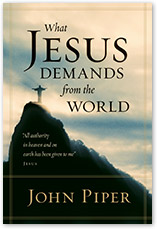
Click to orderNote: these are devotional posts based on John Piper’s new book What Jesus Demands from the World.

Demand #9 — Love God with All your Heart, Soul, Mind, and Strength

Jesus answered, “The most important [commandment] is, ‘Hear, O Israel: The Lord our God, the Lord is one. And you shall love the Lord your God with all your heart and with all your soul and with all your mind and with all your strength.'”   (Mark 12:29-30)

Woe to you Pharisees! For you tithe mint and rue and every herb, and neglect justice and the love of God. These you ought to have done, without neglecting the others.   (Luke 11:42)

But I know that you do not have the love of God within you. I have come in my Father’s name, and you do not receive me. If another comes in his own name, you will receive him.   (John 5:42-43)

As I am progressing through the book, I am painfully aware that posting about each chapter slows my reading down. But on the other hand, it causes me to meditate and think on each chapter twice. So I am determined to continue blogging through the demands of Jesus. While I am talking about this series, I should mention that these posts are more than just a summary of Piper. They include some reflection and some rearranging of material for my own benefit. For instance, the alliteration below is not Piper’s. All that is to say you really should get the book, or at least read it online.

The End of Love

This seems a simple point: we are required to love God. But I think it is important. Piper writes:

To love God we must know him. God would not be honored by groundless love. In fact, there is no such thing. If we do not know anything about God, there is nothing in our mind to awaken love. If love does not come from knowing God, there is no point in calling it love for God….

Since love is directed to God and depends upon a knowledge of God, the fact that Jesus is the fullest revelation of God (cf. Jn. 14:7-9, Matt. 11:27) becomes important. As the John 5 passage above indicates, one cannot love God and reject Jesus. Further, the revelation of Jesus will enhance our love for God.

A practical application of this point would be that as our understanding and knowledge of God grows, our capacity to love God more also increases. Thus doctrine is not a hindrance to love, but rather it should increase our love.

The Emotion of Love

Piper states that Jesus “changes our hearts to know God so that we see him as compellingly beautiful.” That phrase “compellingly beautiful” is an attempt to stress the fact that love is inherently emotional. It is not a mere decision. You can’t turn it off and on like a light bulb. You can’t just love spinach, for instance. Something must change inside of you to make you love it. Similarly, you don’t just love baseball, it must be something wondeful to you before you can love it.

More than just a decision, many people talk of love for God in strictly “duty” terms. Verses like John 14:15, 21 are used to emphasize that love is more an action not just a feeling. Some argue that the essence of love for God is love for your neighbors. But as Piper points out, Jesus distinguishes between love for God and love for neighbors when he lists the two most important commandments. So, love for God cannot be defined by love for neighbor. This is not to say they are not connected, however.

Two verses reveal that “love for God is most essentially an experience of the affections, not behavior.” First, Mk. 7:6-7 talks of people who “[honor God] with their lips, but their heart is far from [Him]…”. The external actions that the Pharisees rigorously observed did not make their worship acceptable to God. God expected worship to come from a heart of love. [On the New Pauline Perspective, and its view of the Pharisees, see this recent post.] Second, Matt. 6:24 states “…either he will hate the one and love the other…”, from which we can rightly infer that the opposite of love is hate. The word “despise” is also used in that verse. Both “despise” and “hate” are “strong emotional words”. So in contrast, “loving God is a strong inward emotion, not a mere outward action.”

It is the above reasons, supported by many other verses, which lead Piper to conclude that loving God happens when, “we begin to prefer above all else to know him and see him and be with him and be like him.” In short, “God’s glory becomes our supreme pleasure.”

The Extent of Love

On this point, I am referring to the command to love God with all your heart, soul, mind, and strength. Let me just quote Piper’s conclusion here:

When Jesus demands that we love God with all of our heart, soul, mind, and strength, he means that every faculty and every capacity of our being should express the fullness of our affection for God—the fullness of all the ways we treasure him…. “Heart” highlights the center of our volitional and emotional life without excluding thought (Luke 1:51).   “Soul” highlights our life as a whole, though sometimes distinguished from the body (Matt. 10:28).   “Mind” highlights our thinking capacity.   And “strength” highlights the capacity to make vigorous efforts both bodily and mentally (Mark 5:4; Luke 21:36).”…. the point is that every faculty and capacity that we have should display at every moment that God is our supreme treasure.

The Essence of Love

Quote: “Loving God is most essentially treasuring God.”

The  Endurance  of Love

Piper ends with a warning from Matt. 24:12. In the last days, many people will see their love “grow cold” (cf. Matt. 24:12 NASB). To ensure that our love remains fervent, to ensure that all of our faculties continue to treasure God, we need to “look steadily at Jesus and pray that he would reveal God as compellingly beautiful.” Since Jesus reveals God fully (Jn. 14:9), studying Jesus as revealed in Scripture should help us know God more and love Him more.

To conclude, let us be reminded afresh that love for God is a feeling. And that God is not pleased with mere external worship—He wants our hearts to be fervent towards Him. Let us look to Jesus and trust Him to make God compellingly beautiful to us. Let us ask that God pour His love into our hearts through the Holy Spirit (Rom. 5:5).

—See all posts on, the Demands of Jesus

He Touched Me — Food for Thought

I have a few more of Jesus’ Demands, to post about. And I have another post or two in the works. But I need to get this Christmas tree put together! It has been so busy around here, it seems.

Well, I want to get a post up today, so let me provide two quotes from a really good post by someone else, and encourage you to use your blogging time reading it. The article is another “Images of the Savior” post by my friend Nathan Pitchford. This one concerns Jesus’ cleansing of a leper in Mk. 1:41-42. The excerpts I’ll provide below should hopefully encourage you to go read the whole thing. (He just posted another “Image of the Savior” today, too. So check that one out as well.) Anyways, here goes.

And then, we may also learn much of the evil-conquering purity of Christ from this account. For consider how overpowering a thing was evil, as Moses’ law testified. For the one who was unclean, when he touched a person who was clean, did not thereby become clean — no, quite the opposite, for both alike became unclean (Haggai 2:11-14). Indeed so powerful was the corrupting influence of sin’s impurity, that he who was a leper was required to withdraw far from his brothers, and to cry out at all times, “Unclean!” lest they, through accidental contact, should contract the same defilement (Numbers 5:2-3; Leviticus 13:45-46). But this leper came straight to Jesus, seeking mercy; and Jesus was not loth to reach out and touch him! And so marvelous is the unspotted purity of our Savior, and so powerful is he over sin and death, that he did not become unclean; but rather, the leper became pure, and was cleansed from all the disfiguring effects of sin in his body. So will it ever be with him who touches Jesus. There is much truth to meditate upon in this exceptional circumstance….

There is no doubt that, to the extent that we see in ourselves the same desperate needs as we see in these hopeless wretches to which Christ revealed his power and compassion, to that extent only will we be blessed and comforted by these stories of the wonderful works of Christ. If we see ourselves as pure and healthy already, we will be little moved by this account of Christ’s dealings with a miserable leper. But if we see that we are indeed leprous, and even worse than he, leprous on the inside, and impure in the heart — then we will find no end of delight in meditating upon the amazing qualities of the Messiah, Jesus Christ, so mightily displayed as he walked on this earth some two thousand years ago….

Don’t forget! Read the whole thing!


∼striving for the unity of the faith for the glory of God∼ Eph. 4:3,13 “¢ Rom. 15:5-7