The Best of Bob's Blog: A Year in Review (2006)

As I pondered the start of a new year, I thought it would be fun to highlight my best posts from this past year. I also thought it would be nice to review some of the milestones and hallmarks of my blog from throughout 2006. To some of you this might be a trip down memory lane. But many of you  only started reading my blog in the last few months. And  surely most of you have not kept up on all the sometimes long-winded posts around here.

Before we begin, let me stress that unlike some other bloggers, I am happy to open up old discussions and interact with comments on old posts. But like most bloggers, it can be hard to keep up with absolutely every comment, so there may be a few comments that are as yet unanswered around here.

Now this could just be a simple “top 10” list of posts. But if you are familiar with me at all, you know that I rarely ever finish a post with a simple paragraph. Hey, I am a preacher’s kid whose dad is also a preacher’s kid, and so I am blessed (cursed?) with a double portion of the “long-winded spirit”. So, don’t be surprised if I try to sneak in at least 10 other posts after the “top 10” list!

So without further ado, here are my top 10 posts from 2006 in reverse order.

Storms, Sleepers, and Substitutes—Jonah As a Type of Christ
This is one of my favorite devotional posts. It also illustrates redemptive historical hermeneutics.

The Role of the Church in KJV Onlyism
This is probably my best post on KJV Onlyism to date. It deals with several misconceptions and false assumptions on the part of KJV Onlyists.

1 Thessalonians and Churches’ Greatest Need
The point I make in this post is very important. Too often in the modern church we neglect the commands to “do church” as it were.

The Rise of the Modern Hymn Movement
This post reflects my desire to see more churches make use of the best of modern worship music. Many songs I highlight can/should be used by traditional-music-only churches.

Charles Finney and the Altar Call
The issue addressed in this post is important whether or not you are Calvinist. Modern evangelicalism needs to be aware of how much they have inherited from the heterodox Finney.

“Wine to Gladden the Heart of Man”: Thoughts on God’s Good Gift of Wine          While this post sure opened a can of worms (one of many opened around here!), I hope it causes some to seriously evaluate what Scripture says on this topic.

Calvinism and Evangelism
I hope this post helps people who are predisposed against Calvinism to be able to understand, appreciate, and even affirm Calvinism’s view of evangelism.

Regeneration, Reception, and Faith
Similarly, this post attempts to explain what Calvinists mean by regeneration preceding faith. Again, please hear us out on the issue before condemning us!

Once Saved, Always Saved?!?!
This attack on a “get-out-of-jail-free” view of salvation delves into the Biblical teaching of both eternal security and the perseverance of true believers.

The Rising of the Sun of Righteousness
Hands down, this is my best (and favorite) post. It is a devotional look at redemptive historical hermeneutics and the typology of all of life.

Alright, I have mentioned the cream of the crop and I plan on giving some more posts  honorable mention, but first let me chronicle some of the blog’s hallmark events from the year 2006.

I started the year on January 9th  with a truly  foundational post for my blog: “Beyond Blogging“, which focuses on my overarching goals. January 16 saw  my second post  focusing on  a modern worship song and really set the stage for many (15+) future  posts devoted to highlighting the lyrics of great modern worship songs. On January 29  I published the  first  of (now 14) my  “Bobspotted Blogrolls”. March  (3rd) began with me interacting with Phil Johnson’s (of Pyromaniacs)  second assessment of fundamentalism. That post actually earned me  my one and only  link from Sharper Iron.

March 25 marked my launch of a new motto: “Striving for the unity of the faith for the glory of God”. And I celebrated the motto with a new banner (which adorned my old blogger blog). Then on April 21st, I publicized my KJV Only Debate Resource Center  (by the way, I have much work left to do over there). On May 8, I posted a memorable post on the Together for the Gospel conference. Besides linking to many conference resources, I also  gave one of my best calls for unity and criticisms of fundamentalist separation.  

July 17, 2006 was the day I launched Fundamentally Reformed 2.0. And let me tell you, I wouldn’t trade WordPress for anything.   It is such a great improvement over Blogger. Then on August 13th, I began my attempt at creating an aggregator of Fundamental Reformers. And finally,  on August 25th, I came out with my “new and improved about-this-blog-post” which is most of what you will read when you click on the “about” tab at the top.    The last hallmark, I guess,  would be the start of my longest series ever: “The Demands of Jesus“.

Okay, we’ve given you a top 10 and chronicled the hallmark events of the year. All that’s left is to hand out some awards and give honorable mention for some posts in various categories. So in no particular order, let’s begin:

  • My  best book review of the year had to be my 2 part series on C.J. Mahaney’s Sex, Romance, and the Glory of God. [part 1, part 2]
  • The best resources I pointed out would be a tie between BibleCentre.Net highlighted here, and 2 Ways to Live, an online interactive gospel presentation.
  • The funniest post of the year was undoubtedly “The Seven Dwarfs –An IFBx  Sermon!
  • The saddest post of the year (which discussed the saddest comment of the year) was Hyper Fundamentalism and the Family.
  • The best illustration of the year was highlighted in “The Goodness of God in Election.” (Every non Calvinist needs to read it!)
  • The biggest flop of the year was my much hyped and long overdue participatory worship post. (I still have not unveiled part 2, but when I do, I hope to do it right this time!)
  • The most timely (and appropriate) post of the year had to be my post dealing with the Ted Haggard scandal.
  • My most controversial post was probably my first post on the wine debate (#5 above).    It, like my two posts on wine several months later, generated lots of comments (32) but the controversy runs deeper than merely numbers of comments [BTW my 2nd post on wine is my 2nd most commented post–49]. Most people assume ex-IFBx people will be into modern music, but something about wine makes it seem that such people have jumped off the deep end into rampant worldliness. I know some of my readers think this of me, so please, please, go read my posts on the issue and see that I really am motivated by God’s Word in this whole issue.
  • The post that generated the biggest debate, however, was my post on the John Piper and Christian Rap controversy. That post has the most comments of any on this blog (51) and several of the longest comments you will find anywhere! The article and comments print off a whopping 45 pages! (My extremely long “my story post” with its 48 comments prints off only 38 pages!)
  • The most disappointing debate was the recent one on limited atonement. The debate went well enough (on the other blog and then on mine), but 1 hour and 12 minutes before I finished a reply I was working on, my chief opponent quit the debate. That reply showed how he was double-speaking on a key passage. (See the beginning of comment #16….) So just when I tried to be very clear in exposing his error, the debate was over!
  • Choosing my favorite song (that I blogged on this past  year) is very difficult! So I will let the award end in a 3-way tie: “Knowing You“, “How Deep the Father’s Love for Us“, and “Before the Throne of God Above“.
  • I happened to blog about my favorite new CD  of the  year (it came out the end of last year, but I got it in 2006): Lifesong by Casting Crowns.
  • And lastly, I had to create a category for best new song of the year and again I couldn’t just go with one, so this past year’s award goes to both “Gospel Song” by Drew Jones (music by Bob Kauflin) and “Receive the Glory” by Bob Kauflin  [both songs are produced and promoted by Sovereign Grace Ministries, highlighted in this post (#7 above)].

So ends my most self-serving post ever! But hey, this is my blog, and I enjoyed it. So, do you have any of your own favorites that I didn’t mention? Oh, and don’t bother telling me that 45 pages of comments is ridiculous. Yeah, I know.

Merry Christmas Everybody

Well, I need to wish all my readers a very Merry Christmas before I head out of town for a few days. I hope you all can spend Christmas with family. Let us remember to pray for those we know who have unsaved relatives that they’ll be seeing at this time. But most of all, let us remember that Jesus is the One who should light up our Christmas. He is who we should be remembering, celebrating, and worshipping.

Before I go, let me offer you a chance to read our Christmas letter. This marks the second year that I have posted it before it will arrive at anyone’s door—this gives my blog readers first dibs. And for those of you who I have grown to know only through the world wide web, this year. Please read our letter, and accept our Christmas blessings.

Thoughts on Educational Choices

Originally, I was going to post a Bobspotted blogroll  post early this week. Well things got hectic with my sister visiting, and then  with almost all of us  getting sick. So here I am about to embark on a Christmas road trip, and I haven’t posted in a while. So I wanted to at least link to these articles by Tim Challies.

Tim Challies discusses the reasons why he sends his children to public school in the following articles: “Why I Do Not Homeschool Part 1“, and “Part 2” [HT: Justin Taylor]. Having been educated strictly in Christian or home schools, I have an inbred prejudice against public schools. But as a parent, I am realizing that deciding between the options for educating my children is really a difficult decision. And this article does a great job of explaining the issue of “to homeschool or not to homeschool”, as well as providing some good reasons why some Christians can legitimately send their kids to public school. I hope the following excerpt will encourage you to go read these posts.
God has placed us in this culture, among these people, and He expects us to reach out to them and to let the gospel go forth….I believe [my children] can best heed this call by being in the culture in which God has seen fit to place them. I want them to be with kids who are not Christians, to be friends with them and to love them, to learn what separates them from their friends, and to begin to understand how their convictions make them different from others. I want them to see and know and understand and believe in the superiority of Christianity to any other religion or way of life. I want them to see what the world has to offer and to see that it quickly loses its lustre….I find it difficult and painful to imagine a public school system devoid of Christians. Imagine, if you will, that every Christian pulls their children from the public schools. There will be no more Christian clubs in junior high schools; there will be no more prayer meetings or Bible studies at high schools; there will be no witnessing, no conversions. Christians will have removed the best indigenous missionaries from their natural mission field. I want my children to learn how to witness to their friends and want them to do it.

Atonement Addendum: Grudem’s Clarifications and Cautions

We have recently been explaining (and debating) the Reformed doctrine of particular redemption, also known as definite atonement or more popularly, limited atonement. And while my post on Calvinism and evangelism follows on the heels of that post, it really was in the works before that whole debate started. But since we are talking about Calvinism in general, and limited atonement in particular (no pun intended), I felt we would do well to heed some clarification and caution from Wayne Grudem on this subject.

If you are unfamiliar with Wayne Grudem, he is worth getting to know. He is a very influential conservative scholar, of a breed which is sadly becoming all to increasingly rare these days! He takes firm positions on hotly debated topics: he defends God’s sovereignty against open theism, and is a prime mover in the defense of complementarian views against the egalitarian or feminist position [this is the debate over women pastors and male headship in marriage]. He also has criticized some of the more liberal translations regarding their gender neutrality, being also a principle promoter of the English Standard Version. You can learn more about him here.

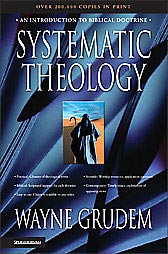
Get this book!!!But perhaps his greatest contribution has been his wonderful Systematic Theology. The book is certainly technical enough to require theologians to interact with its views, yet it is designed for the average church goer, too. Grudem firmly believes that it is the call of every church member to study theology. Proper doctrine is not only for theological professionals to be concerned about. And the book does wonders for making the study of systematic theology accessible to everybody. Each chapter ends with “Questions for Personal Application” and includes a helpful index so one can find sections which cover the same material in the other major Protestant and Catholic systematic theologies. Each chapter also includes a hymn, because Grudem believes theology should move our hearts. In fact the book does just that. Doctrine is not merely analyzed in a test tube, so to speak. Application and personal involvement with the truth presented is made throughout.

Another helpful quality of Grudem’s book is its fairness to opposing views. Grudem is Reformed, but he doesn’t anathematize every other view. He quotes from first hand sources and does his best to present the chief arguments of his opponents, rather than creating a bunch of straw men. He is also careful to tread lightly at times. Rather than making bold assertions, he leans toward one view or another, while honestly acknowledging that a particular topic is open to alternative understandings.

It is just this aspect of the book which really helps us with our current discussion. Pages 601-603 provide “points of clarification and caution regarding [limited atonement]”. And from these I want to stress two points, which are pertinent for us in the discussion that is still hanging in the air concerning this doctrine.

First, we need to be careful with how we phrase things. Many a Calvinist, myself included, is comfortable with the phrase “Christ died for his people only”. But by this I actually mean (according to Grudem) “Christ died to actually pay for all the sins of his people only”. The former phrase is often interpreted or understood by non-Reformed people to be saying “Christ died so that he could make the gospel available only to a chosen few”. And since this is not the case, and we don’t want to communicate that idea, we Calvinists should opt for the more precise phrase, rather than the simpler expression.

Similarly, we should not get bent out of shape over the phrase “Christ died for all people”, because that phrase is true if it means “Christ died to make salvation available to all people” or “Christ died to bring the free offer of the gospel to all people”. Grudem claims that Scripture itself uses such language (the first phrase) in places like John 6:51, 1 Tim. 2:6, and 1 Jn. 2:2. And often when a Calvinist is speaking pastorally, he may use the former phrase rather than the latter one. Grudem goes on to deal with the objection that some Reformed people have to the indiscriminate use of the former phrase, and it is worth the read, but we will move on here.

Secondly, Grudem stresses that both sides of the limited atonement debate agree that people will not be saved without actually believing in Christ. And both sides “want to avoid implying that there might be some people who come to Christ for salvation but are turned away because Christ did not die for them.” Both sides agree the offer of the gospel is a genuine bonafide offer: all who come/believe will be saved. Therefore, we should not make too much out of this whole debate. Grudem says,

…Scripture itself never singles this out as a doctrine of major importance, nor does it once make it the subject of any explicit theological discussion….In fact, this is really a question that probes into the inner counsels of the Trinity and does so in an area in which there is very little direct scriptural testimony—a fact which should cause us to be cautious….

That is all I have from Grudem for you, but you would do well to read those pages for yourself. Since I believe that reading them might help you to convince you to buy the book yourself, let me show you a way to view those pages online. This may not work for you, but it did for me. First, go here (Google Booksearch). Second, search [in the search box on the right of the display] for the following three phrases. They will each bring up links to view the pages in question (601, 602, and 603). However, they will only let you see one page at a time. Here are the phrases (be sure to put them in quotation marks when you search): “rightly object to the way in which some advocates of particular” “unbelievers simply do not reason that way” and “ultimate cause of the atonement is found in the love”. One more note: if you click on the picture above, you will be able to order the book.

Before I go, let me recommend a fascinating interview of Wayne Grudem by Christian blogger Adrian Warnock. Here is the summary post providing links to all 9 parts and more regarding the interview.

The points gleaned from Grudem borrow heavily from pgs. 601-603 of Systematic Theology. Anything within quotes in that section is a verbatim quote from these pages.

Jesus’ Demands — Rejoice and Leap for Joy(#10)

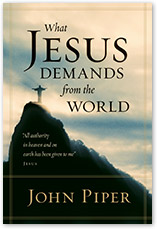
Click to orderNote: these are devotional posts based on John Piper’s new book What Jesus Demands from the World.

Note: For this chapter, I would highly recommend reading it online (pg. 84), since it is so good. It brings together much of John Piper’s teachings regarding joy and delight together in an accessible and highly helpful 8 pages or so.

Demand #10 — Rejoice and Leap for Joy

Blessed are you when people hate you and when they exclude you and revile you and spurn your name as evil, on account of the Son of Man! Rejoice in that day, and leap for joy, for behold, your reward is great in heaven; for so their fathers did to the prophets.    (Luke 6:22-23)

Behold, I have given you authority to  tread on serpents and scorpions, and over all the power of the enemy, and nothing shall hurt you. Nevertheless, do not rejoice in this, that the spirits are subject to you, but rejoice  that your names are written in  heaven.    (Luke 10:19-20)

The kingdom of heaven is like treasure hidden in a field, which a  man found and covered up.    Then in his joy he goes and sells all that he has and buys that field.    (Matt. 13:44)

These things  I have spoken to you, that my joy may be in you, and that your joy may be full.    (John 15:11)

Staggering and Shocking

For many reasons, this demand to “rejoice and leap for joy” is surprising, startling, staggering, and shocking! In fact, John Piper has written several books and devoted much of his resources to delving deeper into the command to rejoice in Jesus. So there is way too much to say on this topic in one small chapter.

For this post, I will be doing a lot of quoting, because I want to capture the spirit of this chapter adequately. First, let me provide a  quote from C.S. Lewis which Piper has reproduced in this chapter. Then I will quote Piper on this point and move on.

…our Lord finds our desires not too strong, but too weak. We are half-hearted creatures, fooling about with drink and sex and ambition when infinite joy is offered us, like an ignorant child who wants to go on making mud pies in a slum because he cannot imagine what is meant by the offer of a holiday at the sea. We are far too easily pleased. (C.S. Lewis from The Weight of Glory)

…the demand that we be happy is not marginal or superfluous. It is a shocking wake-up call to people who are finding their happiness in all the wrong places. Jesus’ solution to our love affair with sin is not merely that we tear out our sin-loving eyes (Matt. 5:29), but that we be mastered by joy in a new reality, namely, God.

Unspeakably Good News!!

The news about Jesus is not ordinary. No, it is good news. In Matt. 13:44, Jesus describes the value of the Gospel (the Good News) as a priceless treasure. It is something so great and so good that people would die for it, so to speak. People would do anything they could to get that priceless treasure.

And so Piper claims, “[God] does not call us to a willpower religion that feels only duty and no delight. He calls us to himself and to his Father. Therefore, he calls us to joy…joy in God and in his Son.”

Self Denial and Joy

The call to experience indescribable joy (see 1 Pet. 1:8) is not opposed to the call to deny yourself and take up the cross. Piper explains:

The demand for joy does not encourage us to retreat one millimeter from the radical demand of Luke 14:33, “Any one of you who does not renounce all that he has cannot be my disciple.” We renounce all those joy-giving things because we have found the treasure hidden in the field and we have been given eyes to see that this treasure—this glorious God—is infinitely more valuable than everything we possess or could possess in this world. This is why we renounce it all with joy.

Piper goes on to give  a quote by C.S. Lewis which points out that Jesus’ demand for self denial is not an end to itself. “We are told to deny ourselves and to take up our crosses in order that we may follow Christ; and nearly every description of what we shall ultimately find if we do so contains an appeal to desire.” Did you catch the last part of that C.S. Lewis quote? Jesus specifies the rewards we will get if we go ahead and deny ourselves in almost every place he calls us to deny ourselves! Jesus sees no problem with motivating us with glorious rewards—because the reward is infinite joy in Christ Himself!

Sober, not Superficial Joy

Let me quote Piper on this point.

What astonishes us most immediately when Jesus says, “Rejoice…and leap for joy” is that he is saying it precisely in the context of pain….

…Therefore, the joy he demands now (“in that day,” Luke 6:23) is not chipper. It is not joy-lite. It is not superficial or marked with levity. This is the mistake of too many people and too many churches. They think that Jesus’ demand for joy is a demand to tell jokes or weave slapstick into Christian corporate life. I don’t smell the Jerusalem-bound Jesus in that atmosphere. Something has gone wrong.

What’s wrong is that the aroma of suffering is missing. For Jesus the demand for joy is a way to live with suffering and to outlast suffering. Therefore this joy is serious. It’s the kind you fight for by cutting off your hand (Matt. 5:30) and selling your possessions (Matt. 13:44) and carrying a cross with Jesus to Calvary (Matt. 10:38-39). It has scars. It sings happy songs with tears. It remembers the dark hours and knows that more are coming. The road to heaven is a hard road, but it is not joyless.

The Fruit of Joy

Piper sees holiness as intimately connected to joy. He sees “the power of a superior pleasure” as the power that sets us free from the “cares and riches and pleasures of life” (Luke 8:14). Listen to a few sentences by Piper on this point:

Many Christians think stoicism is a good antidote to sensuality. It isn’t. it is hopelessly weak and ineffective. Willpower religion usually fails, and even when it succeeds, it gets glory for the will, not for God. It produces legalists, not lovers.

Another fruit, or rather, result of joy is this. God is glorified. Piper elsewhere and often declares “God is most glorified in us when we are most satisfied in Him.” In this chapter, Piper finds proof for the position that joy in God glorifies God from Jesus’ prayer in Jn. 17. “…[Jesus’] intention to sustain our joy in him is part of what it means for us to glorify the Father and the Son.” So this should make us see joy in God as a duty we are to pursue.

Too Much of a Good Thing?

Is it possible to be hung up on joy too much?    Is it wrong to strive for continual joy and fulfillment in all that Jesus is to us? Well Song of Solomon 5:1 says “Eat, friends, drink, and be drunk with love!” From this text, Jonathan Edwards said the following:

Our hungerings and thirstings after God and Jesus Christ and after holiness can’t be too great for the value of these things, for they are things of infinite value…. [Therefore] endeavor to promote spiritual appetites by laying yourself in the way of allurement… There is no such thing as excess in our taking of this spiritual food.    There is no such virtue as temperance in spiritual feasting.

There is so much to be gleaned from this chapter, and I did not get into everything. But I think what arrested me the most was this final quote by Edwards. I understand that joy is very important, but so often I lack that joy. Edwards counsels us to put ourselves “in the way of allurement”. I need to be utilizing the means of grace and being in the word and reading and listening concerning heavenly things. I need to place myself there, and God-willing Jesus will share His joy with me in ever greater measures. May He do the same for all of us.

—See all posts on, the Demands of Jesus