
The Bible & the KJVO Debate, part 7

Note:this is another post in a series exploring how the Bible impacts the KJVO Debate. For all of the posts to date, click here.

Review

As we pick up this series, again, let me review where we are and how we got here. This is a series dealing with how the Bible directly impacts the KJV Only debate. We started by giving a review of how KJV Onlyists often claim their position is supported by the Bible. We then moved on to discuss what the Bible says about inspiration briefly, and moved on to the topic of preservation. That is where the series has bogged down.  

There is not much exegetical discussion out there on the passages often cited by KJV Onlyists as teaching perfect preservation (the view that each word of the original Bible text is preserved perfectly down to today in a generally accessible form to most believers). So I have been trying to take pains to be very clear as to what the text is actually saying, and how exactly it applies to a doctrine of preservation. So far we have concluded that a few verses seem to teach a basic doctrine of preservation, but the doctrine has not been specifically expressed or explained much yet. This post will deal just with Is. 59:21. There will be two more posts on passages which touch on the doctrine of preservation. Then we will bring all the passages together and discuss the Scriptural doctrine of preservation before moving on to some additional posts on this topic (which I am really excited about).

Isaiah 59:21

“And as for me, this is my covenant with them,” says the LORD: “My Spirit that is upon you, and my words that I have put in your mouth, shall not depart out of your mouth, or out of the mouth of your offspring, or out of the mouth of your children’s offspring,” says the LORD, “from this time forth and forevermore.”

This verse often gets overlooked in discussions about preservation. It is somewhat obscure, so perhaps that is why. The verse closes a dark chapter with a hope filled promise. The chapter starts by detailing Israel’s sins and God’s anger over them. However, in God’s dealing with the sin of His people, he causes them to fear Him (v. 19). And he promises a Redeemer will come for those who turn from their evil (v. 20).

“You”

Who is the person or group addressed as “you” in this verse? It could be Isaiah, the prophet. But is God promising something specific about his own personal offspring? For this and other reasons, most conservative scholars conclude that the “you” refers either to the Messiah (the “Servant” so often addressed in this part of Isaiah) or to the godly  remnant of Israel (and by extension God’s people in all ages).

In favor of the view that the Christ is in view, it is mentioned that God’s words were put in “his” mouth. This phrase hearkens back to Is. 51:16. Both at that verse and with regard to our text, J. Alec Motyer makes a convincing case that the “Servant” (or the Messiah) is in view [1]. If it is the remnant of Israel, why is the Spirit mentioned as being upon them in 59:21? Also, a parallel can be seen with Is. 61:1ff. where the Spirit is upon the Messiah and the Messiah is given a message to preach.

“Them”

The covenant or promise is made with “them”. This evidently is the godly remnant of Israel. Keil & Delitzsch point out

In the words, “And I, this is my covenant with them,” we have a renewal of the words of God to Abram in Gen 17:4 , “As for me, behold, my covenant is with thee.” [2]

I have read some dispensational commentaries which try to force this verse to apply only to Israel and not to the church. Most commentaries I read don’t do that, however. The seed of the Messiah, points back to the seed of the woman in Gen. 3:15. And in Gal. 3 all believers are Christ’s seed and thus heirs of Abraham. It seems fairly obvious this is a promise for God’s people, however it may be yet future from Isaiah’s perspective — as in once the Messiah arrives on the scene, the promise will be fulfilled.

“Words”

What is meant by “my words that I have put in your mouth”? To help me finish this post I’m going to survey the landscape here. I will provide some quotes from other commentaries on what they think “words” refers to. I will pick up the discussion on the other end of the quotes.

…the Lord will assist his Church, and will take care of it, so as never to allow it to be deprived of doctrine… for we must be supported and upheld by the word and the Spirit, of which the Lord declares that we shall never be left destitute. “” John Calvin

The Targum interprets this of the words of prophecy; and the Talmud of the law not departing from the disciples of wise men; but it is best to understand it of the Gospel not departing from the disciples of Christ, and the seed of the church. “”  John Gill

…it seems… to refer to the truth of God in general which he had revealed for the guidance and instruction of his church. “”  Albert Barnes

The same doctrines which Jesus preached, all his faithful ministers preach; and his seed “”genuine Christians, who are all born of God , believe; and they shall continue, and the doctrines remain in the seed’s seed through all generations-for ever and ever.   “”  Adam Clarke

The Spirit will be accompanied with certain “words” which will be put into the Church’s mouth; and these words will remain unchanged and pass on from mouth to mouth, age after age, for ever. The “words” intended are probably those of the entire Bible “” “all God’s revelations” (Cheyne) “” which the Church will maintain as inspired truth through all ages. “”  Pulpit Commentary (Exposition section)

The word of Christ shall always continue in the mouths of the faithful… The word shall never depart out of the mouth of the church; for there shall still be a seed to speak Christ’s holy language and profess his holy religion. “”  Matthew Henry [3]

We must acknowledge that “words” can refer to something other than the words of Scripture. I made the point in this post, that we need to establish from the context clearly whether “word” or “words” refers to Scripture or not. This is especially true today, when most Christians read Scripture any time they read “word”. Seeing the parallel with Is. 61:1ff., “words” could very well refer to a specific message Christ was given to declare. As John Gill said above, it could refer to the Gospel message, which Christ first brought, and which his disciples have disseminated throughout the world in the years following Christ’s advent.

As you can see above, others have taken this phrase to refer to doctrines or truth in general. And certainly God has promised that his church would remain with the truth to all ages. Others have taken it to refer to the words of the whole Bible. That may well be, as well.

Before we draw a conclusion, let us ponder what it means for the words to be “in your mouth”. Again, let me provide some quotes in discussing this.

The word in the mouth may suggest personal reading (cf. Josh 1:8), for completely silent reading is a product of a more sophisticated society; or it could suggest that the word given and appropriated is now to be proclaimed. “”  Expositor’s Bible Commentary: Isaiah  (Geoffery W. Grogan) [4]

“Shall not depart out of thy mouth.” This phrase probably means, that the truth of God would be the subject of perpetual meditation and conversation. “”  Albert Barnes

…the comforting saving words of God are not only the blessed treasure of its heart, but the confession of its mouth which spreads salvation all around.   “”  Keil & Delitzsch (Matthew Henry likewise draws a parallel with Rom. 10:9 and words being in the mouth) [5]  

Conclusion  

Whatever else this verse teaches, it clearly promises that God’s people will be preserved through all generations. It declares that they will possess God’s Spirit and God’s words. Clearly this would be the Gospel message and the truth of Christianity which will consistently be in the mouth of God’s people. John Calvin captures what I am trying to express here, well: “Hence we infer that this is a most valuable treasure of the Church, that he has chosen for himself a habitation in it, to dwell in the hearts of believers by his Spirit, and next to preserve among them the doctrine of his gospel.”

Since the Gospel is contained in specific words, and depends upon the authority of Scripture, and since “words” is the term used here, I think it would be reasonable to infer that a promise of preservation for the words of Scripture is in view here. As in previous passages, however, the preservation promised is not expounded upon. We are not told how this promise will come about. We are not told where to look to find the written words. The promise specifically applies to words on your mouth, not necessarily on paper. Further, does the phrase “my words”, necessarily imply “all my words”?  

The text is not specific enough to warrant a dogmatic conclusion that each and every word of God must be on the tongue of each and every child of God throughout all time. Given the nature of the verse and the prophecy in Isaiah, there are a variety of possible interpretations of it. The main point seems to be very clear, God promises His word will be present among His people and that they will always exist as His people. The finer points of the textual debate are not addressed by this passage.

————————————————–
Footnotes

[1]    Below is a quote on Is. 59:21.

The situation, however, is parallel to the covenant references, equally unheralded, in 42:6; 49:8; 54:10; 55:3. All these are directly related to the Servant and his work. According to 49:8 and 54:10, it is through the Servant that the people of Jacob/Zion enter into the blessings of restoration and peace; according to 42:6 and 55:3, blessings are covenanted world-wide through the Servant. The singular you thus stands in a Servant position. Divine action has secured a world-wide reverential people and a company of penitents in Jacob, and there is a person whom we may call the Anointed One, for the Lord’s Spirit is upon him, through whom their relationship with the Lord is eternally secure. Like the Servant (53:10), those to whom he secures these covenant blessings are his “˜seed’.

“” J. Alec Motyer, The Prophecy of Isaiah: An Introduction and Commentary(Downers Grove, IL: Inter Varsity Press, 1993), the electronic version (copyright 1996 by J.A. Motyer), accessed at biblecentre.net (March 30, 2007).

See also his discussion at 51:16, where he states: “This verse describes the equipment, security, and task of the Servant.”

[2]    Keil & Delitzsch’s commentary on Isaiah, accessed at biblecentre.net (March 30, 2007).

[3] All these commentaries were accessed online at biblecentre.net (March 30, 2007).

[4] Geoffrey W. Gohan, The Expositor’s Bible Commentary: Isaiah, edited by Frank E. Gaebelein, (Grand Rapids: Zondervan)  online version, accessed at biblecentre.net (March 30, 2007).

[5] Commentaries accessed online at biblecentre.net (March 30, 2007).

Thoughts on the Battle of Jericho

I recently read the story of Joshua and the Battle of Jericho in the new kid’s Bible storybook I’ve been promoting. In that story I read these words:

Then God made his people a promise. “I will always be with you….    If you do what I say, your lives in the new land will be happy and everything will go well.”

So Joshua gathered his army together…. They were ready to fight. But the plan wasn’t about fighting; it was about trusting and doing what God said. (emphasis added, quote from The Jesus Storybook Bible by Sally Lloyd-Jones)

Canaan as a Type

These words spurred me to think about the battle of Jericho as it relates to the battle of our own personal sanctification. Christians for centuries have interpreted the story of Israel’s redemption and exodus form Egypt, their wandering in the desert, and their conquering the promised land in some kind of a spiritual sense. Scripture certainly presents Jesus as the archetypal Passover Lamb. The misadventures of Israel in the wilderness teach us spiritual lessons (1 Cor. 10). And the promised land is a type of Abraham’s “better” and “heavenly” country which he sought (Heb. 11). Numerous hymns have also  equated crossing the Jordan with entering our eternal rest.

Certainly a redemptive historical hermeneutic finds great significance in the story of the Israelites conquering the promised land. As my friend Nathan Pitchford has so clearly shown, the land of promise is intimately connected to fellowship with God. The land was to be the place where God would be Israel’s God and they would be His people. Fellowship was the goal of the land promise, even as later with David, God chose Jerusalem to be the city where His name would be. The OT covenants and promises became increasingly particularized and focused on the heir of David to be ultimately fulfilled with Christ.

All that is to say the possession of Canaan by the people of God was important because this land was to provide a restoration, in part, of Eden. It was to be a place where God communed with man in intimate fellowship. Such a place clearly typifies the abundant Christian life of a believer. A believer experiences fellowship with God which is truly a foretaste of heaven. Just as the land of Canaan ultimately points forward to the New Jerusalem and the New Earth (see Rev. 21), so the believer’s experience of life in Christ is the foretaste of the true essence of eternal life.

The Battle to Win Canaan

Now that we have established the typical significance of the land of Canaan, we are prepared to see how the battle of Jericho wonderfully instructs us. (And I grant I have not truly established it, rather I  explained it. This post is not a full-fledged  defense of the redemptive historical hermeneutic.) Before the Israelites could possess their inheritance, they had to conquer their foes. The battle of Jericho was the first fight to win the promised land, and it sets up what proves to be a pattern. The Israelites trust in God’s power to win each battle for them.

I hope you can see how this applies to us. In order for us to reach our inheritance — the ultimate promised land of heaven, we must trust in God to win our battles.    In Jesus (the Captain of the Lord’s hosts) must be our trust. So with ultimate salvation, we must trust in God to undertake for us and win the battle.  

But this applies to our sanctification as well. For us to enjoy the abundant life in Christ, we must fight the flesh and engage our besetting sins. We must mortify sin (see John Owen’s excellent work On the Mortification of Sin, which is an exposition of Rom. 8:13). And how do we win the battles of sanctification? By trusting in God to win our battles for us, of course. We follow in Joshua’s footsteps.

The Point of this Post

What most blessed me in thinking through all of this was an observation. Joshua and the army of Israel did not sit around on their hands and wait for the walls to fall down. They obeyed. Scripture repeatedly tells us that good works are the inevitable, even the required fruit of believers.   (See my post Once Saved, Always Saved?!?!) If we are not obeying, we have good reason to be doubting our salvation.  

Today, there are many who so stress the necessity of good works that they have redefined justification. They claim  justification is based on our good works, yet they claim such works are only done through the Spirit, and so this position still qualifies as justification by faith.  

Against the backdrop of this whole debate, the example of Jericho becomes all the more clear. If the Israelites had not obeyed by marching around the city, God would not have given them th evictory. Obedience is necessary. But obedience does not earn or obtain anything. It is only God’s grace which would topple the walls of Jericho. And certainly marching around the city did not do anything to earn the victory. God throwing the walls down earned the victory.

Conclusion

In conclusion, as we face the struggles of personal sanctification, let us take heart. God is fighting our battles for us. We do need to be faithful and march around the walls of the sins in our life. But ultimately God is the one who tears down those walls and gives us spiritual victory after spiritual victory. Just like it took many years for the Israelites to conquer all of Canaan, our own struggle for sanctification is a slow process. And like the Israelites, we will never expel all of our sins. We can, however, win a victory and live a life of victory (see Josh. 21:43-45). And when we do, it is not our obedience which has won anything. It is all by God’s grace and His fighting for us. The battle is indeed the Lord’s.

So let us seek to trust our Great Captain, and follow His lead in fighting our sin. To God be the  glory, great things He has done, and will do!

(For similar posts, see My 219 Epiphany, parts 1 and 2; Once Saved, Always Saved?!?!; and Bitterness and Desire.)

Powerful Thoughts on Preaching

Adrian Warnock has been pumping out a whole host of great posts on expositional preaching over the last several weeks. I happened upon them, and basically read them all in reverse order. May the following excerpts and links awaken a hunger for God’s presence in your life. And I pray God meets you this Sunday in a glorious way.

I’ll begin by  an especially challenging quote for a Sunday, then I’ll arrange the links and excerpts in chronological order. They are all really good, so take a little bit of time and have your zeal increased through the reading of these posts!

There is nothing vital in the religion and in the worship of such people. They expect nothing, and they get nothing, and nothing happens to them. They go to God’s house, not with the idea of meeting with God, not with the idea of waiting upon him; it never crosses their minds or enters into their hearts that something may happen in a service. No, we always do this on Sunday morning. It is our custom. It is our habit. It is a right thing to do. But the idea that God may suddenly visit his people and descend upon them, the whole thrill of being in the presence of God, and sensing his nearness, and his power, never even enters their imaginations …

Do we go to God’s house expecting something to happen? Or do we go just to listen to a sermon, and to sing our hymns, and to meet with one another? How often does this vital idea enter into our minds that we are in the presence of the living God, that the Holy Spirit is in the Church, that we may feel the touch of his power? How much do we think in terms of coming together to meet with God, and to worship him, and to stand before him, and to listen to him? Is there not this appalling danger that we are just content because we have correct beliefs? And we have lost the life, the vital thing, the power, the thing that really makes worship worship, which is in Spirit and truth.

(quote by D. Martyn Lloyd Jones — read the whole post)

…the Word of God is written primarily to produce worship. This means that if that Word is handled like a hot-dish recipe or a repair manual, it is mishandled. And the people will suffer. The Truth of God begs to be handled with exultation. And our hearts yearn for this and need it. Something in us starts to die when precious and infinitely valuable realities are handled without feelings and words of wonder and exultation.

(quote by John Piper– read the whole post)

I can forgive the preacher almost anything if he gives me a sense of God, if he gives me something for my soul, if he gives me the sense that, though he is inadequate himself, he is handling something which is very great and very glorious, if he gives me some dim glimpse of the majesty and the glory of God, the love of Christ my Saviour, and the magnificence of the Gospel. If he does that I am his debtor, and I am profoundly grateful to him.

(quote by D. Martyn Lloyd Jones — read the whole post)

D. Martyn Lloyd Jones reflects on Charles Spurgeon and the relative importance of having sermon series.

The 3 types of expository sermons.

Adrian Warnock reflects on the pitfalls of long and slow expositional sermon series.

Dispassionate preaching is a lie. If the preacher is not consumed with [the] passage for the message, how can those who hear it believe it? This is what must be recaptured by the men at this conference who are not in danger of giving up the pulpit to entertainment, but who can become listless and lifeless in expositing the Scriptures.

(quote by Steve Lawson — read the whole post)

Adrian Warnock writes an excellent article on Technology in Preaching.

Think yourself Empty….Read youself Full….Write Yourself Clear….Pray Yourself Hot….Be Yourself, But Don’t Preach Yourself….

(quote by Alistair Begg — read the whole post)

Begin to tell the people what you have felt in your own heart, and beseech the Holy Spirit to make your heart as hot as a furnace for zeal.

(quote by Charles Spurgeon — read the whole post)

John Stott on sermon preparation (excellent!!).

On the dangers of expository preaching.

The practical effect of maintaining this human cultural distinctive where preaching is concerned is that large segments of the family of God are cut off from significant aspects to good preaching. Some are shaped into emotionally boisterous and doctrinally shallow Christians, while others are doctrinally heady and emotionally paralyzed. In the culture of God, we need truth set on fire so that we might be both rooted and grounded in the truth and stirred to compassion, love, and zeal . . .

(quote by Thabiti Anyabwile — read the whole post)

Warren ends by explaining that, in his view, the application of a sermon should aim to answer two questions: So What? (and) What now? He provocatively ends the article by saying, “If your preaching doesn’t ever answer these two questions, you haven’t applied the Bible to the lives of your listeners.”

(Adrian Warnock quoting Rick Warren — read the whole post)

Look Left

Yes, look left. You will see a new feature to my blog. Similar to Phil Johnson‘s (do I get all my good blogging ideas from him?) “Where I Am Right Now”, my “Blogging Around” section will give you the latest on what I’m reading and where  I’ve been  on the web. It will also  provide updates and programming notes for this blog. I’ll probably still do Bobspotted Blogrolls, but I am excited about what this new feature can offer this blog.
Now, as for the immediate future, I am painfully aware that my next Bible & the KJVO Debate post is not ready yet. So I hope to have it out Monday, Lord willing. But as you can see (if you look left), I have been busy blogging, just not here, and this post gives my good reason!

I’ve got nothing more to say. So, either check out the links on the left, or check back on Monday!

More on a Christ-Centered Kid’s Book

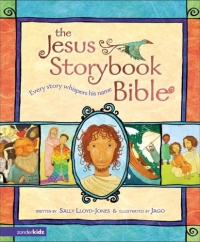
check out The Jesus Storybook BibleNot long ago, I passed along a recommendation for a new Bible Storybook called, The Jesus Storybook Bible. I called it a “storybook for preachers“, and explained why a Christ-centered Biblestory book could help many a preacher.

Well, I came across an excellent and informative interview of the author, Sally Lloyd-Jones about this book over at Eucatastrophe. I’m going to post a few excerpts here, and encourage you all to go read the interview. And more than that, you’ve got to get the book. I did, and I’m loving it. You can expect a review of it before too long.

I found it so moving when I started to discover how the Old Testament is basically one long record of failure””the failure of God’s people time and time again to live rightly, to rescue themselves””and that the stories in the Old Testament are all getting us ready for the One who is coming. They are all signposts to the True Hero, the True King, the True Prince, the True Servant, the greater David, the greater Daniel. The Rescuer.

As a child, I thought the Bible was packed with rules you had to keep (or God wouldn’t love you) and heroes setting examples you had to follow (or God wouldn’t love you). I thought, in short, that the Bible was all about me and what I should (or shouldn’t) be doing. Until I read a Story.

It’s the Story running like a golden stream underneath all the other stories in the Bible: the story of how God loves his children and comes to rescue them. Suddenly, I realized the Bible wasn’t about me and what I should be doing at all. It was about God and what he had done. And it changed everything…

It sounds strange, but the consistent reaction from many adults is that it makes them weep. (I think that’s good? Hope so!) Parents are reading it to one another as their devotional before bed. Pastors are using it to help them with their preaching. I heard someone call it, “the storybook for preachers” [she might be referring to my blogpost here!!].

And of course families are reading it together. Teenagers and college students have told me they are enjoying it. I heard from one dad that his young boys listen to each of the stories and as they near the end of each story, they whisper just one word: “Jesus.” I couldn’t ask for a better response. May all of us to be whispering his name in all the stories of our lives!

Be sure to read the entire interview!! (The comments discuss the Christ-centered treatment of the Old Testament in more depth.)