Unity, Churches, and Shopping

As you go to and return from  your church today, think about all the other churches you passed by. Do you think some of them have fellow believers who likewise were worshipping our Lord because of His grace today? Have you ever really thought about the church down the street?

In this age of church-shopping, and church-pew-sitting, we forget that fellowship is to be around the great truths of the Gospel. In New Testament times, there often was just one church in any given city. The church at Ephesus was probably too large to meet in one place, yet it was a single church with many elders. The NT also shows us how much real inter-connectedness and unity existed between the various churches.

Our day is not like that, sadly. We have fragmented so much that there is a Baskin Robins number of church-flavors in even the smallest cities. Now I know we should be connected, intimately with a body of believers. But I want to encourage you to think about a post my friend Nathan Pitchford has written regarding the possibility of purposing to extend Christian fellowship to other fellow Christians outside of our own church.

Nathan’s post is especially relevant for my blog since we’ve been discussing Ken Field’s questions about the label Fundamentalist, and how that label might be adding to schism in the body of Christ. Let me close this post with a quote from Nathan’s post, and one more encouragement to go read it.

It is an interesting observation that, in those areas of the world where the Church is being persecuted, or is significantly in the minority, such manifestations of unity and love among believers of different denominations and doctrinal convictions is much more commonplace — and yet without the compromise of all the particular doctrines which each one holds dear, but rather a labor to understand and be understood, or, in a word, to grow up together to greater doctrinal maturity and unity. Perhaps this is because, to them, the battle is real, the enemy is ferocious, and they feel most poignantly their need for one another. I would contend that, in America, the battle is just as fierce, the enemy is just as deceptive and strong, and our need for one another is just as desperate. If we could have the scales lifted from our eyes but for a moment, even as Elisha prayed for his minister (II Kings 6:15-17), what differences would we see in the attitudes and practices of the American church today?

From “Shopping for the Right Church” by Nathan Pitchford. The post is also posted at Monergism‘s blog Reformation Theology.

Bobspotted Blogroll: March 4, 2007

It’s been a while since I’ve done a blogspot post. Actually I’ve only done 2 in the past three months, I guess. Well lately (since early January) I’ve been really busy at my job and haven’t kept up on the blogosphere as I’d like to. Then February brought me into the thick of the KJVO Debate. That sapped my blogging time even more! (I’m still working thru a series on that issue, by the way).
Well, this week I’ve had more time, and I’ve stumbled into fantastic posts everywhere I turn. So…this post will have a lot of links! Hopefully you find a few that you hadn’t already seen. I try to bring attention to posts that not everyone in the conservative Christian Blogosphere has already seen. So I’ll quit now, and give you the links.

On the “Tomb” of Jesus

Egg Head Religion  

On Preaching

The Pride in Doctrinal Controversy (and Blog Wars)

The Glory of God

On Worship

Tolkien’s Teachings

Jamsco Scores Again & Again

Finally

  • If you haven’t already, you need to go check out the new and improved Monergism.com. It is arguably the largest conservative evangelical resource center on the web. And it centers on Reformed Theology. You can find articles or mp3s on almost any topic relating to Calvinism or Orthodox Christianity. And they have fun pages, like The Hall of Contemporary Reformers, too.

Drop Everything…

…and read this post by Ken Fields: “Should I Continue to Embrace the Fundamentalist Label?”!!!

It’s possibly the equal of one of  Phil Johnson‘s critiques on Fundamentalism. Well thought through, carefully worded, and challenging — at the very least this post will cause you to think and evaluate where you stand on this issue.  

My prayer is that it will encourage even more unity within the Body of Christ.

Thanks, Ken!

(Oh yeah, you might be interested in my response to his post. Comment #26 I believe.)

The "Tomb" of Jesus

It should be fairly obvious to any and all that the buzz concerning the supposed discovery of the tomb of Jesus is merely a publicity stunt. In the wake of The DaVinci Code, anything which purports to advance the theory that Jesus married Mary Magdalene, is sure to generate excitement and draw a crowd. Both of those results are what movie makers desire, so it is no wonder that a documentary has been made attempting to prove that a tomb found in Jerusalem over 20 years ago is actually the tomb of Jesus and his family.

I probably wouldn’t have devoted too much space to this, but I have already had one reader email me to ask what I thought. About the same time, I was made aware of a post on this issue over at my friend John Chitty’s blog: The Misadventures of Captain Headknowledge. In his post, he linked to  Pulpit Magazine’s  compilation of online resources concerning this claim.

I read the first one, an article written by Darrell Bock. I’d encourage you all to read that article too. He is thorough and fair. Basically, this is all just a case of extremely wishful thinking. If you buy in to all the documentary’s assumptions and surmisals, then you will agree with their statistical analysis.

The Christian faith rests on the empty tomb. And we have the witness of numerous eyewitnesses who went to their death perpetuating the story of Jesus’ resurrection. How many do you know who’d die for a fraud?

The evidence is in the eye of the beholder. Our faith is ultimately in Jesus Christ and the Scripture. And God’s Word is sure.  

[Update for faithful readers: I just wanted to let you all know that later this evening I hope to have my next post on “The Bible & the KJV Only Debate” finished.]

The Storybook for Preachers

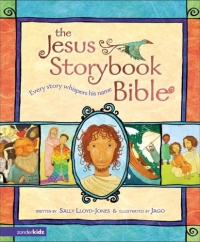
check out The Jesus Storybook BibleThe more I learn about Pastor Tim Keller (of Redeemer Presbyterian Church in New York City), the more I respect his opinion. So when he says of a new kid’s Bible storybook: “I’d urge ministers to buy it and read it for themselves. It will improve their preaching.” I listen up.

From what I have heard and seen about the book so far, I’d have to agree. But perhaps you’re wondering, “How can any Bible storybook help a preacher? Storybooks are just dumbed down Sunday School lessons for kids, aren’t they?”

Very often, and with many a book, sadly, I’d have to agree with your point. In fact, Kathy Keller, Tim’s wife, who has edited children’s Sunday School curriculum  and also  worked as a theological consultant for Zondervan, says the following:

It is very hard to find (or even produce) material for children that doesn’t essentially contain the message “Be good, so that God, your heavenly Father will  love you, and your earthly parents will be happy with you, too.”

In stark contrast to such kid’s material, stands Sally Lloyd-Jones’ new book: The Jesus Storybook Bible. Of this, Kathy Keller writes:

…Sally goes out of her way in the first pages of the book to reclaim the true story of the Bible: not a book of rules, nor a book of heroes, but:

The Bible is most of all a Story…It’s like the most wonderful of fairy tales that has come true in real life! You see, the best thing about this Story is —it’s true! There are lots of stories in the Bible, but all the stories are telling one Big Story. The Story of how God loves his children and comes to rescue them.

Tim Keller describes the book:

Sally Lloyd-Jones has captured the heart of what it means to find Christ in all the scriptures, and has made clear even to little children that all God’s revelation has been about Jesus from the beginning–a truth not all that commonly recognized even among the very learned.

This storybook in a nutshell,

capture[s] the plot line of redemption in a children’s story Bible that sings the praise of Jesus and his saving grace on every page, in every story. (—Kathy Keller)

Now, Tim Keller is Sally Lloyd-Jones’ pastor. But still  by now you should be convinced this book is different. But why should it be required reading for pastors?

Here’s why. When we step back and see the Bible as a whole, and look at all the characters and events in light of their place in redemptive history, the power of the Story shines through. Stories, especially well crafted ones, capture our imagination. They thrill even as they teach. This is why fairy tales and good fantasy literature are so enduringly popular. So looking at the Bible as a story, has practical benefits. It can thrill us anew at the wonder of God’s redemption work.

But today, pastor’s are busy preaching other things than the Gospel Story of Redemption. Often the Bible is seen as a “how-to-have-a-successful-life-manual”. Other times it is simply  a rule-book for how to please God. For others it is a theological manual or a social-remedy-guide. It is everyone’s panacea, and everyone has a prooftext for teaching anything.

So why not let the Bible speak for itself? Why not let the Biblical story shine as intended? Sometimes, I think, we would if we could just see it. There are so many other things about the Bible that are important, yet they steal our attention from Its Big Story.

So perhaps a kid’s storybook, pictures and all, might just do the trick. And let me tell you, just the two stories I read in the online sample, were enough to convince me that the book might just have that effect on me.

So check this book out. Read Kathy Keller’s full review,  and see Justin Taylor’s  brief post on it (that’s where I found out about it, and it is in the comments there  that Pastor Keller made the statement that started this post). Then buy it, and purpose to use it for yourself first, and your kids second. [Also check out the book’s  flyer.]

For more info on the  redemptive historical approach to Scripture, check out my hermeneutics topic, my friend Nathan Pitchford’s blog, or this category at Monergism.