
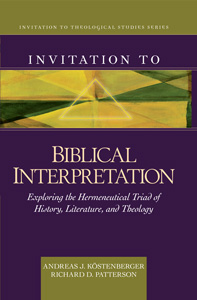
 Book Details:
• Authors: Andreas J. Köstenberger and Richard D. Patterson
• Category: Hermeneutics / Theology
• Publisher: Kregel (2011)
• Format: hardcover
• Page Count: 896
• ISBN#: 9780825430473
• List Price: $46.99
• Rating: Must Read
Review:
I have handled my fair share of textbooks over the years. I’ve also used a variety of Bible commentaries, Bible dictionaries, theology resources and biblical study tools. But I have never come across a more comprehensive and accessible resource for handling the Word of God than Invitation to Biblical Interpretation: Exploring the Hermeneutical Triad of History, Literature, and Theology by Andreas J. Köstenberger and Richard D. Patterson. This new 900 page book has truly set a new standard when it comes to Christian academic resources. In its thoroughness and detail, usability and accessibility, scholarship and piety, this work is simply unmatched. And I am not alone in this assessment, the book’s opening 13 pages contain no less than 39 endorsements from a wide range of leading evangelical scholars. And the fact that this is a hermeneutics textbook makes such widespread acclaim all the more surprising.
While the book is designed for the classroom, I read through the book from the standpoint of an educated layman looking for a resource on interpreting Scripture. This book proved to be more than just a resource tool, it is a virtual stand-alone hermeneutics course in and of itself, with a limitless supply of suggested books and articles for additional reading and self-study.
The book unfolds Köstenberger and Patterson’s “hermeneutical triad” as an overarching approach to interpretation. This triad consists of history (archeology, culture, manners and customs, and other historical matters), literature (canon, genres, linguistics), and theology (biblical theology). But before getting into the heart of the book, the authors reveal their philosophical approach to interpreting Scripture, which I find incredibly helpful:
[W]e don’t start with words; we start with the canon. For example, this is also how we would interpret, say, a play by Shakespeare. We don’t just analyze the words in a given sentence; we first try to learn more about Shakespeare, his background, the time in which he wrote, surveying his major works, and so on, before finally settling on a particular play. Even then we might read a good summary before eventually delving in and starting to read the play. When we encounter a given word with which we are unfamiliar, we would not stop reading, because we are more concerned about following the general flow than identifying individual word meanings. Thus we don’t start with analyzing the details of the biblical text (word study); we start with the whole (canon).
What is more, we also don’t start out pretending the Bible is just like any other book, because we don’t believe it is. Rather, our purpose here is not to study just any form of human communication; our purpose is to study the Bible–the inerrant, inspired Word of God…. Ultimately, this is God’s canon, conveyed in the genres intended by God, and communication of God’s discourses using God’s words (without of course denying human instrumentality , style and authorship). Thus, we don’t introduce the notion of the Bible being “special” at some point later in the interpretive process (as if it were immaterial to the early stages of general hermeneutics) but put it front and center in the organization of the book. (pg. 25-26)
I hold that both of these points are incredibly important. We have to encounter God’s Word from a big picture approach that pays attention to authorial intent, but we also have to recognize the Divine Author behind the text.
After explaining their method, the authors more right into focusing on each element of the triad. A brief overview of the history of hermeneutics is given and then the matters of history, archeology and the historical context of the times of the Bible are discussed at a fairly high level, but with many particular examples. This is helpfully fleshed out in a “sample exegesis” section which concludes most chapters. The research into how the Canaanites viewed the god Baal (the god of storms) helps us appreciate what is at stake when Elijah announces that Yahweh has suspended all rain (and all storms).
After discussing the role that history plays, the authors then devote the lion’s share of the work to the discussion of literature. The canon, its development and current shape, is explored as to how that should shape our interpretation, and a brief theology of the OT and the NT are sketched. The minor prophets offer an example where both the message of the books themselves need to be understood as well as their particular literary arrangement as “the book of the twelve”. I really appreciated this emphasis on canonical interpretation, which the authors define as: “a faithful effort to hear the way in which God addresses his people in and through the text of Scripture as it testifies to God in Christ” but it is not so much a method as “a practice of theological reading” (pg. 157).
The discussion of Genre covers OT historical narrative, poetry and wisdom literature, prophecy, NT historical narrative, parables, epistles and apocalyptic literature. Some genres are covered more in depth than others, with epistles and prophecy perhaps getting pride of place. The discussions give numerous examples and flesh out the why and how in an extremely clear and careful manner. Wise cautions and helpful insights abound. No real theological biases are detectable except perhaps a bias against full preterism. The authors don’t rush to make judgement calls on how everyone must read prophecy or view Revelation, either. At times I felt they must be historic premil, yet they stressed the symbolic nature of Revelation, as per its genre. The discussions take care to root themselves as much as possible in analysis of the biblical text rather than forcing foreign genre considerations onto textual data. I found the dicsussion of parables extremely helpful and balanced, not advocating a rigid “one-point” approach to parables yet not aiming for a no-holds-barred allegorical free-for-all, either.
The discussion on analyzing the language of literature was extraordinarily helpful. The authors emphasize looking at how the larger sections of the text relate to one another (discourse analysis) rather than just doing word studies. They give a helpful overview of some technical points of Hebrew and Greek (as well as English) grammar, and even point out occasional problems with the lexical approach of even such classic works as Kittel’s TDNT, and stress the role of context and semantic range in determining meaning. They also include a helpful section covering 12 exegetical fallacies with plenty of examples to illustrate the discussion. They also discuss figurative language and how we can recognize and interpret it.
The book then shows how to put everything together. The third tier of the triad, theology actually begins this process by stressing that we make our theological connections based on the text, which is the essence of biblical theology. After discussing the nature and method of biblical theology, the book closes with an exceedingly helpful chapter that offers a method for preaching through the various genres and applying the message of the text to the lives of people today. This chapter includes a discussion of Bible software tools and commentaries and other resources, but spends the bulk of the time discussing how to preach through all the various genres that were discussed earlier in the book. Cautions, challenges, methods, and sample outlines make this section especially practical and useful in the context of a daily ministry. An appendix is also included that has a short list of the best commentaries to get on each book of the Bible as well as other important resources to have handy.
My biggest critique of the book would be that it doesn’t go on to cover in detail absolutely everything I would want it to! But that is hardly fair, and it would make for a more unmanageable and unwieldy tool. I do have one bit of criticism, however. I would have liked to see the “how to” section at the end, with the example of how to preach through the genres more clearly called out from the sections covering the genre. For example, the section covering Proverbs in the chapter on Wisdom literature doesn’t deal with some of the pastoral concerns such as whether proverbs apply universally to all situations or not. Yet this concern is addressed in the how to section in the last chapter. I think a clearer link would have served those of us who will use the book more as a reference work than a seminary text book. My only additional quibble is that the assignments and bibliography from the previous chapter blend right in with the introductory objectives and outline for the next chapter. The formatting of the book just seems a bit odd in that regard.
Mentioning the bibliographies leads me to one more positive feature of the book. Each chapter has a selected bibliography for additional reading, and then in the footnotes, specific articles or books are called out that will be pertinent to the topic at hand. The footnotes and bibliography are usually helpful and accessible, rather than merely technical and scholarly.
As the book closes, the authors warn their readers against just putting this book on the shelf and ignoring this material. Instead the reader is encouraged that this book can “serve as a point of departure for a lifetime of studying and preaching or teaching the Bible” (pg. 727). I would most heartily concur. This book deserves pride of place on the shelf of anyone studying, preaching or teaching the Bible. Even where one may have a different theological bent or a disagreement with the authors, the book still will prove useful.
Invitation to Biblical Interpretation truly is a must-read, need-to-get book. It is evangelical scholarship at its best, and cannot be ignored. If you are not employing the techniques and practices put forth in this book, you owe it to yourself, at the very least, to read it and justify why you are not. This book can’t do the hard work of faithful exegesis for you, but it can set you in the right direction and prevent you from stumbling at all the wrong places. You really need to get this book!
Author Info:
Andreas J. Köstenberger (PhD, Trinity Evangelical Divinity School) is Senior Professor of New Testament and Biblical Theology and Director of PhD Studies at Southeastern Baptist Theological Seminary. He is also editor of the Journal of the Evangelical Theological Society.
Richard D. Patterson (PhD, University of California, Los Angeles) is Distinguished Professor Emeritus at Liberty University.
Where to Buy:
• Westminster Bookstore
• CBD
• Amazon.com
• BarnesandNoble.com
• Kregel Publications
Disclaimer:
This book was provided by Kregel Publications for review. I was under no obligation to offer a favorable review.




























Bob, good review. I am glad you thought it was a good one for laypeople. There are some others out there that are suggested for laypeople but I don’t feel they are enough and would leave the reader wanting more. This book has enough for layperson without being overbearing. Hermeneutics is a big area and this covers most of the basis.
Thanks, Craig. Your review was good too, just read it. (Didn’t want to read other reviews till mine was written).
Glad I finally got this done, barely got it done in time for the blog tour. But the book is just superb – so glad I have it now.
I’ll have to add it to my wishlist to get after I finish the umpteen dozen other books I have in line.
Good review.
I hear ya, Jason. You will really want to get this one, though. Very good.
Hope all is well.
Blessings,
Bob
[…] evangelical scholars and is the best work on hermeneutics I’ve ever read. (Read my reiew here.) I found their comments on this question insightful. What could be wrong with interpreting […]
[…] and seminary classrooms and a warm welcome in Bible institutes and Sunday Schools everywhere. Read my review for more on this […]