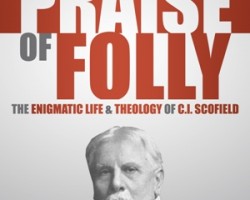
 The Praise of Folly: The Enigmatic Life and Theology of C.I. Scofield is a title that may raise some eyebrows. Scofield, of course, is most famous for his Scofield Reference Bible, with its doctrinal notes.
The book is a fascinating read, no matter what side of the dispensational-covenantal divide you find yourself on. Lutzweiler presents a well-researched, historical account of Scofield’s life, and sprinkles in some thoughts on the rise of dispensationalism and its deficiencies as a theological system, to boot.
At times, I felt that Lutzweiler may have been encouraging his readers to jump to conclusions too quickly. And it is also quite true that even if Scofield is shown to be a dishonorable man, in certain respects (such as his treatment of his ex-wife and his children), still that should not necessarily invalidate the teaching of dispensationalism. Still at the end of the day, I think Lutzweiler’s depiction of Scofield and the history of the Plymouth Brethren movement should give a reason to pause in one’s evaluation of dispensational theology. A modernistic, self-centered, everyone-can-do-their-own-theology may be behind the rise of this system of thought. And while ultimately the arguments have to go to Scripture, this nevertheless weakens the dispensational claims to historic support for their particular doctrinal emphases.
In any case, this book by Lutzweiler deserves to be read and considered. And it is available as a free ebook download now through Saturday evening (12/17/11). You can pick up a hard copy of the book direct from Apologetics Media Group (a division of, The Nicene Council), or from one of the following online retailers: Monergism Books, CBD, or Amazon. There is also a DVD available based on this book (get it at Monergism Books or from the publisher). You can also purchase the ebook at a low price here.
Disclaimer: This book was provided by Apologetics Media Group. I was under no obligation to offer a favorable review.
About Book Briefs: With limited time available to give every book sent my way a full review, I\’ll be offering short-form book reviews called Book Briefs. Book Briefs are book notes, or my impression and informed evaluation of a book, but they stop short of being a full book review.




























“A modernistic, self-centered, everyone-can-do-their-own-theology may be behind the rise of this system of thought. ”
Dispensationalism in its most basic form (differing divine protocols for believers during various periods of time) is as old as the theology gets. Maybe someone needs to do a bit more “research” before making such myopic conclusions.
You’re wrong, Alex. The sine qua non of the 19th century theology known as “Dispensationalism” is the complete separation of Israel and the Church. This is why Dispensationalism is completely a 19th century theological innovation without Biblical support. It should not be confused with historic premillennialism or a simple belief in “dispensations”.
Bob is correct about the mindset lying behind the establishment of Dispensationalism. It is the same mindset that led to the establishment of Campbellism and many other 19th century cults that thought they were restoring the original apostolic truth after 1,900 years of apostasy. Most cults of the modern era have a “restorationist” mentality and believe in the universal apostasy of everyone except them. Darby seemed to lean towards this doctrine of universal apostasy as well.
For some good reading on Dispensationalism, go to the “Bad Theology” section at monergism.com
A modernistic, self-centered, everyone can do his own theology may be behind the rise of the “New Calvinism” which departs from historic Reformed and Calvinistic theology in so many ways. That line cuts both ways, brother.
Regarding the book, I downloaded it and glanced through it the other day. The price was right! The author does attempt to be more objective than the hagiographies and the book by that Reconstructionist. But as an Amazon reviewer notes, a definitive bio remains to be written. I’m not sure how much new information can be dredged up on this shadowy and enigmatic man. But a definitive bio would perhaps do better with setting him in the context of his times, etc.
Who says Bob Hayton is a “New Calvinist”?
I grant your thoughts on “the new Calvinism”. But that isn’t just an independent development either. And what exactly makes one a “new” Calvinist? Not having a captial R in their use of the word “reformed”?? I am still growing in my studies in this area, and so I’m not really beholden to one version of Calvinism or anything…. But no offense taken. You bring up a good point.
And yes this is what I was referencing — the idea that we can just figure out the Bible through modern science and study and comparisons. And furthermore that its message is so plain that anyone can do this without a need to study historic theology or doctrine or anything — that no education in theology is needed for one to interpret the Bible and teach others…. The mentality is correct to a degree, but it can be abused — and abuse is ultimately in the eye of the beholder, I guess.
I also think that the particulars of dispensational theology (as Nicholas points out) are new, and honest dispensationalists should be willing to admit that. Now that doesn’t make them wrong anymore than does some of the Reformation teaching being “new” makes it wrong, either…
Bob,
I haven’t read that part of the book yet but I might take a look at it soon. I did read the last part, which is sad, alarming and well, enigmatic. (I’m thinking in particular of the last letter to his daughter.) I wonder how many times he uses the word enigma in the book?
Most dispensationalists today don’t pay Scofield much regard anyway. People who cut their teeth on Ryrie and Walvoord are in their 50’s and 60’s now. The exception would be IFB’s and old school Bible churches where people still tote the Old Scofield. (Was that your background?) So I agree with you that attacking Scofield personally (not unjustified, it would appear) is not likely to sway many convinced dispensationalists. It might trouble some who hold to that position out of prejudice.
With regard to novelty, in particular I’d say that pretribulationism and the idea that the church consists only of those saved between Pentecost and the rapture was new. I would imagine that’s what he’s referring to, and it was what was most objected to at the time in which dispensationalism emerged among the Brethren and beyond. I’m sure given the current landscape that some might be shocked to learn that dispensationalism emerged from Calvinistic circles, both among the Plymouth Brethren and among Presbyterians, Congregationalists and Baptists in North America!
That being said, dispensationalism didn’t completely develop out of thin air. During that era it appears that outside of places like Old Princeton that there wasn’t a strong emphasis on covenant theology. There was also a growing premil movement in the 19th Century (what we’d call historic today, or more properly, covenantal.) What one might call Christian Zionism wasn’t the exclusive province of the dispensationalists either.
A lot of the older type premils (including some Reformed/Calvinistic stalwarts in the Free Church of Scotland and elsewhere) taught a restoration of national Israel that included a return to the Promised Land. From what I understand some “classic” postmils were of that opinion as well, although they may have largely been from an earlier period. So those ideas aren’t dispensational distinctives, (i.e. in the sense that nobody but dispys believe or have believed them or that the ideas originated with them) although I thought they were until a few years ago. I thought a weakness in the book (at least the parts I’ve read so far) was the author’s failure to recognize that. Spurgeon was indeed sharply critical of the Exclusive (Darby) Brethren, as much for their sectarianism as for their distinctive views regarding eschatology and ecclesiology. But his prophetic views would be considered excessively Judaistic or Zionistic by many today, including many in the “historic” premil camp.
And, as you may be aware, Darby wasn’t the first to come up with what might be called a dispensational scheme in which different ages are distinguished. But those who had done so previously didn’t impose it as a rigid grid through which to interpret Scripture. Evidently were simply attempting to illustrate the flow of Biblical history. I think the distinctive with modern dispensationalism is probably the teaching that every dispensation includes a test.
For a time it appears that in the late 19th Century and perhaps a little into the 20th, there wasn’t a sharp division in the premil camp over different views of the tribulation. There were conferences in which pre-tribbers and post-tribbers both appeared. At that time Postmillennialism was still strong and was seen as the threat. Around the turn of the 20th Century that changed, perhaps when pre-trib began to be more aggressively propagated and perhaps when post-tribulationists grasped the implications of that view. Then the Scofield Bible was published and the rest, as they say, is history. W. E. Blackstone’s “Jesus Is Coming” was a widely circulated book around that time that also served to popularize pretribulationism. I think it was published a few years before the 1909 Scofield Bible. Unfortunately shortly thereafter pre-trib became an article of faith and remains so today in many schools and churches.
With regard to New Calvinism, I could write a lot more and have written more elsewhere. But know that I wasn’t really aiming that at you in particular.
Understood, Chris. And I pretty much agree with everything you’ve said here. I do think the author quotes Spurgeon’s sharp disagreement with Darbyism, however.
I respect progressive Dispensationalists and really need to study that out more. I guess I should say I respect all dispensationalists as brothers in Christ. But I’m closer to progressive Dispenstaionalism than anything else that goes by the name. I also could almost consider myself a historic premil (non-dispensational variety). But right now I lean a-mil. I also agree with the basic thrust of covenant theology, but still need to study more on the new covenant theology position. The writings of O. Palmer Robertson have been helpful to me.
Thanks for chiming in, however. The book is interesting, and I’m glad you could get a free copy. I just want to be prudent in how I talk about it, because it is apparent that the author (or at least the publishers) have an axe to grind. I think we need to be careful in how we interact with others of differing viewpoints, and not blast our would-be friends in the foot before we have a chance to influence them. I guess that’s the former hard-nosed legalistic fundy in me who’s recoiling a bit due to what I’ve gone through in the past. Oh, and on my background, the circles I ran in respected Scofield immensely but taught Ryrie and Walvoord like doctrine. My parents went to Hyles-Anderson where they gave the Scritpure reading with page numbers from the Old Scofield Bible all the way up until the 1990s and beyond, even!!!
Anyway, got to run.
Blessings,
Bob
You’re wrong Nicholas. But then I guess history and distinctions of divine economies from the early church onward escape your attention.
Yes, proprietary forms of dispensationalism, much like Covenant and Reformed theology, can be traced to certain people and periods but not its underlying premise which is as old as the church. Sorry for your error on this.
Oh, yes I should go to monergism.com for a fair treatment of dispensationalism? LOL, you sycophants need to get out more.
Alex,
Drop the bad attitude or go elsewhere. Seriously. We can’t have a decent discussion here? Nobody here is a “sycophant” and that label doesn’t serve Christian charitable conversation.
By dispsensationalist’s own admission, “distinctions of divine economies” do not make for the sina qua non of dispensationalism.
One other thing “I guess they escape your attention” – that is also uncalled for. It’s belittling another comment and violates my commenting policy.
The root error in Scofieldism is the idea of an absolute antithesis between Israel and the Church. This is clearly wrong, and has nothing to commend it. A second, though somewhat lesser error, is the approach that says each administrative period in God’s plan of redemption is its own separate box-car in the Gospel Train. Dallas Theological Seminary has spent its existence either defending those two ideas and all the aberrant permutations that sprout out of them (John Walvoord, J. Dwight Pentecost), trying to semi-modify them (Charles Ryrie), or, more recently, try to create a mediating position between covenant theology and dispensationalism (Bock, Blaising). However, at the same time, there are some covenant theologians who are trying to do a better job at acknowledging the dis-continuities between Israel and the Church, and the idea of progress between the epochs. Presbyterianism’s battle against theonomy (which it still hasn’t fully won) forced it to more thoroughly grapple with what it means not to be under the Law.
Bob
Your posturing is embarrassing. Maybe I could go through you blog and find “sarcasm” in its use and then demonstrate, over and over again, where you failed to be offended because it supported your Neo-Calvinist views.
I am not the bad guy, Bob. You are your own worst enemy.
Your respond just as you did when you were a King James Onlyist Fundie, you have just traded horses. You are a person who wants to fit in, be part of the crusade, be on the right side of history and so on and it is typical of such eagerness to betray its freshman with its zeal. You have, again, much like when you were a KJV Onlyist crusader, become a crusader of someone else’s arguments and theology. Only this time the crowd is much more respectable and you have learned a more sophisticate vocabulary and method of rationalizing. However, this holds in store for you the same end as before, disillusionment.
No Bob, I am not the bad guy for using the rhetorical device of sarcasm to point out a glaring deficiency of an argument. You’re simply angry that it is true and someone on “your side” of the argument lost. You only have yourself to be angry with.
But I am not alone. One of your own good blogging friends has warned you about your excessive allegiance to Neo-Calvinisim and Neo-Reformed theology and your growing arrogance toward other theologies outside of Neo-Reformed/Calvinism. Again, you are headed into the same wall as before, just this time with more armor and a different horse.
But if it is important to you to threaten me as the “Blog Gestapo” because my deportment isn’t dainty, so be it. It simply demonstrates what others state about Calvinists in the first place so it might be better that you live up to the reputation anyway.
One last point about your alleged protest about “attitude”. I used sarcasm quite legitimately and if sarcasm offends you then best wishes grappling with the stout and consistent use of sarcasm by our Lord Jesus (And no Bob, I am not comparing myself to Jesus and you know better if you dare assert this, you know this is about the use of sarcasm and your complaint about its use).
Alex,
Nice try. You didn’t use sarcasm. Calling a number of us in the current discussion “sycophants” is not a use of sarcasm. Perhaps the note about this escaping Nicolas’ attention was sarcasm, but it was a demeaning variety of it.
Jesus use of sarcasm and name-calling was warranted given the severity of the errors he was combating. Brothers in Christ who differ on secondary and even more peripheral matters do not deserve such a smack down. I may not be a perfect moderator, and those touting my own opinions sometimes slide through my moderation, but I do try to be fair to all and my track record is plain for all to see on this point.
I’m not the “gestapo” I’m the owner of this blog. You are here by my permission and should abide by my stated rules and policies. Moderation is an acceptable and understood thing and so I stepped in. Dislike it you may but don’t believe for a second this is about you and your position. Speak contrarily to my views, take me to task with sound argumentation — but keep the conversation charitable. Don’t judge motives and don’t through out verbal insults to others. We can’t see your demeanor, and it clouds what could be a valuable discussion.
Oh and I should thank you for reading my motives and telling me where I am and where my trajectory is taking me. All of that has nothing to do with this post, and is beside the point.
I’m anticipating you’ll fire back disputing me point by point in this comment of mine. If you do, I’m deleting that post — just so you know in advance.
No Bob I am just going to LOL
[Great blog, Bob. And Lutzweiler’s book is equally great. Readers might like to Google “Pretrib Rapture Dishonesty” which supports all anti-dispies! BTW, here’s what I caught on the fascinating web. Frank]
PRETRIB RAPTURE SECRETS
How can the “rapture” be “imminent”? Acts 3:21 says that Jesus “must” stay in heaven (He’s now at the Father’s “right hand,” Acts 2:34) “until the times of restitution of all things” which includes, says Scofield, “the restoration of the theocracy under David’s Son” which obviously can’t begin before or during Antichrist’s reign. (“The Rapture Question,” by long time No. 1 pretrib authority John Walvoord, didn’t dare to even list, in its scripture index, these too-hot-to-handle verses!) Since Jesus can’t even leave heaven before the tribulation ends, which is also when His foes are finally put down (made His “footstool,” Acts 2:35), the rapture therefore can’t take place before the end of the trib! (The same Acts verses were also too hot for John Darby – the so-called “father of dispensationalism” – to list in the scripture index in his “Letters” which covers Acts 2 and 3 much more comprehensively than Walvoord’s!)
Paul explains the “times and the seasons” (I Thess. 5:1) of the catching up (I Thess. 4:17) as the “day of the Lord” (5:2) which FOLLOWS the posttrib sun/moon darkening (Matt. 24:29; Acts 2:20) WHEN “sudden destruction” (5:3) of the wicked occurs! The “rest” for “all them that believe” is also tied to such destruction in II Thess. 1:6-10! (If the wicked are destroyed before or during the trib, who’d be left alive to serve the Antichrist?) Paul also ties the change-into-immortality “rapture” (I Cor. 15:52) to the posttrib end of “death” (15:54). (Will death be ended before or during the trib? Of course not! And vs. 54 is also tied to Isa. 25:8 which is Israel’s posttrib resurrection!)
Many are unaware that before 1830 all Christians had always viewed I Thess. 4’s “catching up” as an integral part of the final second coming to earth. In 1830 this “rapture” was stretched forward and turned into a separate coming of Christ. To further strengthen their novel view, which the mass of evangelical scholars rejected throughout the 1800s, pretrib teachers in the early 1900s began to stretch forward the “day of the Lord” (what Darby and Scofield never dared to do) and hook it up with their already-stretched-forward “rapture.” Many leading evangelical scholars still weren’t convinced of pretrib, so some pretrib teachers then began teaching that the “falling away” of II Thess. 2:3 is really a pretrib rapture (the same as saying that the “rapture” in 2:3 must happen before the “rapture” [“gathering”] in 2:1 can happen – the height of desperation!).
Here are some Google articles on the 182-year-old pretrib rapture view: “Pretrib Rapture Politics,” “Pretrib Rapture Scholar Wannabes,” “Famous Rapture Watchers,” “Pretrib Rapture Diehards,” “X-Raying Margaret,” “Edward Irving is Unnerving,” “Thomas Ice (Bloopers),” “Walvoord Melts Ice,” “Wily Jeffrey,” “The Rapture Index (Mad Theology),” “America’s Pretrib Rapture Traffickers,” “Roots of (Warlike) Christian Zionism,” “Scholars Weigh My Research,” “Pretrib Hypocrisy,” “Thieves’ Marketing,” “Appendix F: Thou Shalt Not Steal,” “Pretrib Rapture Secrecy,” “Deceiving and Being Deceived,” and “Pretrib Rapture Dishonesty” – all by the author of the extremely accurate and highly endorsed book “The Rapture Plot” (see Armageddon Books).
The “hyper-dispensationalists”, whatever their errors may be, irrefutably handled the problems of early Acts so deftly that “Bible-believing Baptists” (i.e. the PBI school of Bible study) adopted their teachings without giving them much credit (or should I say, while simultaneously calumniating and despising them). Cornelius Stam isn’t to everyone’s taste theologically, but his work on Acts should at least be read and considered by any person with a passing interest in what dispensationalism has produced since the era of Scofield. His work on Acts is available for reading online for free.
https://www.dovhost.com/grace-books/StamI16.pdf