More on a Christ-Centered Kid’s Book

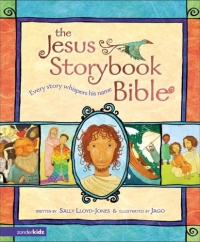
check out The Jesus Storybook BibleNot long ago, I passed along a recommendation for a new Bible Storybook called, The Jesus Storybook Bible. I called it a “storybook for preachers“, and explained why a Christ-centered Biblestory book could help many a preacher.

Well, I came across an excellent and informative interview of the author, Sally Lloyd-Jones about this book over at Eucatastrophe. I’m going to post a few excerpts here, and encourage you all to go read the interview. And more than that, you’ve got to get the book. I did, and I’m loving it. You can expect a review of it before too long.

I found it so moving when I started to discover how the Old Testament is basically one long record of failure””the failure of God’s people time and time again to live rightly, to rescue themselves””and that the stories in the Old Testament are all getting us ready for the One who is coming. They are all signposts to the True Hero, the True King, the True Prince, the True Servant, the greater David, the greater Daniel. The Rescuer.

As a child, I thought the Bible was packed with rules you had to keep (or God wouldn’t love you) and heroes setting examples you had to follow (or God wouldn’t love you). I thought, in short, that the Bible was all about me and what I should (or shouldn’t) be doing. Until I read a Story.

It’s the Story running like a golden stream underneath all the other stories in the Bible: the story of how God loves his children and comes to rescue them. Suddenly, I realized the Bible wasn’t about me and what I should be doing at all. It was about God and what he had done. And it changed everything…

It sounds strange, but the consistent reaction from many adults is that it makes them weep. (I think that’s good? Hope so!) Parents are reading it to one another as their devotional before bed. Pastors are using it to help them with their preaching. I heard someone call it, “the storybook for preachers” [she might be referring to my blogpost here!!].

And of course families are reading it together. Teenagers and college students have told me they are enjoying it. I heard from one dad that his young boys listen to each of the stories and as they near the end of each story, they whisper just one word: “Jesus.” I couldn’t ask for a better response. May all of us to be whispering his name in all the stories of our lives!

Be sure to read the entire interview!! (The comments discuss the Christ-centered treatment of the Old Testament in more depth.)
Jesus, Our Sacrifice, Our Priest, and Our Tabernacle

I am remiss to say I don’t keep up with all my friend’s blogs as often as I should. And I confess I have not been reading my friend Nathan Pitchford’s recent Studies in the Gospel of John. But I have been blessed by reading his most recent study on chapter 17. It is a long post, but every inch of it is worth a spiritual mile. It is rich and precious food for your soul.

The post reminded me of the richness of our salvation and  the Glory of our Savior, as it explored  some of the riches of John 17.   And as  Nathan had promised (in a comment on my last post), his post touched  on the ultimate reasons God had for creating man. What I want to focus on in this post, is how Jesus fulfills the rich imagery of the OT sacrificial system.

I am sure he delves deeper into an explanation of this in his prior posts, but let me quote  Nathan’s first paragraph which states how John’s Gospel presents Jesus as the Fulfillment of the OT Tabernacle (think John 1:14 “dwelt” = “tabernacled”).

During the course of our journey through the gospel of John, we have also taken a journey through the tabernacle, and we have seen how all of its imagery is fulfilled in Jesus. He is the Lamb of God, offered upon the brazen altar at the entrance to the courtyard. He is the laver by which the priests were cleansed, and in him is the water of everlasting life. He is the table of the bread of the presence, nourishing those who eat of him with the true life of fellowship with God. He is the candlestick, the tabernacle’s only source of light. And now, just before he offers himself up for our sins, we see that he is likewise the fulfillment of the symbolism in the altar of incense.

The post on chapter 17 goes on to detail how Christ was both the Sacrifice (offered on the brazen altar for the sins of the people) and the High Priest (who would take of the blood of that altar and offer it before the LORD, at times on the altar of incense). We do have a full salvation, as Jesus our Great High Priest can “save to the uttermost” all who come to Him in faith. And as the prayer of Jesus reminds us, God is sure to preserve and keep His own people perfectly.

Before I bow out, and ask you to read Nathan’s post, let me quote what Nathan wrote concerning the importance of the prayer in John 17 to John’s Gospel as a whole.

…The fact that all of Jesus’ specific requests, as to what precisely his imminent death and resurrection should accomplish, are things that John’s gospel has emphasized, tells us that John must have considered this prayer so important that he intentionally designed his gospel account around fleshing out the truths which he had heard in Jesus’ prayer. This chapter is not the summary of John’s gospel, it is the fountain and foundation for everything that John wrote. Really, it would be hard to overestimate the importance of this prayer: who would know better what specific effects to look for from the most important event of all history (indeed, the event for which all of history was designed) than the one who actually accomplished this all-important event of redemption through his sacrificial death on the cross? Do we want to know what God intended for Christ’s death and resurrection to accomplish? We have no further to look than right here.

Allright, I don’t think there is any more enticement needed for you to go read Nathan’s post. Read it today on Sunday, if you can. Read it and rejoice in our Savior.

The Storybook for Preachers

check out The Jesus Storybook BibleThe more I learn about Pastor Tim Keller (of Redeemer Presbyterian Church in New York City), the more I respect his opinion. So when he says of a new kid’s Bible storybook: “I’d urge ministers to buy it and read it for themselves. It will improve their preaching.” I listen up.

From what I have heard and seen about the book so far, I’d have to agree. But perhaps you’re wondering, “How can any Bible storybook help a preacher? Storybooks are just dumbed down Sunday School lessons for kids, aren’t they?”

Very often, and with many a book, sadly, I’d have to agree with your point. In fact, Kathy Keller, Tim’s wife, who has edited children’s Sunday School curriculum  and also  worked as a theological consultant for Zondervan, says the following:

It is very hard to find (or even produce) material for children that doesn’t essentially contain the message “Be good, so that God, your heavenly Father will  love you, and your earthly parents will be happy with you, too.”

In stark contrast to such kid’s material, stands Sally Lloyd-Jones’ new book: The Jesus Storybook Bible. Of this, Kathy Keller writes:

…Sally goes out of her way in the first pages of the book to reclaim the true story of the Bible: not a book of rules, nor a book of heroes, but:

The Bible is most of all a Story…It’s like the most wonderful of fairy tales that has come true in real life! You see, the best thing about this Story is —it’s true! There are lots of stories in the Bible, but all the stories are telling one Big Story. The Story of how God loves his children and comes to rescue them.

Tim Keller describes the book:

Sally Lloyd-Jones has captured the heart of what it means to find Christ in all the scriptures, and has made clear even to little children that all God’s revelation has been about Jesus from the beginning–a truth not all that commonly recognized even among the very learned.

This storybook in a nutshell,

capture[s] the plot line of redemption in a children’s story Bible that sings the praise of Jesus and his saving grace on every page, in every story. (—Kathy Keller)

Now, Tim Keller is Sally Lloyd-Jones’ pastor. But still  by now you should be convinced this book is different. But why should it be required reading for pastors?

Here’s why. When we step back and see the Bible as a whole, and look at all the characters and events in light of their place in redemptive history, the power of the Story shines through. Stories, especially well crafted ones, capture our imagination. They thrill even as they teach. This is why fairy tales and good fantasy literature are so enduringly popular. So looking at the Bible as a story, has practical benefits. It can thrill us anew at the wonder of God’s redemption work.

But today, pastor’s are busy preaching other things than the Gospel Story of Redemption. Often the Bible is seen as a “how-to-have-a-successful-life-manual”. Other times it is simply  a rule-book for how to please God. For others it is a theological manual or a social-remedy-guide. It is everyone’s panacea, and everyone has a prooftext for teaching anything.

So why not let the Bible speak for itself? Why not let the Biblical story shine as intended? Sometimes, I think, we would if we could just see it. There are so many other things about the Bible that are important, yet they steal our attention from Its Big Story.

So perhaps a kid’s storybook, pictures and all, might just do the trick. And let me tell you, just the two stories I read in the online sample, were enough to convince me that the book might just have that effect on me.

So check this book out. Read Kathy Keller’s full review,  and see Justin Taylor’s  brief post on it (that’s where I found out about it, and it is in the comments there  that Pastor Keller made the statement that started this post). Then buy it, and purpose to use it for yourself first, and your kids second. [Also check out the book’s  flyer.]

For more info on the  redemptive historical approach to Scripture, check out my hermeneutics topic, my friend Nathan Pitchford’s blog, or this category at Monergism.

The Advance of God's Kingdom, Updated

The Advance of God's Kingdom

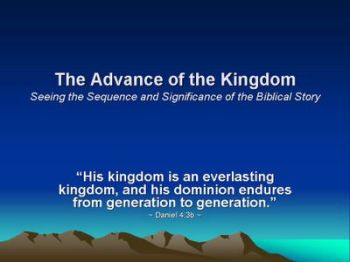
About a year ago, I posted the pictures of a power point presentation my brother (Dave) had put together for a series of Sunday morning messages at his church. The series traces the covenants of Scripture and how they relate to the advance of God’s Kingdom. It is an excellent presentation and also serves as an excellent (albeit  simple)  introduction to covenantal theology (as opposed to dispensationalism).

Well lately I’ve received a few requests for the actual presentations themselves, rather than pictures of them, and so I updated the original post to include the power point files (which WordPress allows me to upload). The files actually take up much less memory than the pictures of each slide, and you are welcome to download them if you’d like.

Since I was updating the post, I thought I’d bring it back to the front page again as it really is one of my favorite posts of all time. If you’ve got the time, take a look at some of the presentations, just click on the picture above to go to that post.

A Musical Antidote to Legalistic Thinking

Legalism is a dangerous problem. As an IFB, I always thought of legalism as strictly a works-based-justification approach to salvation. The only legalists I knew were Roman Catholics, eastern religionists, and some cultists.

But since I came away from IFB/IFBx circles, I have come to understand legalism as applying to sanctification not merely justification. I was a legalist, in many respects. Why? Because I felt my standing with God, on a day to day (sanctification) basis, depended upon my performance. I could be definitely not right with God, and more right with Him, than at other times. Often, the solution to struggling against sin was provided as merely gritting one’s teeth, and working harder. Character was the means to accomplishing my moralistic goals. How could I not see this as so contradictory to the gospel of salvation by grace?

IFB/IFBx churches stressed the importance of duty. But they did not address the question of human inability and depravity, so much. We all could do it, and if we didn’t we weren’t filled with the Spirit enough. Blame and guilt was applied as a means to motivate us to do right. Worship was wonderful when I was performing well, and horrible when I was not. Sometimes going through the motions was all I felt I could do.

Now, granted, this kind of thinking is not singular to IFB churches–any church is susceptible to it. And it has a grain of truth. We are called to live holy lives. Absolutely! But we are not to depend on ourselves or glory in our accomplishments. We are to boast only in the cross! (See this post along these lines.) Since knowledge affects our experiential walk so much (as the NT epistles constantly stress), misunderstanding the relation of our spiritual and Christian duties and the accomplishment of Christ on the cross can severely impact our personal enjoyment of Christ and His love and consequently hinder our walk with Christ. Without clear teaching that Christ is our only means of righteousness (ultimate and practical/daily), duty and resolve become first in our life, and delight and dependence are minimized. This is a danger still for me, and I think it is for all of us. But we must remind ourselves that our favor with God is solely due to Christ’s glorious work being accepted by God as sufficient for us and Christ’s constant and successful intercession for us. Anything good we do is only on account of God’s grace working in us (1 Cor. 15:10, Phil. 2:13).

Well, I was spurred on to thinking about these things again when I heard the following song on the radio this morning. It has blessed me and challenged me time and again. I put forth the lyrics here with the hope they will challenge you to see the glorious and awe-inspiring truth of God’s grace for us in Christ.


What If

By Jadon Lavik

What if I climbed that mountain? What if I swam to that shore?
What if every battle was victorious, then would You love me more?
Would You love me more?

What if I were everyone’s first choice? What if I went farther than before?
What if I stood high above the rest, then would You love me more?
Would You love me more?

You say I belong to You apart from the things I do.
You say I belong to You, I’m in awe of why You do,
Why You do, why You do. I’m in awe of You, ooh.

What if I ignored the hand that fed me? What if I forgot to confess?
What if I stumbled down that mountain, then would You love me less?
Lord, would You love me less?

What if I were everyone’s last choice? What if I mixed in with the rest?
What if I failed what I passed before, then would You love me less?
Lord, would You, would You love me less? Oh no, oh no, oh no.

You say I belong to You apart from the things I do.
You say I belong to You I’m in awe of why You do,
You do, You do, You do.

What have I done to deserve your Son sent to die for me?
What can I give? I want to live, give me eyes to see.
In a world that keeps changin’ there’s one thing that I know is true.
Your love is stayin’ there’s nothing else I’ll hold onto.

You say I belong to You apart from the things I do.
You say I belong to You I’m in awe of why You do,
Why You do.

You say I belong to You apart from the things I do.
You say I belong to You I’m in awe of why You do.
I’m in awe of You, I’m in awe of You.

The way You love me, the way You do.
The way You do, the way You love me, You love me, You love me.
The way You do, the way You do, the way You love me.
The way You love, You love, You love.

Lavikmusic ASCAP


You can listen to a song sample here, from the author Jadon Lavik’s website.