The “Sinner’s Prayer” Problem

** this is part 3 in a series on man-centered Christianity, see part 1 & part 2.

Now I lay my fears to sleep
I prayed, now the Lord must keep.
Nothing to lose, everything to win
I prayed the prayer, now I’m in.

The above prayer is patently absurd. Yet many actually do think that praying the sinner’s prayer is what guarantees they will be saved. God’s hand is forced. Rom. 10:13 obligates Him to keep His promise. They have “called upon the name of the Lord”, and He must save them.

Often people are encouraged to give Jesus a try. Commit yourself to Jesus and you will enter a brand new and exciting life! It only takes a few minutes, don’t you want to know that you will spend eternity in Heaven? Just pray this prayer and mean it, and on the authority of the Bible I guarantee you will be saved! Come on, what have you got to lose?

Anyone will have to admit that this is extremely common. Some form of the above appeal commonly ends most evangelical messages. It is often employed at the end of 1-on-1 witnessing conversations. But put yourself in the shoes of the lost person. The promises of life change sound pretty good. I would like to be accepted and these people are really nice, after all. What would it hurt? Sure, I’ll pray this prayer.

Or think of the Hindu: I want to have the gods accept me. This Jesus must be a powerful god. If I can appease him, I’ll surely be better off. I’ll pray to him and worship him, just like my family worships their god of choice.

Or what about the Catholic: I pray to Mary all the time for acceptance. I never knew you could actually be sure of heaven. I’m not sure how this works, but maybe it will add to the merits my efforts have been giving me. I receive Jesus at communion, receiving him in this prayer makes sense. I hope this works, maybe I won’t have to keep going to confession. Here goes.
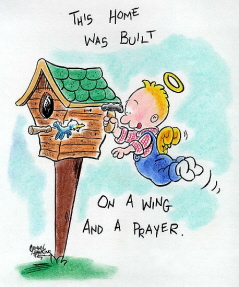
wingprayer.jpgMany are simply building their spiritual lives on a wing and a prayer. They enter Christianity as if it were a club. They pray the prayer and gain acceptance. They hear messages about how they are to feel about themselves and about various Christian ethical concerns. They give to charity, and dress nicely for their church gatherings. They feel generally good about themselves, and if they doubt their salvation, they are often assured on the basis of having prayed the prayer, that God will save them, because He doesn’t lie. Doubt is of the devil, after all.

Certainly there are many examples of those who have savingly believed at the time of their sinner’s prayer experience. Many are genuinely converted and trust in Jesus alone, even though they employed a sinner’s prayer. I want to be careful as I critique this popular method. But please consider the following.

1) No one in the NT is ever instructed to pray for salvation, or to pray “to be saved”.

2) The Bible witness is clear: believing Jesus saves you. So then, as I’ve wondered before, what would the “sinner’s prayer” do? Only those who believe in Christ will even pray the prayer and mean it. If the belief is what saves, why is the prayer framed in such a way as to imply that the asking is what saves? Does asking for salvation save, or does believing Christ alone save?

3) Rom. 10:13 in context does not teach that a prayer for salvation results in salvation.

Rom. 10:13-14 “For everyone who calls on the name of the Lord will be saved. But how are they to call on him in whom they have not believed? And how are they to believe in him of whom they have never heard?”

This is absolutely clear, before the “call” there must be faith. How can they “call” if they haven’t believed?

4) Why is “call on the name of the Lord” so quickly assumed to be “called out unto the Lord for salvation”? There is no object of the prayer in view in the text. In fact, if you trace the concept of calling on the name of the Lord, you will find something completely different. Let’s do that quickly.

1 Cor. 1:2 speaks of the saints as being “those who in every place call upon the name of our Lord Jesus Christ”. 2 Tim. 2:22 also speaks of “those who call on the Lord from a pure heart”. In both of these places the idea is used as a descriptive term for those who are worshippers of Jesus. This again is seen in Acts 9:14. Also, “call” is a continuous present tense idea — not those who did call (for salvation), but those who do call.

The NT use follows a pervasive OT usage of this idea. In the OT the phrase is often used of praying to God in specific circumstances for help, but it also refers to a general concept of worship: “I will call upon the Lord…”. The wicked are those who do not call on the Lord (Ps. 14:4), but the righteous do. Sometimes God delivers them physically or spiritually after their calls for help (Ps. 116:13) and other times God’s deliverance provides the impetus for the believers to call upon him (Ps. 80:18). In one sense, calling is what believers do — they come to God for help. But in another, it is who they are, they are worshippers who call upon their God.

Everyone, then, who calls on God, who is a worshipper of God, who worships God now and continually, all of these can expect ultimate salvation. “Salvation” is often referring to ultimate salvation or glorification, not justification, remember.

5) Rom. 10:9 is also not a formula for salvation. Merely saying “Jesus is Lord” does not save. Vs. 9 follows the order of the OT quote given in vs. 8 (“The word is near you, in your mouth and in your heart”). Vs. 10 seems to explain the logical or chronological order: belief is first, which brings justification; confession follows that, even as ultimate salvation follows justification.

6) The concept of asking Jesus in one’s heart is also unbiblical and unhelpful. See this booklet [PDF] by Pastor Dennis Rokser of Duluth Bible Church. Or this article by Todd Friel, of Way of the Master Radio.

7) The repentant publican who says “Lord be merciful to me, a sinner” had his repentant believing heart before he verbalized his prayer. And the thief on the cross changed his mind about Jesus, and ceased railing against him, before he called on him for mercy.

As humans, a prayer is sometimes inevitable. We may feel like we need to do something. We will pray to be saved and forgiven, but Scripture testifies that it is faith that saves. Requiring a prayer or encouraging someone to ask for salvation, muddles the waters and can potentially confuse matters. Enduring faith in the substitutionary Lamb of God is what saves. Trusting a personal act (praying) doesn’t. Worse, this theology can lead to a wrong assumption that even unrepentant faith can demand things of God.

I understand that there may be questions and difficulty in accepting what I’ve said here. I welcome further interaction in the comments. This post is sort of an aside from my current series on man-centered Christianity. I think the self-centered focus that the sinner’s prayer promotes is a contributing factor in the pervasive problem of man-centeredness in the church. In the next post, we will show how a wrong view of eternal security is likewise contributing to this problem. Then we will be ready to see what a God-centered view really is.AddThis Social Bookmark Button

Why Mike Huckabee Can Win the General Election

Update: For a post which lays out the reasons why Huckabee is a genuine conservative and can appeal to all 3 conservative factions, check out this post from Evangelical Outpost (Joe Carter, with Matt Anderson and Justin Taylor).
Momentum is Mike Huckabee‘s friend right about now. He’s been riding it for quite some time.

Huckabee scored big in yesterday’s Iowa Straw Poll by finishing solidly in 2nd place, with 18% of the vote. Romney spent literally millions more than Huckabee, and won first place with only 31% of the vote, even though the two other big name, top tier candidates didn’t participate.

With characteristic charm, Huckabee remarked, “For us to finish second, for all intents and purposes, we won the Iowa straw poll. This is David and Goliath and one smooth stone.” (source, David Chalian of ABCNews.com). Huckabee may not be over exaggerating either.

Chris Cillizza on his Washington Post political blog “The Fix”, suggested that Huckabee may well be the biggest winner from the straw poll. And “The Blue State”, a progressive blog without bias, predicts “Mike Huckabee is about to receive a huge bounce in the polls after finishing second…“. Blue State went on to discuss how Huckabee can position himself as “the leading conservative alternative to the frontrunners“. After highlighting evidence which may suggest hundreds of voters actually changed their minds to vote for Huckabee, Noam Scheiber of The New Republic‘s political blog “The Plank”, went on to describe how, “The political press is absolutely head over heels for Huckabee.”

So with all the buzz surrounding Mike Huckabee and his bid for the Republican nomination, now might be a good time to raise the question: “Can Huckabee win the general election?” I suggest he can, for the following reasons.

  • With a Republican party lagging in morale and political viability, the best chance Republicans have for winning must be a united front. They would need a candidate who appeals both to their base and to middle-of-the-roaders. Huckabee is that man. Conservatives have nothing to fear, and moderates will warm to Huckabee’s optimistic emphasis on vertical politics.
  • Who can say what it takes to win on the big stage, but a healthy dose of charisma, charm, and a quick witted humor never hurt anyone. Huckabee has that and more. He has consistently over achieved in the debates, and displays a presidential tone.
  • Huckabee is not connected to Washington. And he’s a governor — a governor’s governor, really. With 10 1/2 years of executive experience to leverage, Huckabee will convince the public that America needs a proven leader.
  • Since Huckabee isn’t a Washington insider, he isn’t in Bush’s back pocket. He’s been loathe to openly criticize the sitting president, but one can tell he has some significant differences and disappointments with Bush. Republicans and Democrats alike will need to be assured that Huckabee doesn’t represent more of the same.
  • Huckabee is also one of the few Republican candidates with a full-orbed political plan for change. He emphasizes vertical politics and the importance of actually governing and getting things done (see this video clip of Huckabee on this very point).
  • What’s more he is extremely believable and likable. The media love him. He has a great story of losing 100 pounds, and he would also have an underdog turned contender storyline going into the general election.
  • And Huckabee is not a cookie-cutter Republican. Sure he is solidly pro life, but he emphasizes the need to support life from the womb to the grave and everyplace in between. He also is calling for Republicans to take the lead in the stewardship of our environment, and the fighting of corporate greed. He even advocates an emphasis on art & music education in public schools. As for his faith, he stresses that it will influence him to “do what’s right” in office.
  • Early media reports have tried to paint Huckabee as a member of the radical right, with him being an ordained Southern Baptist preacher and all. They’ve made much of his personal belief in God’s creation, over and against evolution. Yet Huckabee’s record will prove them wrong. He won election twice in a solidly democratic Arkansas, and worked with Democrats to get things done.
  • He has a clear across-the-aisle appeal. Huckabee, his bass guitar, and his quick wit proved enough to win applause and more in a must-see interview with Jon Stewart of Comedy Central’s “The Daily Show”.
  • To sum it all up, Huckabee is the only conservative who can genuinely appeal to his party’s base as well as reach out to independents and moderates. It’s like Huckabee says, although he’s a conservative, he’s not mad at everybody!

AddThis Social Bookmark Button

Orange No More

Were any of you all sick of orange too?

I have been yearning for a blog design change for a while now. And I had been hoping to get rid of some of the clutter in my sidebar. I don’t know if I succeeded in that, but I am happy with the new look.

I wonder if anyone remembers the old Blogger version of this blog? Red, gray, and some tan — remember? Then who could forget the olive green garb the blog took on as I moved my blog to WordPress, July of last year. Since March, I was using the three column orange themed design that hopefully you remember quite well.

Well, this then is Fundamentally Reformed 4.0! I really like the color scheme and overall design. I am going to have to get used to having just one post display on the home page, however. That’s the main drawback, but there really aren’t any other choices I like for a three column design that uses widgets. Besides, this theme lends itself well to the use of more pages. And that is where I wanted to go with the blog.

I am planning to update each of the pages (they run along the top of the blog, under the header) in the near future. The one requiring the most work is the “Topics” page. I hope to list all the discussion topics I’ve had with the blog. It will be something like a site map, when I get finished with it. I’m hoping it will be a great place to start with, for those first coming across my blog.

Well, I’ve introduced the new design. It was my easiest design transition yet! If any of you have helpful suggestions, or constructive critique, please let me know. I’m glad you all read my blog. But my blog is, mine after all! And I like the design change.

Oh, and “Regler joe”, you can have your orange!

Baptism & Young Children

A quick update here. Grudem responded to Piper’s rebuttal of Grudem’s change of his position on baptism and church membership. (That sentence is a mouthful!)

Then Justin Taylor followed that up by highlighting two helpful articles by Vern Poythress. The first one is called “Indifferentism and Rigorism in the Church: With Implications for Baptizing Small Children“, and explores two attitudes to church membership and the nature of faith in little children (ages 2 and up). What Poythress says concerning the church in that paper is worth thinking through irrespective of the baptism position altogether — especially for us fundamentalist types.

The second paper is more overtly connected to paedobaptism (Vern Poythress is paedo), and is entitled “Linking Small Children with Infants in the Theology of Baptizing“. It explores the implications of Jesus’ reception of the little children and the nature of our experiencing Jesus in the company of the saints every time we gather in corporate worship.

Both of the articles by Poythress are well worth your time. He is very humble and brings up some excellent points. What he says can also be taken to heart even without opening membership to those of the opposite baptismal position. I’d be interested to hear any of your thoughts on the articles!

Barry Bonds: A Bonafide Bid for "Baseball's Best"

Having lived in the San Francisco Bay area for a couple of years, I grew to appreciate Barry Bonds. For the past five or six years as I’ve more closely followed his career, what continuously amazes me is how he stands head and shoulders above the rest.   No one is as feared a hitter as Bonds, and no one earns more walks.

Despite the chorus of rolling eyes, sighs, and moans which I’m receiving right now, let me briefly explain my point of view, and point you to an excellent piece on Bonds and his greatness.

Bonds has never been proven guilty of steroid-use, albeit from the news you’d have thought they already have a jail cell waiting for him. But can steroids really improve your swing? Can steroids earn you the batting crown? Can steroids gain you such a fear among the league’s elite pitchers?

Tony Gwynn, a baseball great of unstained reputation, made a comment a few years back. He claimed Bonds had the purest swing in baseball. Coming from baseball’s best hope for a .400 season in the last twenty years, this compliment by Gwynn seems quite signficant. And Gwynn spent many years playing in Bonds’ division, so he saw Bonds more often than most.

Further, steroid use has historically been widespread throughout baseball. And if it isn’t steroids, its something else. Players from Ruth’s era and on have continually used anything they could to improve their abilities. Bonds is no exception. And again, nothing illegal has been proven.

Under intense scrutiny of late, and amid the fiercest pitching schemes with the ever common intentional walk, Bonds has nevertheless continued to be at the top of the game. And not just in home run numbers. His OPS (on base percentage + slugging percentage), has been miles ahead of the rest of the league for the last several years.

Perhaps because he makes the other sluggers look like underclassmen, and because he is a maverick who doesn’t appreciate nosy reporters, Bonds has gained a lot of ill will. And the steroid suspicion adds to all this. So no one likes Bonds.

Like him or not, you’ve got to admit he is one of the greatest hitters of all time.

Not convinced? Read a very good and fact-filled treatment of Bonds by Kent Brandenburg, here. This piece also speaks to the mistaken thoughts surrounding Bonds increasing in his hat size and body build over the years. If any of you novice writers out there are going to dis Bonds (hey, I’m novice too), you ought to at least read this piece by Brandenburg. Its quite convincing, although this assessment does come from someone already firmly planted in Bonds’ peanut gallery!