Powerful Thoughts on Preaching

Adrian Warnock has been pumping out a whole host of great posts on expositional preaching over the last several weeks. I happened upon them, and basically read them all in reverse order. May the following excerpts and links awaken a hunger for God’s presence in your life. And I pray God meets you this Sunday in a glorious way.

I’ll begin by  an especially challenging quote for a Sunday, then I’ll arrange the links and excerpts in chronological order. They are all really good, so take a little bit of time and have your zeal increased through the reading of these posts!

There is nothing vital in the religion and in the worship of such people. They expect nothing, and they get nothing, and nothing happens to them. They go to God’s house, not with the idea of meeting with God, not with the idea of waiting upon him; it never crosses their minds or enters into their hearts that something may happen in a service. No, we always do this on Sunday morning. It is our custom. It is our habit. It is a right thing to do. But the idea that God may suddenly visit his people and descend upon them, the whole thrill of being in the presence of God, and sensing his nearness, and his power, never even enters their imaginations …

Do we go to God’s house expecting something to happen? Or do we go just to listen to a sermon, and to sing our hymns, and to meet with one another? How often does this vital idea enter into our minds that we are in the presence of the living God, that the Holy Spirit is in the Church, that we may feel the touch of his power? How much do we think in terms of coming together to meet with God, and to worship him, and to stand before him, and to listen to him? Is there not this appalling danger that we are just content because we have correct beliefs? And we have lost the life, the vital thing, the power, the thing that really makes worship worship, which is in Spirit and truth.

(quote by D. Martyn Lloyd Jones — read the whole post)

…the Word of God is written primarily to produce worship. This means that if that Word is handled like a hot-dish recipe or a repair manual, it is mishandled. And the people will suffer. The Truth of God begs to be handled with exultation. And our hearts yearn for this and need it. Something in us starts to die when precious and infinitely valuable realities are handled without feelings and words of wonder and exultation.

(quote by John Piper– read the whole post)

I can forgive the preacher almost anything if he gives me a sense of God, if he gives me something for my soul, if he gives me the sense that, though he is inadequate himself, he is handling something which is very great and very glorious, if he gives me some dim glimpse of the majesty and the glory of God, the love of Christ my Saviour, and the magnificence of the Gospel. If he does that I am his debtor, and I am profoundly grateful to him.

(quote by D. Martyn Lloyd Jones — read the whole post)

D. Martyn Lloyd Jones reflects on Charles Spurgeon and the relative importance of having sermon series.

The 3 types of expository sermons.

Adrian Warnock reflects on the pitfalls of long and slow expositional sermon series.

Dispassionate preaching is a lie. If the preacher is not consumed with [the] passage for the message, how can those who hear it believe it? This is what must be recaptured by the men at this conference who are not in danger of giving up the pulpit to entertainment, but who can become listless and lifeless in expositing the Scriptures.

(quote by Steve Lawson — read the whole post)

Adrian Warnock writes an excellent article on Technology in Preaching.

Think yourself Empty….Read youself Full….Write Yourself Clear….Pray Yourself Hot….Be Yourself, But Don’t Preach Yourself….

(quote by Alistair Begg — read the whole post)

Begin to tell the people what you have felt in your own heart, and beseech the Holy Spirit to make your heart as hot as a furnace for zeal.

(quote by Charles Spurgeon — read the whole post)

John Stott on sermon preparation (excellent!!).

On the dangers of expository preaching.

The practical effect of maintaining this human cultural distinctive where preaching is concerned is that large segments of the family of God are cut off from significant aspects to good preaching. Some are shaped into emotionally boisterous and doctrinally shallow Christians, while others are doctrinally heady and emotionally paralyzed. In the culture of God, we need truth set on fire so that we might be both rooted and grounded in the truth and stirred to compassion, love, and zeal . . .

(quote by Thabiti Anyabwile — read the whole post)

Warren ends by explaining that, in his view, the application of a sermon should aim to answer two questions: So What? (and) What now? He provocatively ends the article by saying, “If your preaching doesn’t ever answer these two questions, you haven’t applied the Bible to the lives of your listeners.”

(Adrian Warnock quoting Rick Warren — read the whole post)
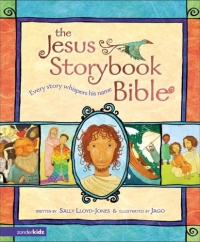
More on a Christ-Centered Kid’s Book

check out The Jesus Storybook BibleNot long ago, I passed along a recommendation for a new Bible Storybook called, The Jesus Storybook Bible. I called it a “storybook for preachers“, and explained why a Christ-centered Biblestory book could help many a preacher.

Well, I came across an excellent and informative interview of the author, Sally Lloyd-Jones about this book over at Eucatastrophe. I’m going to post a few excerpts here, and encourage you all to go read the interview. And more than that, you’ve got to get the book. I did, and I’m loving it. You can expect a review of it before too long.

I found it so moving when I started to discover how the Old Testament is basically one long record of failure””the failure of God’s people time and time again to live rightly, to rescue themselves””and that the stories in the Old Testament are all getting us ready for the One who is coming. They are all signposts to the True Hero, the True King, the True Prince, the True Servant, the greater David, the greater Daniel. The Rescuer.

As a child, I thought the Bible was packed with rules you had to keep (or God wouldn’t love you) and heroes setting examples you had to follow (or God wouldn’t love you). I thought, in short, that the Bible was all about me and what I should (or shouldn’t) be doing. Until I read a Story.

It’s the Story running like a golden stream underneath all the other stories in the Bible: the story of how God loves his children and comes to rescue them. Suddenly, I realized the Bible wasn’t about me and what I should be doing at all. It was about God and what he had done. And it changed everything…

It sounds strange, but the consistent reaction from many adults is that it makes them weep. (I think that’s good? Hope so!) Parents are reading it to one another as their devotional before bed. Pastors are using it to help them with their preaching. I heard someone call it, “the storybook for preachers” [she might be referring to my blogpost here!!].

And of course families are reading it together. Teenagers and college students have told me they are enjoying it. I heard from one dad that his young boys listen to each of the stories and as they near the end of each story, they whisper just one word: “Jesus.” I couldn’t ask for a better response. May all of us to be whispering his name in all the stories of our lives!

Be sure to read the entire interview!! (The comments discuss the Christ-centered treatment of the Old Testament in more depth.)

Jesus, Our Sacrifice, Our Priest, and Our Tabernacle

I am remiss to say I don’t keep up with all my friend’s blogs as often as I should. And I confess I have not been reading my friend Nathan Pitchford’s recent Studies in the Gospel of John. But I have been blessed by reading his most recent study on chapter 17. It is a long post, but every inch of it is worth a spiritual mile. It is rich and precious food for your soul.

The post reminded me of the richness of our salvation and  the Glory of our Savior, as it explored  some of the riches of John 17.   And as  Nathan had promised (in a comment on my last post), his post touched  on the ultimate reasons God had for creating man. What I want to focus on in this post, is how Jesus fulfills the rich imagery of the OT sacrificial system.

I am sure he delves deeper into an explanation of this in his prior posts, but let me quote  Nathan’s first paragraph which states how John’s Gospel presents Jesus as the Fulfillment of the OT Tabernacle (think John 1:14 “dwelt” = “tabernacled”).

During the course of our journey through the gospel of John, we have also taken a journey through the tabernacle, and we have seen how all of its imagery is fulfilled in Jesus. He is the Lamb of God, offered upon the brazen altar at the entrance to the courtyard. He is the laver by which the priests were cleansed, and in him is the water of everlasting life. He is the table of the bread of the presence, nourishing those who eat of him with the true life of fellowship with God. He is the candlestick, the tabernacle’s only source of light. And now, just before he offers himself up for our sins, we see that he is likewise the fulfillment of the symbolism in the altar of incense.

The post on chapter 17 goes on to detail how Christ was both the Sacrifice (offered on the brazen altar for the sins of the people) and the High Priest (who would take of the blood of that altar and offer it before the LORD, at times on the altar of incense). We do have a full salvation, as Jesus our Great High Priest can “save to the uttermost” all who come to Him in faith. And as the prayer of Jesus reminds us, God is sure to preserve and keep His own people perfectly.

Before I bow out, and ask you to read Nathan’s post, let me quote what Nathan wrote concerning the importance of the prayer in John 17 to John’s Gospel as a whole.

…The fact that all of Jesus’ specific requests, as to what precisely his imminent death and resurrection should accomplish, are things that John’s gospel has emphasized, tells us that John must have considered this prayer so important that he intentionally designed his gospel account around fleshing out the truths which he had heard in Jesus’ prayer. This chapter is not the summary of John’s gospel, it is the fountain and foundation for everything that John wrote. Really, it would be hard to overestimate the importance of this prayer: who would know better what specific effects to look for from the most important event of all history (indeed, the event for which all of history was designed) than the one who actually accomplished this all-important event of redemption through his sacrificial death on the cross? Do we want to know what God intended for Christ’s death and resurrection to accomplish? We have no further to look than right here.

Allright, I don’t think there is any more enticement needed for you to go read Nathan’s post. Read it today on Sunday, if you can. Read it and rejoice in our Savior.

“Reclaiming the Two Books of God” by Don Sailer

351 footnotes will either make or brake a 100-page book. In this case, it is the footnotes (which document the many quotes)  which make the book so interesting. The books full title is Reclaiming the Two Books of God: Restoring Moral Sanity to the Church. And the book’s author is Don Sailer. Some of you might recognize the author’s name from his interaction in the comment threads over at Sharper Iron. Yes, he is a fundamentalist, but he also has a doctorate from Gordon-Conwell Theological Seminary and currently pastors an Evangelical Free Church, so he is not your ordinary guy.

And it takes an unordinary guy, sometimes, to take on an unpopular topic. His book focuses on the widespread rejection of Biblical authority in both church and mainstream culture. He traces the issues which led to the abandonment of Biblical inerrancy and one by one, all the cardinal doctrines of Christianity.

For such a difficult topic, the book is helped immensely by the opening discussion of the Scopes’ trial. With that colorful event as a backdrop, Sailer moves on to tackle the growth of modernism and the advancement of Darwinism. He then details both the fundamentalist defense of the Bible’s authority in the face of modernism and the extreme humanist reaction against naturalism. In all of this, Sailer is sounding a call for today’s church to return to a firm position on the Bible’s authority.

While there is obviously much that could be said about these subjects, Sailer focuses in on the intersection of the two books of God: Creation and Revelation. Using the Puritan imagery of two books, Sailer discusses how science and the Bible complement each other. He focuses on the arguments that stem from the Darwinian view of science — ultra naturalism, if you will. And he contrasts that view with the Fundamentalist view of Scripture.

Sailer aims to accomplish his impossible mission through the use of numerous quotes. These often help the book, by letting historical figures speak to the issues themselves. He quotes, for instance, many of the leading fundamentalists and modernists of the late 1800s and early 1900s. Sometimes, though, I must admit, the quotes tend to weary the reader. And at times Sailer seems to jump from contemporary authors to those of yesteryear without properly alerting the reader. All in all, though, the value of the book is in the many quotes.

A secondary main point of the book is to demonstrate how the two books of God do not contradict each other. Rather than attempting a full fledged creationism discussion, Sailer focuses in on one key point: the age of the earth. Leaning heavily on Gorman Gray’s book The Age of the Universe: What are the Biblical Limits?, Sailer presents a strong case for a mediating position. He defends six literal days of creation, but claims that the universe and the planet earth were actually created before those six days: there is an unspecified amount of time between Gen. 1:1-2 and 1:3ff, he argues (cf. Is. 45:18). He also notes that Scripture merely teaches that God created and ordered life on earth in the six days. This position avoids the problems of the Gap Theory (death before Adam), and joins young earth creationists in denying evolution and affirming a literal view of Genesis. At the same time, it allows for the scientific findings of the speed of light in relation to the size and age of the universe.

I must admit that two things struck me as odd in Sailer’s discussion of the age of the earth. First, I could see how strict Biblical literalists who claim the chronology in the Bible would point to the earth being only at most 10,000 years old, would argue that Don is doing the same thing the modernists did with science: accommodating his view of Scripture to science’s claims. Second, I thought it odd that the book which had hitherto spoken largely in generalities and affirmed all those who resisted modernism, now became so specific as to dismiss old earth creationist views (like the Day Age theory) and strict young earth views out of hand.

Yet this view of creation appeals to me. I admit that I can see how astronomical and geological claims for the age of the earth and universe would be a stumbling block to people’s faith if they are told the bible teaches expressly a young earth. But the Bible does not teach this directly, and so it is a needless stumbling block. (I know evolution vs. creation is a big enough stumbling block of its own, but lets not discuss this here.) So I can see how this view does much to “reclaim the two books of God”. I haven’t come to a definitive conclusion on this issue yet, but if you are interested in a short article defending a Day Age view of an old earth, check out this one by Justin Taylor. And then check out Gray’s book (the first few chapters of which are online).

In conclusion, I would heartily recommend Don Sailer’s book. It is only 109 pages and is quite easy to read, and the historical quotes he pieces together are worth the price of the book. Consider, for example, this gem from William Jennings Bryan:

They first discard the Mosaic account of man’s creation, and they do it on the ground that there are no miracles. This in itself, constitutes a practical repudiation of the Bible: the miracles of the Old and New Testament cannot be cut out without a mutilation that is equivalent to rejection…. (pg. 18)

His discussion of the Scopes’ trial is enlightening, and you will be fascinated by his discussion of the age of the earth. Through it all, Sailer stresses the importance of Biblical inerrancy and succeeds in making his case that we cannot abandon the Bible’s authority, or else we are left without any Christianity at all. And considering the issues facing today’s church, this is a case worth hearing.

Disclaimer: this book was provided by the author for review. The reviewer was under no obligation to provide a positive review.

This book may still available for purchase at Amazon.com.

Moving and Improving

With the recent KJV Only debate getting so much airtime around here, I finally got around to updating my King James Version Only Debate Resource Center. I did more than just update it, I moved it. The new address is kjvodebate.wordpress.com. (Please update your bookmarks or links accordingly.)

With WordPress, I have been able to do more with the site than before. It now looks much more like a normal webpage (its still free for me, which is important). And with WordPress I can post unlimited pages which can be organized in more ways than simply a chronological order. [All this updating has me eager to revamp this blog a bit (the sidebar is in need of some improvement I think).]

I like the new site a lot better, and I hope to continue to work on updating and improving it over time. I would love any suggestions or recommendations any of you have concerning it as well.  

Regarding my “Bible and the KJVO Debate” series, I hope to have another post done sometime tomorrow, Lord willing.