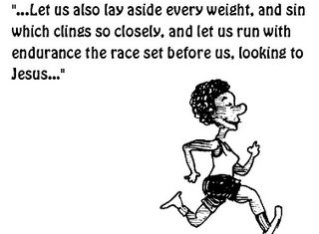
The Christian Life As a Race–Heb. 12:1-17

Run the Race

Hebrews 12:1-17 speaks of the Christian life as a race. Here are some thoughts concerning that race which were helpful in my Christian walk/race!

I. Pattern for our race.

A. OT Saints (chapter 11)

  • Ran it by faith
  • Endured hardship (self-chosen risk and external persecution)
  • Had a definite goal in view (Abraham = heavenly city; Moses = wealth/reward of Christ)

B. Christ (vs. 1-4)

  • Trusted the Father [had faith, in a sense] (“for the joy”; learned obedience)
  • Endured hardship (cross, shame, sinners, hostility, death)
  • Had a definite goal in view (joy; redeem a people for God)

II. Problem for our race.

A. We need faith

  • To see the witnesses
  • To see Jesus
  • To see the reward

B. We have obstacles

  • Weights (entanglements, see 2 Tim. 2:4)
  • Sins (besetting sins)

C. We have hardships

  • Requires endurance (v. 1)
  • Potential weariness (v. 3)
  • It is painful (v. 11)
  • Wears us out (v. 12)
  • Requires striving (v. 14)

III. Purpose of our race

A. Ultimate purpose

  • To win the prize (1 Cor. 9:24-27)
  • To gain Christ (Phil. 3)
  • To see the Lord (Heb. 12:14)

B. Progressive purposes

  • Our good (v. 10)
  • Share in his holiness (v. 10)
  • Fruit of righteousness (v. 11; Phil. 1:10-11)

IV. Perspective for our race

A. Our intensity/difficulty is really minor

  • Consider Christ (v. 3-4)

B. Our difficulty is to be welcomed not begrudged (v. 5-6)
C. No difficulty = no sonship (vs. 7-8]
D. God is working in this for our good (v. 9-10)
E. Our hardship is unpleasant but effective (v. 11)
F. Keep the pitfalls in view.

V. Pitfalls of our race

A. Potential to not see the Lord (v. 14)
B. Potential to fail to obtain grace (v. 15)
C. Potential to become or be poisoned by a “root of bitterness” (v. 15–also cf. Dt. 29:18ff. for the OT context of the phrase “root of bitterness”)
D. Potential to cross the line and be rejected finally (v. 16-17)

VI. Partners for our race

A. Brothers (and sisters) in Christ

  • Strive together (v. 14)
  • Help all (v. 15)
  • Prevent any (v. 16)
  • Also see Heb. 3:12-14 and 10:24-25

B. Christ (vs. 2)

The outline above should be sufficient for you to catch the gist of my thoughts on this passage. But let me expound on a few points so you better understand the outline. First, I take the “chastening” or “discipline” of verses 5 through 11 to be not so much God’s punishing us when we do evil as it is the whole difficulty involved in the sanctification process. What makes me conclude in this way? Well, verse 3-5 uses the concept of chastening to remind us to not view the race with a bad attitude. Verse 7 continues, “It is for discipline that you have to endure”. I see that as connected with the endurance mentioned in verse 2 and 3. In other words the whole Christian life–the race–requires endurance because it is God’s disciplining work. Verses 11-13 go back to the race metaphor again, showing that chastening should be viewed within that motif. Further, if chastening is done only to believers, and yet all the lost equally reap the bad results of their bad deeds, something different must be understood in the idea of chastening. I do not discount that an inward grief and struggle concerning sin is in view with this chastening, but it is only part of it and not the sum total of chastening.

Second, some of you may wonder what I am getting at under point number 5–the pitfalls. Feel free to consult a post dedicated strictly to this concept–the perseverance of the saints–entitled “Once Saved, Always Saved?!?!”. There I maintain that the warnings against apostasy are real and are used to help us become sanctified. In our race, we better remember that if at any time we give up, we may very well prove to have been a fake all along (1 Jn. 2:19). Only those who endure to the end will be saved, remember.

The Fullness of Jesus' Love Shown in the Lowly Act of Footwashing

Dr. Sam Storms of Enjoying God Ministries preached an excellent message for us this Sunday from John 13:1-11. Our overall theme for messages at Bethlehem Baptist during the five months our preaching pastor, John Piper, is gone has been “toward all the fullness of God through Christ” from Eph. 3:14-19 (I blogged about this series recently, so go to that post to find a link to the schedule and free mp3s/audio for each message.). After the introduction message, the first four messages have specifically focused on the fullness of the Spirit–Dr. Storms preached one of those messages for us last week [it was excellent and thought provoking, you should listen to it!]. Anyway, the next few messages center on the fullness of the love of Christ.

Dr. Storms chose an excellent text to highlight Christ’s love. The passage centers on Christ washing the disciples’ feet. Verse 1 stresses Christ’s love in this act and its greater context–“having loved his own who were in the world, he loved them to the end.” Dr Storms highlighted how this time in Jesus’ life was clearly a crisis. As a human he was facing his hardest hours. And while we would find it very difficult to think about and love others in such a time, our Savior did not. From this text and others we know that Jesus knew his disciples would very soon forsake him in his need, yet he lovingly served them anyway.

Dr Storms reminded us that nowhere in ancient history do we hear of any superior washing the feet of those beneath him, until Jesus. Dr Stroms then showed how the text stresses the exalted position of Christ–the glory Christ is anticipating returning to–and the extreme lowliness of serving through washing dirty and smelly feet. And he brought this all together as a wonderful portrait of Christ’s love in all its fullness for us.

He ended his message with an extended quote from Jonathan Edwards which was so good, I just had to post it. I found that it was from a sermon entitled “The Excellency of Christ” based on Rev. 5:5-6. Yet the passage Sam Storms quoted dovetails beautifully with his text, John 13:1-11. So let me provide the quote, and you can read Edward’s sermon in depth, if you like, here.

There do meet in Jesus Christ infinite highness and infinite condescension. Christ, as he is God, is infinitely great and high above all. He is higher than the kings of the earth, for he is King of kings, and Lord of lords. He is higher than the heavens, and higher than the highest angels of heaven. So great is he, that all men, all kings and princes, are as worms of the dust before him. All nations are as the drop of the bucket, and the light dust of the balance, yea, and angels themselves are as nothing before him. He is so high, that he is infinitely above any need of us, above our reach that we cannot be profitable to him, and above our conceptions that we cannot comprehend him. Pro. 30:4 “What is his name, and what is his Son’s name, if thou canst tell?” Our understandings, if we stretch them never so far, cannot reach up to his divine glory. Job 11:8 “It is high as heaven, what canst thou do?” Christ is the Creator and great Possessor of heaven and earth. He is sovereign Lord of all. He rules over the whole universe, and does whatsoever pleaseth him. His knowledge is without bound. His wisdom is perfect, and what none can circumvent. His power is infinite, and none can resist him. His riches are immense and inexhaustible. His majesty is infinitely awful.

And yet he is one of infinite condescension. None are so low or inferior, but Christ’s condescension is sufficient to take a gracious notice of them. He condescends not only to the angels, humbling himself to behold the things that are done in heaven, but he also condescends to such poor creatures as men, and that not only so as to take notice of princes and great men, but of those that are of meanest rank and degree, “the poor of the world,” Jam. 2:5. Such as are commonly despised by their fellow creatures, Christ does not despise. 1 Cor. 1:28 “Base things of the world, and things that are despised, hath God chosen.” Christ condescends to take notice of beggars (Luke 16:22) and people of the most despised nations. In Christ Jesus is neither “Barbarian, Scythian, bond nor free” Col. 3:11. He that is thus high condescends to take a gracious notice of little children, Mat. 19:14, “Suffer little children to come unto me.” Yea, which is more, his condescension is sufficient to take a gracious notice of the most unworthy, sinful creatures, those that have no good deservings, and those that have infinite ill-deservings.

Yea, so great is his condescension, that it is not only sufficient to take some gracious notice of such as these, but sufficient for everything that is an act of condescension. His condescension is great enough to become their friend, to become their companion, to unite their souls to him in spiritual marriage. It is enough to take their nature upon him, to become one of them, that he may be one with them. Yea, it is great enough to abase himself yet lower for them, even to expose himself to shame and spitting; yea, to yield up himself to an ignominious death for them. And what act of condescension can be conceived of greater? Yet such an act as this, has his condescension yielded to, for those that are so low and mean, despicable and unworthy!

Such a conjunction of infinite highness and low condescension, in the same person, is admirable. We see, by manifold instances, what a tendency a high station has in men, to make them to be of a quite contrary disposition. If one worm be a little exalted above another, by having more dust, or a bigger dunghill, how much does he make of himself! What a distance does he keep from those that are below him! And a little condescension is what he expects should be made much of, and greatly acknowledged. Christ condescends to wash our feet, but how would great men (or rather the bigger worms), account themselves debased by acts of far less condescension!

Picture above is public and was found here


∼striving for the unity of the faith for the glory of God∼ Eph. 4:3,13 “¢ Rom. 15:5-7

"I Love You, Lord"–With Additional Verses by John Piper

Last week, April 2, the song I wanted to do my weekly Musical Notes post on, was a special version of “I Love You, Lord”. What makes it special when we sing it at Bethlehem, are the two extra verses that Pastor John Piper wrote for the song. I tried finding the lyrics last week, but to no avail. I finally emailed Bethlehem’s office and they were kind enough to send me the lyrics. I hope they bless you as they have blessed me.


I Love You, Lord

by Laurie Klein (v. 1 & music)
by John Piper (v. 2, 3)

I love you, Lord, and I lift my voice
To worship you, O my soul, rejoice!
Take joy, my King, in what you hear:
May it be a sweet, sweet sound in your ear.

I love You, Lord, and I stand amazed;
My sins are gone! May Your name be praised!
Exult, my soul! And behold His face;
I will ever sing, O my King, of Your grace.

I love You, Lord, and for You I wait:
Your promises and Your power are great!
Make haste, my God, may I taste Your ways;
I will magnify Your sweet peace all of my days.

Music and Verse 1  © 1978 House of Mercy Music
(admin. by Maranatha! Music) CCLI# 130553


In case you are unfamiliar with this song, you can click here for an example of the melody. You can click here for a guitar chord sheet. And you can read the interesting story of the song (minus John Piper’s words) here.


∼striving for the unity of the faith for the glory of God∼ Eph. 4:3,13 “¢ Rom. 15:5-7

Palms and Praise: Worship Traditions for Palm Sunday


For the second year in a row (at least), my church has done something wonderful for Palm Sunday. They had the combined children’s choirs enter the worship service holding and waving palm branches while the congregation was singing the hymn “All Glory, Laud and Honor”. Then later, the children sang a choral arrangement of “Hosanna”.

This tradition at Bethlehem Baptist beautifully focuses our hearts on the day we are remembering each Palm Sunday. Does anyone else know of any other worship traditions which honor Palm Sunday?


∼striving for the unity of the faith for the glory of God∼ Eph. 4:3,13 “¢ Rom. 15:5-7

Toward All the Fullness of GOD Through Christ

I have been meaning to post about this for some time. Our pastor, John Piper, is on a 5 month sabbatical. Most of that time is a special gift from the church in honor of his 25 years of ministry. He typically takes a one month sabbatical to write each year, as it is. Anyway, in his absence, our church has planned a thematic preaching schedule to include both some of our own pastors and other speakers with whom Bethlehem has a special relationship with. The theme is “Toward All the Fullness of GOD Through Christ”, based on Eph. 3:14-21.

Not long before Pastor John left for his sabbatical, he preached an excellent message challenging our church to pray and work toward the best 5 months in our 135+ year history. Why? He believes that God would get more glory in working gloriously in Piper’s absence–where John could have no opportunity at all to get any credit. He also pushed us to not simply coast through these months and expect for things to happen only when Piper returns. So far, the preaching and the spirit of the church has been wonderful. God has worked in the hearts of members to push for having every service covered in prayer (following the example of Spurgeon’s boiler-room prayer meetings–people praying during the entirety of each service [4 downtown, and 2 at our north campus each weekend]), and also toward calling many individuals to commit to praying daily for God’s blessing during these months.

I previously posted my sermon notes from Wayne Grudem’s message on the Fullness of the Holy Spirit. Let me now direct you to the preaching schedule, where you will also be able to listen to each sermon online for free (or you can download the mp3s for free). Here is the schedule.

Now remember to pray for us, and be stirred up to pray for your own church and heart as well.

Eph. 3:14-21 “For this reason I bow my knees before the Father, from whom every family in heaven and on earth is named, that according to the riches of his glory he may grant you to be strengthened with power through his Spirit in your inner being, so that Christ may dwell in your hearts through faith–that you, being rooted and grounded in love, may have strength to comprehend with all the saints what is the breadth and length and height and depth, and to know the love of Christ that surpasses knowledge, that you may be filled with all the fullness of God. Now to him who is able to do far more abundantly than all that we ask or think, according to the power at work within us, to him be glory in the church and in Christ Jesus throughout all generations, forever and ever. Amen.”