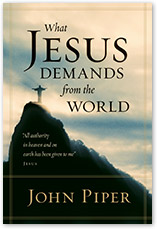
Jesus’ Demands — Take up your Cross and Follow Me (#8)

Click to orderDemand #8 — Take Up Your Cross and Follow Me

If anyone would come after me, let him deny himself and take up his cross and follow me. For whoever would save his life will lose it, but whoever loses his life for my sake will find it. (Matt. 16:24-5)

Follow me, and I will make you become fishers of men. (Mark 1:17)

I am the light of the world; he who follows me will not walk in darkness, but will have the light of life. (John 8:12)

Follow me, and leave the dead to bury their own dead. (Matt. 8:22)

If you would be perfect, go, sell what you possess and give to the poor, and you will have treasure in heaven; and come, follow me. (John 8:31)

Following Jesus means Fulfilling Jesus’ Mission.

Jesus came to “seek and to save the lost” (Luke 19:10). And he did this ultimately through his suffering on our behalf on the cross. Jesus’ mission was “to gather a people in allegiance to himself for the glory of his Father” as Piper puts it. And following Jesus is joining Him in that mission, or helping Him fulfill that mission. This is why Jesus said “Follow me, and I will make you fishers of men.” (Mark 1:17)

Following Jesus is Painful.

Jesus promised us, “If they persecuted me, they will also persecute you.” (Jn. 15:20) Jesus did not promise us a rosy life. He promised us suffering. This is why he calls his followers to first “take up their cross” and then to “follow” Him. In Matt. 16:24 “Jesus put the emphasis on self-denial and cross-bearing”.

The suffering we are called to endure creates ruptures in our relationships with people, wealth, and our occupation. We are to hate our most intimate family members, even our own selves, in comparison to our devotion to Jesus (Luke 14:26). And we are to “renounce all that [we have]” if we want to be a true disciple (Luke 14:33). This results in a liberal approach to giving, such that Jesus can say to the rich young ruler “sell what you possess and give to the poor, and you will have treasure in heaven; and come, follow me”. (Matt. 19:21) Piper points out that many of the disciples had to leave their occupations, and many times Jesus will move his people to leave their good jobs, pack their bags, and head off to Africa or Asia, or go into ministry here in America. Not everyone will be called to leave, but all are called to follow which will change your perspective on your job, your money, and your family.

Following Jesus is “Worth It”.

The suffering we are called to endure as we follow Jesus will be worth it. Jesus promises that if we hold on to our life we’ll lose it, and if we lose our life we will save it. (Mk. 8:35) And He constantly declares that following Him is a wise and exceedingly beneficial choice. Consider Jesus’ stress on our eternal reward to be received through this suffering/following in the following verses Jn. 12:25; Matt. 19:27, 29; Luke 14:14; Matt. 5:12. So while the suffering is only temporary the pleasure is eternal.

Yet the pleasure is not only future. Following Jesus brings joy now. It can make the persecuted “leap for joy” (see Demand #10 and Luke 6:22-23). This kind of faithful following even through suffering—the kind that rejoices to suffer for Jesus’ name—brings great glory to our Savior. A sad, somber, doleful “suffering for Jesus” will not necessarily glorify Him. But the kind of triumphant joy which smiles in the midst of tragedy, that points to the incomparable worth of Jesus Christ and properly displays His value to a watching world. Consider Piper, finally, on this point.

If you follow Jesus only because he makes life easy now, it will look to the world as though you really love what they love, and Jesus just happens to provide it for you. But if you suffer with Jesus in the pathway of love because he is your supreme treasure, then it will be apparent to the world that your heart is set on a different fortune than theirs. This is why Jesus demands that we deny ourselves and take up our cross and follow him. [emphasis added]

—See all posts on, the Demands of Jesus


∼striving for the unity of the faith for the glory of God∼ Eph. 4:3,13 “¢ Rom. 15:5-7

Reflections on the Cross from Mark Driscoll

I don’t listen to sermons all that frequently. I don’t own an i-pod, and I tend to read and surf through blogs during my spare time. But lately, I have tried to get in at least one sermon a week in addition to what I get from church.

This week’s sermon was an address (“Death by Love: Reflections on the Cross”—8MB download or 35MB download) that Mark Driscoll gave at a recent Resurgence conference hosted by his church, Mars Hill Church in Seattle. I know that Driscoll is controversial, but this message revealed an earnest, serious fellow who exults in the cross. Without going into a defense of him or his missiological emphasis, let me just encourage you all to listen to this sermon. It is an hour and thirteen minutes of reflecting on the cross. And I almost think he just about covered everything that is really important about the cross—all in one message.

He starts out with a vivid description of what a crucifixion actually was. I was thankful to be reminded of the terrors that Christ underwent purposefully for me.

Then he stressed the centrality of the cross. He made some helpful evaluations of various movements within Christendom with regard to how they view the cross. And while they are certainly generalizations, I think they help point out the natural pitfalls and tendencies of these movements.

Charismatics generally tend to move away from the cross to Pentecost and beyond. They focus on Acts 2, rather than on the climax of the gospels. Liberals prefer to focus on the kingdom rather than the cross and atonement. Fundamentalists, he said, tend to preach a religion of works and don’t focus on the fact that Christ has done all that is needed through the cross. They ignore the cross, he said. [From my perspective, I can understand how he would generalize fundamentalists in this way. No fundamentalist would claim to be a legalist, yet the following points would combine to make many of them (especially hyper fundamentalists) practical legalists: 1) a practical emphasis on dos and don’ts 2) a common tendency to view salvation strictly as a done deal, or past event, rather than an ongoing process (Phil. 2:12) 3) a sanctification approach based on “gritting your teeth” and “trying harder” (Gal. 3:3)] And finally, postmoderns tend to reinterpret the cross for today’s culture. The language of wrath and atonement wouldn’t apply today, they’d say.

Then Driscoll finished the message by focusing on the penal substitution aspect of the atonement. He stressed that the atonement is multifaceted and that there are elements of truth to almost all the atonement theories. But the point of contention today is over the penal substitution of the atonement. Driscoll did not really make a detailed defense of penal substitution, but sought to explain it and stress its significance. In doing so, he pointed back to the Day of Atonement in the Old Testament sacrificial system. There were two goats used on that day. One was slaughtered—that is propitiation, he said. The other was released to wander in the wilderness—that is expiation.

Propitiation is the fact that God is angry justly at us for our sins. Driscoll pointed out something I hadn’t thought of before under this point. Everyone goes out of their way to stress God’s love for us as being personal. But no one wants to think of His wrath as personal. We are okay with getting upset at people who wrong us, but God can’t get upset when we or others wrong Him. Driscoll further stressed that we need not think of the message of propitiation as detracting from a message of God’s love for us. No, 1 John 4:10 explains that Jesus’ propitiation of God’s wrath for us is the love of God. Propitiation illustrates and explains God’s love for us.

And expiation is another aspect to this penal substitution. Driscoll pointed out that some translations echo a popular theological position today in translating the Greek word for propitiation as expiation. Driscoll stresses that the word includes both expiation and propitiation, not strictly expiation. He also challenges Calvinists for he believes they often defend propitiation to the exclusion of expiation. To Driscoll, expiation is basically cleansing from sin. Christ takes our punishment (propitiation) and delivers us/cleanses us from our sin (expiation). He pointed to 1 John 1:7 for this.

To conclude my post here, let me encourage you all to listen to this sermon. It will fill your mind with thoughts of Jesus and the cross, and I trust it will cause you to be more captivated and enthralled by the wonder that Jesus suffered on our behalf. May the cross of Christ—and all its ignominy, shame, and horror—fill you with awe at the glorious love of God revealed in Jesus Christ. And may it free you to trust in Christ alone for the guarantee of all of God’s promises to us, even eternal life.


∼striving for the unity of the faith for the glory of God∼ Eph. 4:3,13 “¢ Rom. 15:5-7

You NEVER Outgrow Your Need for the Gospel

I would highly recommend that you listen to my pastor’s (John Piper) recent sermon “God Strengthens Us by the Gospel”. You can read it here, as well as find links to watch or listen to it online or even to download it.  

The text for the message is Rom. 16:25-27.

Now to him who is able to strengthen you according to my gospel and the preaching of Jesus Christ, according to the revelation of the mystery that was kept secret for long ages but has now been disclosed and through the prophetic writings has been made known to all nations, according to the command of the eternal God, to bring about the obedience of faith”” to the only wise God be glory forevermore through Jesus Christ! Amen.

Piper sees the main point of this passage being that God strengthens us according to the gospel. And the gospel was given according to preaching and revelation of the mystery through  prophetic  writings, and was given according to the command of God, and the gospel was given to bring obedience of faith.    

Piper saw something  incredibly striking in all of this. The passage ends  Romans and is a typical doxology. That means that something about God is  said to be glorious and worthy of praise. The thing  (of all  of God’s attributes  or actions) that  Paul chose to stress at the end of arguably the greatest letter ever written, is that God strengthens us through the Gospel. Piper saw this as stating something great about God. Other dictators and kings become great by walking on the backs of those they govern. They glory in being stronger than others and in holding them down.

But God is so much greater  than that. He glorifies Himself by strengthening those whom He governs. He is big enough that He does not have to fear competition and advance His cause by humbling his own subjects. God strengthens His people, and that indeed is glorious, and an amazing grace we are so unworthy of!

Then Piper makes the obvious point, that Paul considers the gospel to be central to life as a Christian. It is not merely a “ticket to Heaven”, that once acquired you can drop in your pocket and forget about. No it is much more than that. Piper said,

You never, never, never outgrow your need for this gospel. You don’t begin the Christian life with this and then leave it behind and get stronger with something else. God strengthens us with the gospel to the day we die.

If you listen to the sermon, you will see that Piper adds about four or five more “never”s in that statement: “You never, never, never, never, never, never, never, NEVER, outgrow your need for this gospel.” The gospel is to fuel our worship and be ever in front of us as we come to God for acceptance. All of our works should flow from the gospel, and not be separate from its impact. This is the heart of gospel-centeredness. The gospel is what strengthens us. (Take the time to look up Acts 20:32 in this regard.)

Finally, I want to encourage you to follow this series. There are four more messages on this paragraph. One of them, I am sure, will delve into the fact that now the mystery of Christ is revealed in the prophetic Scriptures (the OT, as far as I can tell). That part, to me, is a justification for the redemptive historical hermeneutical approach to Scripture. But that is for another post.

(P.S. I wanted to beat John Chitty to posting on this sermon! I am sure that he will have a post on it soon, as “gospel centeredness” is the main theme of his blog.)

Jesus’ Demands — Abide in Me (#7)

Click to orderDemand #7 — Abide in Me

Abide in me, and I in you. As the branch cannot bear fruit by itself, unless it abides in the vine, neither can you, unless you abide in me. I am the vine; you are the branches. Whoever abides in me and I in him, he it is that bears much fruit, for apart from me you can do nothing. (John 15:4-5)

As the Father has loved me, so have I loved you. Abide in my love. (John 15:9)

If you abide in my word, you are truly my disciples, and you will know the truth, and the truth will set you free. (John 14:11)

Jesus said to the Jews who had believed in him, “If you abide in my word, you are truly my disciples, and you will know the truth, and the truth will set you free.” (John 8:31)

What abiding is.

To abide, is to stay, continue, or dwell. So Piper says, “Jesus meant: ‘Stay in me. Continue in me. Keep me for your dwelling.'” With the figure of the vine, we understand a little better what “abiding” is. Piper says it best: “Abiding in Jesus means staying vitally connected to the life-giving, power-giving, fruit-producing branch, namely, Jesus.”

What abiding produces.

Piper claims abiding is the “moment-by-moment cause of every good thing in our lives”. Of course, he gets this from Jesus’ statement “Apart from me you can do nothing”. So in John 15, abiding in Jesus results in fruit. No fruit without abiding. So Piper again states that abiding means “staying vitally connected, hour by hour, to the one who alone produces in our lives everything he demands.”

What abiding isn’t.

Abiding produces fruit, so abiding cannot be that very fruit. It is wrong to think we are obeying Christ’s demand to abide if we are just “bearing fruit” or “keeping Jesus’ commandments”. That is the fruit of abiding. Maybe we don’t have abiding quite pigeonholed yet. So…

How do we abide?

Jesus says abide “in me” (Jn. 15:4) and “in my love” (Jn. 15:9). He also says to abide “in my word” (Jn. 14:11). All of this points toward “abiding as continual trust in the truth of Jesus’ words and in the certainty of his love.” We would not be abiding in Jesus’ love if we stopped beleiving that we are loved by him. We would not be abiding in Jesus’ word, if we ceased believing in the truth of that word. Abiding is a continual trust in Jesus’ love and in His words, in other words, a continual trust in Him as a person.

Piper concludes that “abiding in Jesus—in his love and in his word—is trusting that he really is loving us at every moment and that everything he has revealed about himself and his work for us and our future with him is true.”

A warning.

Jesus’ demand that we abide in Him is a warning. In Jn. 8:30-31 (quoted above), Jesus ties abiding in with being a “true” disciple. In John 15, Jesus speaks of the utter destruction of those who, in the words of Piper, “appear to be truly in the vine, but are not”. All of this is to warn us that if we are not abiding, if our lifestyle is one that consistently does not trust in Jesus’ love and in Jesus’ Word continually, then we might very well not be genuinely born again. We may still be on our way to hell.

Such warnings do not prove that we can actually lose our salvation. 1 Jn. 2:19 teaches that those who fall away were never truly saved, they just seemed to be. These warnings should also not cause us to try to earn our salvation by working real hard. No, they are what God uses to prod us onward along that straight and narrow way—the hard way. At times we will need to be warned that our lifestyle is not matching our profession. And they ultimately remind us that it is only God’s free grace given to us because of Jesus Christ’s perfect life, death, and resurrection, that gives us a secure place in heaven. The very warnings to continue believing will help us believe and call us to find refuge in Jesus Christ through ongoing faith and trust. [See this post for more on this point.]

Encouragement.

Piper stresses that ultimately we cannot “abide” on our own. God keeps us in the vine. He does not let us slip through His hand (Jn. 10:27-29). Jesus prays for us and sovereignly determines that our faith will not fail (cf. Luke 22:31-32).

So with all this in mind, let us purpose to abide, moment by moment, in a vibrant trust in Jesus—His love and His Word. Let us seek to put His Word in front of our eyes, so that reading it faithfully, we will be nourished and abide in the vine. Let us use the means of grace in our lives and take advantage of our church and our relationships with other believers, so that we keep on keeping on. Let us press on to higher ground!

—See all posts on, the Demands of Jesus


∼striving for the unity of the faith for the glory of God∼ Eph. 4:3,13 “¢ Rom. 15:5-7

A Gracious Gospel vs. A Fleshly Façade

The blessed “gospel of grace” declares: “…[God] saved us, not because of works done by us in righteousness, but according to his own mercy…” (Tit. 3:5). And again, “…not having a righteousness of my own that comes from the law, but that which comes through faith in Christ, the righteousness from God that depends on faith…” (Phil. 3:9). So why then do we so often act like the Galatians of whom Paul asked, “Having begun by the Spirit, are you now being perfected by the flesh?” (Gal. 3:3)

It is so easy to depend upon our own performance for our standing before God. We struggle to live a life that will please God, and when we momentarily succeed our hope, joy and love are increased. Ah… but when we fail or fall, the hope, joy, and love flee. We hide how bad we are in hopes of being accepted by others, yet we can’t hide from God. So we grit our teeth and try to do better.

We all have experienced this cycle at one time or another, and to varying degrees. What is missing in all of this,  is a focus on Christ and  the Gospel. We are to live constantly aware of Christ’s sacrifice on our behalf. We are to be consumed with the Gospel. Our hope is in the Gospel and in Christ’s victorious death and resurrection. He is our standing with God. He is our only acceptance with God. None of our works, even as a Christian, are good enough to please God. We are utterly dependent on the One who intercedes for us. And praise God He is interceding for us and He will not let us slip out of His hand! Let us live lives centered on the Gospel.

To that end, let me quote a thought provoking post on this subject by DJ Cimino over at Doxoblogy. I couldn’t really quote just an excerpt, it is too good. I encourage you to check it out on their blog too, as there is a really nice picture to go with this over there.

Why do we as Christians think that we are living a good Christian life as long as other Christians are unaware of our sin and shortcomings? Why do we accept a “performance based” Christianity? Why don’t we realize that we still sin and fall short of the glory of God? Why do I feel like a good person of I think I haven’t done anything really bad today, when the Bible says that in my flesh even my good works are as filthy rags in God’s sight? Why don’t we walk in the light and be honest about our mistakes, failures and sin? Why do we want others to think we are someone who is holy and pious, when it is only by the righteousness of Jesus that we are blameless in the eyes of God? Why do we get upset at our fellow believers when they ever so slightly sin against us? Why can’t we see that it’s only by God’s grace that we didn’t do the same thing to them? Why can’t we have a more honest Christianity in America, instead of the fake shell of flesh-produced psuedoholiness?

Why can’t we have a more Gospel-centered/cross-centered Christianity? One that daily looks to the Gospel as a foundation for our lives, the hope of our salvation (past, present & future) and the answer to our sinfulness, and not the shifting sands of self-righteousness that produces a performance based, man-centered Christianity.

Why? [underlined emphasis is italic in original]

Before closing, let me direct you to two previous posts on a performance based “legalism” and Christ centered (vs. moralistic) preaching.