The “Sinner’s Prayer” Problem

** this is part 3 in a series on man-centered Christianity, see part 1 & part 2.

Now I lay my fears to sleep
I prayed, now the Lord must keep.
Nothing to lose, everything to win
I prayed the prayer, now I’m in.

The above prayer is patently absurd. Yet many actually do think that praying the sinner’s prayer is what guarantees they will be saved. God’s hand is forced. Rom. 10:13 obligates Him to keep His promise. They have “called upon the name of the Lord”, and He must save them.

Often people are encouraged to give Jesus a try. Commit yourself to Jesus and you will enter a brand new and exciting life! It only takes a few minutes, don’t you want to know that you will spend eternity in Heaven? Just pray this prayer and mean it, and on the authority of the Bible I guarantee you will be saved! Come on, what have you got to lose?

Anyone will have to admit that this is extremely common. Some form of the above appeal commonly ends most evangelical messages. It is often employed at the end of 1-on-1 witnessing conversations. But put yourself in the shoes of the lost person. The promises of life change sound pretty good. I would like to be accepted and these people are really nice, after all. What would it hurt? Sure, I’ll pray this prayer.

Or think of the Hindu: I want to have the gods accept me. This Jesus must be a powerful god. If I can appease him, I’ll surely be better off. I’ll pray to him and worship him, just like my family worships their god of choice.

Or what about the Catholic: I pray to Mary all the time for acceptance. I never knew you could actually be sure of heaven. I’m not sure how this works, but maybe it will add to the merits my efforts have been giving me. I receive Jesus at communion, receiving him in this prayer makes sense. I hope this works, maybe I won’t have to keep going to confession. Here goes.
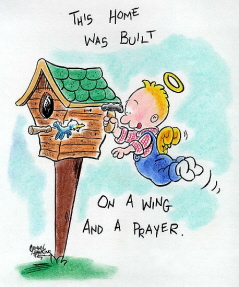
wingprayer.jpgMany are simply building their spiritual lives on a wing and a prayer. They enter Christianity as if it were a club. They pray the prayer and gain acceptance. They hear messages about how they are to feel about themselves and about various Christian ethical concerns. They give to charity, and dress nicely for their church gatherings. They feel generally good about themselves, and if they doubt their salvation, they are often assured on the basis of having prayed the prayer, that God will save them, because He doesn’t lie. Doubt is of the devil, after all.

Certainly there are many examples of those who have savingly believed at the time of their sinner’s prayer experience. Many are genuinely converted and trust in Jesus alone, even though they employed a sinner’s prayer. I want to be careful as I critique this popular method. But please consider the following.

1) No one in the NT is ever instructed to pray for salvation, or to pray “to be saved”.

2) The Bible witness is clear: believing Jesus saves you. So then, as I’ve wondered before, what would the “sinner’s prayer” do? Only those who believe in Christ will even pray the prayer and mean it. If the belief is what saves, why is the prayer framed in such a way as to imply that the asking is what saves? Does asking for salvation save, or does believing Christ alone save?

3) Rom. 10:13 in context does not teach that a prayer for salvation results in salvation.

Rom. 10:13-14 “For everyone who calls on the name of the Lord will be saved. But how are they to call on him in whom they have not believed? And how are they to believe in him of whom they have never heard?”

This is absolutely clear, before the “call” there must be faith. How can they “call” if they haven’t believed?

4) Why is “call on the name of the Lord” so quickly assumed to be “called out unto the Lord for salvation”? There is no object of the prayer in view in the text. In fact, if you trace the concept of calling on the name of the Lord, you will find something completely different. Let’s do that quickly.

1 Cor. 1:2 speaks of the saints as being “those who in every place call upon the name of our Lord Jesus Christ”. 2 Tim. 2:22 also speaks of “those who call on the Lord from a pure heart”. In both of these places the idea is used as a descriptive term for those who are worshippers of Jesus. This again is seen in Acts 9:14. Also, “call” is a continuous present tense idea — not those who did call (for salvation), but those who do call.

The NT use follows a pervasive OT usage of this idea. In the OT the phrase is often used of praying to God in specific circumstances for help, but it also refers to a general concept of worship: “I will call upon the Lord…”. The wicked are those who do not call on the Lord (Ps. 14:4), but the righteous do. Sometimes God delivers them physically or spiritually after their calls for help (Ps. 116:13) and other times God’s deliverance provides the impetus for the believers to call upon him (Ps. 80:18). In one sense, calling is what believers do — they come to God for help. But in another, it is who they are, they are worshippers who call upon their God.

Everyone, then, who calls on God, who is a worshipper of God, who worships God now and continually, all of these can expect ultimate salvation. “Salvation” is often referring to ultimate salvation or glorification, not justification, remember.

5) Rom. 10:9 is also not a formula for salvation. Merely saying “Jesus is Lord” does not save. Vs. 9 follows the order of the OT quote given in vs. 8 (“The word is near you, in your mouth and in your heart”). Vs. 10 seems to explain the logical or chronological order: belief is first, which brings justification; confession follows that, even as ultimate salvation follows justification.

6) The concept of asking Jesus in one’s heart is also unbiblical and unhelpful. See this booklet [PDF] by Pastor Dennis Rokser of Duluth Bible Church. Or this article by Todd Friel, of Way of the Master Radio.

7) The repentant publican who says “Lord be merciful to me, a sinner” had his repentant believing heart before he verbalized his prayer. And the thief on the cross changed his mind about Jesus, and ceased railing against him, before he called on him for mercy.

As humans, a prayer is sometimes inevitable. We may feel like we need to do something. We will pray to be saved and forgiven, but Scripture testifies that it is faith that saves. Requiring a prayer or encouraging someone to ask for salvation, muddles the waters and can potentially confuse matters. Enduring faith in the substitutionary Lamb of God is what saves. Trusting a personal act (praying) doesn’t. Worse, this theology can lead to a wrong assumption that even unrepentant faith can demand things of God.

I understand that there may be questions and difficulty in accepting what I’ve said here. I welcome further interaction in the comments. This post is sort of an aside from my current series on man-centered Christianity. I think the self-centered focus that the sinner’s prayer promotes is a contributing factor in the pervasive problem of man-centeredness in the church. In the next post, we will show how a wrong view of eternal security is likewise contributing to this problem. Then we will be ready to see what a God-centered view really is.AddThis Social Bookmark Button

Man-Centered Christianity (part 2)

** first read part 1

Jesus is our buddy, and God is our friend. Christ is hip, and church is cool. This sentiment is alive and well in today’s American Christianity, along with: God has a special plan for your life. You are very special to Him.

The problem with the Church today is that we are using God. Like Aladdin, we depend on our genie to help us live a meaningful and happy life. Afraid of hell, or guilty over sin? Pray a prayer, and Jesus takes care of it. Worry on the job, stress in your family situation? The Bible has the answer, its God’s guidebook for life. Longing for true acceptance and love? No one loves you like Jesus does! In the church we all love each other and look out for one another.

It takes a trained eye, but do you see how the above concerns all center around self and self-esteem? Perhaps its no wonder, then, that Jesus is also offered among evangelicals today, as one who can guarantee that you will get what you want, that you will get rich, that you will prosper, or that you will be healed.

How did we get here? Man-Centered Methodology including the Sinner’s Prayer

I suppose that there have always been such errors in the Church, after all we are human. But with the rise of the revivalist movement in the 1800s, an emphasis was placed on crafting evangelistic appeals tailored to the likes and dislikes of the audience. Charles Finney invented the altar call, and appealed to the human free will to come forward and make a commitment to Christ. Later evangelists continued to employ pragmatic methods in a largely parachurch context as they drew ever larger crowds together in large mass meetings around the country, and the world.

The pledge a new convert would make eventually was replaced by a prayer. And under Billy Sunday, the prayer was changed into the modern “sinner’s prayer”. Never before in the history of the church had such a method been used. Now sinners were directed to pray for personal salvation, rather than given counsel and encouraged to believe and thereafter commit/pledge to follow Christ with all their being. This subtle change in methodology, like the many that preceded, became a new tradition that bound countless evangelists and ministers for generations to follow.

From a personal prayer for salvation, the “sinner’s prayer” became employed en masse. Crowds were instructed to repeat this prayer if they wanted to be saved. And then came the religious tracts, which today overwhelmingly call for a prayer to be repeated. These prayers have given assurance to thousands, and have transformed our modern view of salvation.

While Scripture speaks of those who are “being saved”, most evangelicals view salvation in the past tense. While past evangelists exhorted converts to continue steadfastly in the faith, modern-day converts are promised that even the most damaging sins will not result in the loss of your salvation — the salvation they “received” upon their just completed recitation of the “sinner’s prayer”. Today, multitudes struggle over whether they “said the right words”, or truly “meant it”. And assurance is often given based on Rom. 10:13 and whether the person remembers a “time and a place” when they accepted Christ.

Whereas before converts would often come from churches where they had heard countless Scriptural sermons, and been given personal Scriptural counseling, before finally coming to repentance, today’s converts are given a few (often very few) verses, ripped from their context and strung together in the form of a “Roman’s Road”, or “The Four Spiritual Laws”. Earnest and biblical preaching has sometimes been turned into a well-crafted psychological appeal. Often times seekers are manipulated into just “trying” the prayer, or giving Jesus “a test drive”. In some fundamentalist circles, almost any means is employed to get people to repeat the magical, soul-saving, prayer — including putting a foot in people’s doors so they can’t shut it and so they have to hear the soul-winner’s quick appeal to pray this prayer.

Hold on a second, Bob! Where’s your proof, and aren’t you exaggerating a bit here? I knew someone was thinking that. You were, weren’t you?

In the next few days I will be reviewing a book which offers some historical background and proof for many of my assertions here. I’ll even be having a book give away (so stay tuned!). But at this point, I should insert a caveat. I do not think, that a “sinner’s prayer” experience is necessarily void of any merit. I think countless believers started believing in Christ right around the time they prayed that first prayer. The prayer didn’t save them, faith did; and the prayer was merely a vehicle by which to express their faith.

Problems with the “Sinner’s Prayer”

But at the same time I see some serious problems with this methodology. The “sinner’s prayer” can lead people to trust in an act they did as a means of salvation. They are saved because they prayed and did their part of Rom. 10:13 — they “called”, so God has to “save”. But salvation is not a mere transaction. And often the prayer is merely a recognition that you believe certain facts — the Gospel facts. No one is saved by believing facts, people must repent and trust Jesus alone for salvation.

Further, a “sinner’s prayer” gives people a false hope. Assurance is tied to the act, not to faith. And beyond that, it fosters a point-in-time prevailing view of salvation. It does not encourage people to take seriously the many Biblical warnings for those who do not persevere in faith.

And lastly, the “sinner’s prayer” fosters a self-orientation and a man-centered view of Christianity. Because God died to save people, people are important. I am important. My needs were met by God, so I should thank him and live for him. But still everything centers around me, even God is bowing down to serve me, having done all He could to save my soul.

Looks like these posts are turning into a series. Next time, I will discuss the theology of the “sinner’s prayer”, and Bible arguments against it. Then I will get into a Biblical view of eternal security/perseverance. And finally, Lord willing, I will explain what a God-centered Christianity looks like.AddThis Social Bookmark Button

Man-Centered Christianity?

Many times labels are a bit self-serving. After all, “I” am God-centered, Gospel-centered, Christ-centered, God-saturated, etc. etc. And of course you aren’t. Oh, and I’m orthodox, my beliefs are historical and Biblical, and Spurgeon agrees with my position! Labels are at the same time helpful. There is an orthodox position. History does matter, and gospel-centered does mean something.

Perhaps an aversion to any kind of theological pride in labels is behind recent blog discussion (by those Phil Johnson calls “post-evangelical”) centering on the question, “Can you be too God-Centered?” While some good points are raised concerning that question, from my vantage point the overwhelming problem in evangelicalism today is that far too many are man-centered.

I don’t want to merely throw out such a label in hopes of scoring points. And I realize no one will be standing in line to claim the label I’m describing here! But this is a very important issue, and I hope I can gain a hearing.

The problem I’m discussing is especially big among strict fundamentalists, yet it’s present among many more liberty-conscious evangelicals. From the TBN-watching Arminians, to even the staunchest, doctrine-loving Reformed — man-centered Christianity finds a home.

It’s sometimes overt, yet often dangerously subtle. And since we are all recipients of Adam’s sin nature (and the pride of our one-time father the devil), we would do well to at least explore whether perhaps we might have slipped into being too man-centered.

“I suddenly saw that someone could use all the language of evangelical Christianity, and yet the center was fundamentally the self, my need of salvation. And God is auxiliary to that….I also saw that quite a lot of evangelical Christianity can easily slip, can become centered in me and my need of salvation, and not in the glory of God.” — quoted in Tim Stafford, “God’s Missionary to Us”, Christianity Today, Dec. 9, 1996.

I read the above quote in John Piper’s book The Legacy of Sovereign Joy (pg. 118), and felt I just had to comment on it. Man-centeredness can be successfully cloaked in a religious and even conservative garb, and therefore it is even more dangerous.

So central to American revivalist evangelicalism, is man’s personal need for salvation. For many — the majority, I would say — in evangelicalism, the need of personal salvation brings them into the church, and is very soon taken care of. Then other needs find central place.

A wide segment of the church today emphasizes the emotional and physical needs of the congregation, straining to serve and help everyone become successful and happy. And another more Biblical (in my opinion) aim centers on the need to live a holy life and obey God’s commands. Serving the poor, reforming one’s own character, contributing to the common good by volunteering and giving to the church, sacrificing to reach the lost, these all are good things which become central. Even in worship, an emphasis on personal tastes and being accepted is quite common. Others stress a personal experience.

The danger in all of this, becomes the tendency to center everything around self. God saved me, so He deserves my love and praise. I want a better life, so I enjoy and benefit from teacher so-and-so’s practical teaching….

This can lead to lives that are not much different from the non-churched. God has a part, but He is not central. The here and now matters an awful lot, as does economical and emotional well-being. Helping each other, and feeling good about ourselves are essential.

But where is the light on the hill? How is this all that different from the world? Do you find a feel-good invitation in Scripture? Come follow Jesus, and there’s no cross to bear, and all your problems get fixed! God loves you so much he did everything just to help you. Shouldn’t you love such a God in return?

The problem with this is that we don’t need a great and glorious God to make it work. Its not all that different from secular health-and-wellness seminars, or the new age movement. Substitute yoga for God and you get about the same thing. Yoga can transform your life and give you real meaning and purpose….

All I’ve done here today has been to introduce the problem. I hope to explore what God-centered Christianity would look like. And I hope to point out how the popular methodology & doctrine concerning salvation has a profoundly negative impact with regards to this problem.

So for now, ask yourself: Am I too man-centered? And please, let me know if you think I’m off base in my assessment that this is 1) a widespread problem, and 2) this is a big problem.AddThis Social Bookmark Button

Minnesota Bridge Collapse & Thinking About Tragedies

Last night, while we were gathered at a local park with fellow church members from our church, we were informed of the bridge collapse on I-35W in Minneapolis (which happened at 6:05pm Central time). As most of you should know, we live in St. Paul, MN and so the bridge tragedy struck close to home. In fact the bridge was just blocks away from our church’s downtown campus.

So I can thankfully say we are all just fine, and unaffected by the collapse. I had relatives call me last night (my parents in Africa had even heard about the collapse and called us before we could get back home from church) and 2 blogging friends email me to make sure we were okay. It is nice to know that people care about you, in times like these.

Considering this tragedy, with 7 people dead and 38 or so more injured (as of the time of this writing), I thought it would be a good time to rehash how Christians should view such tragedies. And I can do no better than to direct you all to go read my pastor John Piper’s personal thoughts about the tragedy. For further reading, you can read what I wrote about the Virginia Tech shootings if you like.

photos are all from the AP / Star Tribune and found here at foxnews.comAddThis Social Bookmark Button

Helen Roseveare: Her Suffering & Her Challenge

I posted the following post on Kingdom Surge, and thought it would work well to post it here as well.

In her book Faithful Women and Their Extraordinary GodNoel Piper presents a biographical sketch of the life of Helen Roseveare, missionary to the Congo for over 20 years. The above video clip is a 4 minute condensed version of Helen’s life presented by Noel (HT: Desiring God’s Blog). Helen is now 82, and still travels around speaking about the great need for missions. She will be speaking at the 2007 Desiring God National Conference: “Stand: A Call for the Endurance of the Saints“.

Helen Roseveare’s Suffering

On the heels of Zioneer’s post The Blood of the Martyrs, it is perhaps fitting that we pause and reflect on one of the many modern day missionaries who faced severe suffering for the sake of Christ and His Kingdom. Helen upon graduating from medical school, took her promising future and went to serve in one of the poorest and most remote places in Africa. She stayed there for 20 plus years.

Her time in Africa was one of constant work, treating 200 or more patient’s a day, struggling to build a hospital practically by herself, training numerous medical students, and suffering from constant tropical sicknesses. I would encourage you to read Noel’s account of Helen’s life, it is available to read online here, and is only 20 or so pages long. It reveals how sensitive Helen was to the things of the Lord, and how she grew through so many and varied trials.

The most trying time of her life, and the great suffering that she endured for Christ came during the Simba rebellion of 1964. Her house was ransacked and she was brutally beaten, and even raped. Then she was in captivity for several months, during which time she again suffered rape and brutal treatment. Through this dark time in her life, Christ Jesus was faithful to meet her with special peace and grace. You can read the account of her suffering starting on this page

After that time of suffering, Helen still stayed on for several more years of service in the Congo. Oh for more missionaries like Helen Roseveare who embrace suffering for the sake of the Kingdom.

Helen Roseveare’s Challenge

As I read the section on Helen’s life, I couldn’t help but notice her current passion. She has a strong desire for the youth of today’s Church to join the cause of missions, specifically for the sake of the thousands of unreached people groups in the world today. Listen to Helen’s challenge in her own words:

Since 1973, I have been living in the United Kingdom, and seeking to present the desperate need of the three thousand million people, alive today, who have never yet heard of our Lord Jesus Christ and of the redemption He wrought for them at Calvary. These are the “hidden peoples” in more than ten thousand ethnic groups around our world. As I try to present their needs, I pray earnestly that the Holy Spirit will stir hearts to make a response. It seems so obvious to me that Christian young people…should rise up and go….

Why is the response so poor?…

Is it that we Christians today have an inadequate understanding of God’s holiness and therefore of his wrath against sin and of the awfulness of a Christless eternity? If we were gripped by the two facts–of the necessity for judgment of sin because God is holy; and of the necessity of holiness in the Christian that he may represent such a God to others–would we not “hunger and thirst after righteousness” whatever the cost, and would not others then see Christ in us, and be drawn to Him?

In other words, if we [understood] the Scriptural teaching on the need of Holiness in the life of every believer, we should not need to plead for missionaries. (From Helen Roseveare’s book Living Holiness, pg. 32; cited by Noel Piper, Faithful Women And Their Extraordinary God pg. 168)

AddThis Social Bookmark Button