Preaching the Gospel to Ourselves

Recently there have been some good comments here, concerning the importance of encouraging others and ourselves with the Gospel. Under my brief post about C.J. Mahaney’s sermon on Encouragement at Bethlehem (my church), Alana Asby Roberts wrote:

That thought about speaking the gospel to other Christians is interesting. After my “new” and final conversion experience at nineteen, I found that I enjoyed the gospel as food, loved to sing its truths, etc.

When we got a new pastor, he began by preaching his first Sunday morning series on “The Nature of Saving Faith” and was going deep into the truths, usually neglected, of the full gospel. He abruptly switched, I am sad to say, to a series about the Ten Commandments (with all of their possible ‘applications’). We later found out that people had been complaining about having to listen to all these “salvation messages” when they were already “saved”.

But it is the gospel of the grace of Jesus Christ. What could be more edifying or encouraging? He comes to us in it again and again, no matter how long we have been walking in the Way.

And under the comments for my post on “The Gospel Song” , Capt. Headknowledge said:

Mahaney’s book [The Cross Centered Life] helped me realize I can preach the Gospel to myself when I find I’m going without it in my own “worship experience.”

Sadly, Alana’s experience is all too common, and Capt. Headknowledge’s discovery isn’t. Believers do not want to have the gospel preached at them, so of course they don’t preach it to themselves! The Gospel is just for the lost (they say), and of course once they pray the sinner’s prayer, then all is good and well, right?

The ESV and other modern versions capture the essence of the Greek of 1 Cor. 1:18 better than the old KJV. It says:

For the word of the cross is folly to those who are perishing, but to us who are being saved it is the power of God. (emphasis added)

Salvation is in one sense a process. The common expression “whoever believes will be saved” in most of its occurences could be understood as “the believing ones will be saved”, based on the literal sense of the Greek. Belief commences when we convert to Christ but it is to continue our whole lives [see this post which emphasizes that]. And belief is nurtured through hearing the word of God (Rom. 10:17). And the phrase “word of God” most often in the NT refers to the gospel message of Christ–“the word of the cross”.

John Piper in his book When I Don’t Desire God: How to Fight for Joy encourages us to preach the Gospel to ourselves!

We must not rely only on being preached to, but must become good preachers to our own soul. The gospel is the power of God to lead us joyfully to final salvation, if we preach it to ourselves. (emphasis in the original)

Piper points out that Martin Lloyd-Jones emphasized this truth in his book Spiritual Depression: Its Causes and Cures. The book is…

“an exposition of Psalm 42, especially verse 5: ‘Why art thou cast down, O my soul? And why art thou disquieted in me? Hope thou in God: for I shall yet praise him for the help of his countenance’ (KJV).”

Piper and Lloyd-Jones point out that the psalmist is preaching the promises of the Gospel to himself. I will end with just a quote Piper gives from Lloyd-Jones and then point you to Piper’s book pgs 80-82 (and also 88-89) which is available online for free here. Lloyd-Jones, then will conclude this post for us:

The main art in the matter of spiritual living is to know how to handle yourself. You have to take yourself in hand, you have to address yourself, preach to yourself….You must turn on yourself, upbraid yourself, condmn yourself, exhort yourself, and say to yourself: “Hope thou in God”–instead of muttering in this depressed, unhappy way, and then you must go on to remind yourself of God, Who God is, and…what God has done, and what God has pledged Himself to do. Then having done that, end on this great note: defy yourself, and defy other people, and defy the devil and the whole world, and say with this man: “I shall yet praise Him for the help of his countenance, who is also the health of my coutenance and my God.” [Ps. 42:11b, KJV]

[For my treatment of how the Gospel should be the focus of each and every public sermon in church, see here]

Stomping Toes and Stomping Souls: The Moralistic Bent to Fundamentalist Preaching

DISCLAIMER: Although I am dealing specifically with fundamentalist preaching, the problem of moralistic messages without explicit reference to the redeeming work of Christ permeates all of evangelicalism.
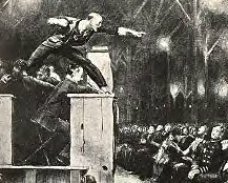
Billy SundayIndependent Fundamental Baptists love preaching! And when I say preaching, I mean hell-fire and brimstone, Bible-waving, Satan-trouncing PREACHING! Amen? The best preaching is usually accompanined by the most screaming, hollering, spitting, snorting, and a good dose of preaching “antics”.

An example of this I’ll never forget would be the preaching of George Griffis, camp director of Camp Victory in Somerset, KY. My church made the long drive from the Detroit area to Camp Victory every summer when I was a teen. There would be various preachers, but always Bro. George would preach. When he got worked up, he would be screaming and crying at the same time. He had a knack of jumping from the edge of the platform and grabbing the rafters of the old-fashioned tabernacle, where the preaching was done. He would swing and scream with all his might! A few hundred wide-eyed teens was always the result…. He had his heart and soul involved in his preaching for sure!

toes.jpgNow another aspect of the kind of preaching fundamentalists savored was what is called toe-stomping. Yes, if you are thinking of the image of someone stomping on your toes–that is what is meant. It seems the preachers job was to make us feel guilty about all of our failures. If we really felt like he had put us through the ringer, so to speak, it was thought the preacher had really done his job well. This is why a full altar meant a great sermon. When all kinds of people felt the weight of their guilt to the point of coming forward and “getting things right” with God, the preacher had done his job well. No pain, no gain! Amen?

This view of preacing had many direct and indirect results. In many spheres of extreme fundamentalism, theatrical antics, brashness, an almost uncouth mouth, and emotional manipulation became the tools of the trade for the kings of the sermon. And even among those who were not so keen on showmanship, Billy Sunday remained a hero. Still, in most IFBx churches, if one does not holler one is not really a preacher. “We need preachers not teachers”, as the saying goes. Expositional preaching does not serve this view of preaching as easily as topical preaching, and so in many spheres of fundamentalism expositional preaching was outright condemned, while in others it just became more and more rare.

While the loss of expositional preaching is great indeed, I would venture to say another result of IFBx’s view of preacing is even more troubling. I would say the tactic of heaping guilt on the hearers and calling them to reform and seek revival, has led to a kind of moralistic preaching which is most perilous indeed!

Fundamentalist preaching mirrors the fundamentalist view of sanctification by keeping rules. While not all IFBs and IFBxs claim to believe in sanctification by keeping rules, to one degree or another the fundamentalist emphasis on external conformity to standards conveys the idea that the more one adheres to these standards the more right with God he is. This results in the unconscious view that our own level of performance plays a big part in God’s acceptance of us. As I said in an earlier post,

“Often, the solution to struggling against sin was provided as merely gritting one’s teeth, and working harder. Character was the means to accomplishing my moralistic goals….IFB/IFBx churches stressed the importance of duty. But they did not address the question of human inability and depravity, so much. We all could do it, and if we didn’t we weren’t filled with the Spirit enough. Blame and guilt was applied as a means to motivate us to do right.”

What do I mean by moralism? I mean the mere attempt to be good. I have heard countless fundamentalist messages on having character, giving, being truthful, loving others, obeying one’s parents, reading the Bible, praying, going to church, courage, not quitting, leadership, and on and on the list goes. Yet many of these same virtues are extolled among people who have no true claim to the name Christian. Mormons extol family values, and Jehovah’s Witnesses are for many of the things on that list. In fact, non religious groups extol sacrifice, leadership, truthfulness, loving others, courage, even meditation, etc. These things are moral issues, and Christians do not have the market cornered on morality.

Recently, I came across another ex-fundamentalist blog called The Misadventures of Captain Headknowledge. In a few of his posts he emphasizes this very thing: how Christ needs to be central in preaching. Let me quote him in-depth from his post, “What am I Hearing in this Sermon?”, as he sums it up well.

“…the Law (what God is and does, and so what man ought to be and do) is imperative, and the Gospel (what Christ has done for sinners) is indicative.

In Christ-centered preaching, the logic will flow from indicative to imperative; from what God does, in Christ, to what man ought to do. We derive the proper motive and power to perform the imperatives of Scripture from the proclamation of the indicatives of Scripture.

Whenever the focus of the sermon is imperative, what we can or should be doing, and the indicatives of God’s work on our behalf rates as a secondary concern in the sermon, we unintentionally slip into thinking we’ll earn the indicatives (that which God grants by his grace) by performing the imperatives (that which God gave us to prove to us we must rely only on his grace). This is the danger of man-centered preaching.

Is Jesus mentioned in the sermons you hear? If he is, is he the subject of the verbs; is he the one doing the work, or is Man? If Jesus is the one doing the work, what work of his is being proclaimed? Is he proclaimed as our Problem-Solver, Example (WWJD), Therapist or Sugar Daddy? Or is he proclaimed as our Creator, Redeemer, Advocate, Mediator, Judge, Prophet, Priest or King?

The reason this matters is because ‘the gospel is the power of God for salvation to everyone who believes’ (Romans 1:16). Salvation is an all-encompassing work, including not only our justification, but also our sanctification and our glorification. Preaching on sanctification is vitally important; there is much for us to do, in dependence on God’s gracious empowerment, to grow in sanctification, but this is not achieved by majoring on detailing all the imperatives alone, but the imperatives of preaching, what we normally call ‘application’ of God’s Word, must be built on the foundation of the indicative of the Gospel preached alone.” (emphasis his)

I believe he leans heavily on Bryan Chapell‘s book Christ-Centered Preaching. Chapell emphasizes that in every sermon one must relate the explanation of the Scripture passage to the redeeming work of God in the present. Otherwise, he insists, all you have is “simply a ‘sub-Christian’ call ‘to be’ or ‘to do’ something in one’s own strength” (quoted from an online summary of Covenant Theological Seminary‘s homiletical programs). Chapell’s book is simply a homiletical application of the Reformed approach to hermeneutics–redemptive historical interpretation, which I have discussed elsewhere. UPDATE: To listen to a message by Bryan Chapell which summarizes well his book, click here [or right click on it and select “save target as” to download it and listen to it later].

Captain Headknowledge goes on to say in another post:

“…and this is the point of my incessant howling about basing all application… in preaching on the basis of the Gospel preached…, and not only preached as an evangelistic appeal directed toward unbelievers, but preached also to the believers as the foundation and reason and source of the particular application of each and every ‘practical and relevant’ sermon. If application is preached as separate from the gospel, you have legalism. It’s not good enough to assume the listeners understand the foundation, it must be presented as a unified, package deal. It is ‘wickedness of the deepest darkness’ to preach application without explicitly basing it on the gospel. Imperative comes from Indicative; application comes from gospel; ‘do’ comes from ‘be’. Kind of like that old saying, ‘we sin (do, imperative) because we are… sinners‘. Likewise, we walk in righteousness because we are righteous, not ‘we become righteous by walking in righteousness’. How did we become righteous? Righteousness was given to us by God as a free gift of his grace (Romans 1:17; 3:24). Hello! Indicative! Followed by Imperative!” (emphasis his)

So what am I driving at? I am not concluding one should never encourage believers to obey God’s Word. Believers do need to be truthful, godly, etc. The Holy Spirit certainly may convict believers of their need to “do better”. But ultimately, we need to preach how the gospel touches each area of the believer’s life. We cannot, apart from God’s Spirit given to us based on the Gospel work on our behalf, ever be wholly truthful and godly. And even if we could, it would avail us nothing! We need to be reminded that God accepts us based on Christ and because of Christ we can obey and become all that we already are in Christ.

We don’t need more toe-stomping sermons. We need more sermons that direct sin-laden believers to feast their eyes on the glories of Christ. A greater appreciation of Him, a greater understanding of His work–these will give us hope and faith and courage to keep pressing on.

So whatever standards you hold, and whatever group you identify with, beware of moralism. Make much of Christ! Glory in the cross!

Picture of Billy Sunday borrowed from here.


∼striving for the unity of the faith for the glory of God∼ Eph. 4:3,13 “¢ Rom. 15:5-7

Happy Birthday from the Texas Baptist Underground

Happy Birthday to Me!

Okay. I just celebrated my birthday on Wednesday, May 3. My wife informed me that I was 9496 days old, by the way. Anyway, today I found out about a great birthday gift I received–sort of a blogging birthday gift. For a long time now, I have enjoyed and respected James Spurgeon’s posts on his blog devoted to fundamentalism called The Texas Baptist Underground. I have linked to that blog almost from the inception of my blog. Anyway, on Wednesday, James added six new links to his blog and two of them were to my blogs–my main blog as well as my new KJV Only Debate Resource Center blog. Now James did not know it was my birthday, but I thanked him for the gift anyway!

While I am on the subject, let me recommend James’ new book, The Texas Baptist Crucible: Tales from the Temple. It is the published version of a compilation of stories that James published on the internet under the title “Tales from the Temple”. The Temple would be Longview Baptist Temple, and the stories were of James’ days at Texas Baptist College (a ministry of LBT). The book was published by a company specializing in helping individuals self-publish their books, and so it is a little costly–starting at around $24.95. But believe me, it is worth every penny. I am gobbling the book up as you read this!

The stories are fascinating reading, but they teach a sobering message. They point out the worst in extreme fundamentalism, but do so in a graceful and healthy way. While laughing at his own troubles, James’ tells his own story in the hope of disclosing the doctrinal and practical errors which abound in certain sectors of fundamentalism. For me, reading James’ book helped me to see how some of the same ungodly leadership tactics, misplaced emphases, and wrong attitudes about ministry were present (albeit in a less blatant form) in my own experience in extreme fundamentalism. James’ experience was extreme, mine was not, yet many of the root problems were identical.

I encourage my readers to get this book and read it thoughtfully. It will entertain, yes. But it will also enlighten. Ponder your own experiences in light of James and see anew what the errors of extreme fundamentalism can produce. Be warned and move away from the error into a life of grace. The encouraging thing about James’ book is that he did not bail out on God when faced with the problems he endured. Rather, he continued in his faith and therefore is able to see God’s hand at work in his life and encourage others in similar situations to follow the Lord and His Word to such a degree that they are willing to test their own leaders and church by His teachings.

Oh, and lest I forget, let me challenge you fundamentalist readers of mine to get this book. Read what an ex-IFB thinks of you and see if there is any truth to it. Don’t be afraid of the truth. Honestly evaluate your own beliefs and practices. When you place yourself outside of outside scrutiny and Scriptural evaluation, you have placed yourself in a dangerous position. Check out James’ blog, as well as mine. Take the haughty smirk off your face and be willing to see if there is any truth in what ex-IFBs are saying. You may find some truth at least, and be equipped to change a little to better line up with God’s Word. Isn’t that what you are all about anyway?

The Cross of Christ: Central and Singular

Happy Easter

This Easter morning, I am thinking of the cross. And I wonder that I do not think of it more. Around Easter time it is easy to think of the cross, but we should not leave such thoughts to Easter time alone. The cross is the heart of the Christian faith, but in all the doctrinal discussions and practical considerations, in all the preaching and praying and studying and living, in all the ministry and fellowship and missions and evangelism, in all we as God’s church are called to do, do we minimize or marginalize the cross? Directly or indirectly, neglect of the cross is all too common in my life and yours. I pray these thoughts will be fodder for further meditation. I pray that we will ponder these things and focus our gaze more intently and more enduringly on the cross of Christ–today, tomorrow, and beyond.

The cross of Christ is clearly central. In a great post on the nature of the gospel, C.J. Mahaney points out that while the gospel is the “good news of God’s saving activity in the person and work of Christ” (a definition he borrows from Jeff Purswell) it focuses more particularly on the death, burial, and resurrection of Christ. And more specifically still, he asserts, the gospel is summarized by the cross–“For I decided to know nothing among you except Jesus Christ and him crucified.” 1 Cor. 2:2. The resurrection is essential, for without it the cross’s message would be pointless, but the cross is where the gospel is seen most clearly.

The cross, then, proclaims the message that God became man to take upon Himself the punishment for our sins. Further, the perfect and righteous life of Christ–the God Man–enables God to give us the righteousness of Christ graciously and freely. This transaction occurs to those who believe on Jesus Christ and is wholly of grace and not in any way deserved by man. The cross shows the seriousness of sin–in that God would sacrifice His own Son because of the weight of our sins; and it also shows the magnitude of God’s mercy–that God would offer up His Son for us who in no way deserve mercy.

Further, the cross is seen as central in that it is the pinnacle of history, for it is the ultimate display of God’s glory–which is the ultimate purpose for God’s creation and all of its subsequent history. (I would encourage you to check out my friend Nathan Pitchford’s “Meditation for Good Friday” posted over at Reformation Theology Blog which deals with the centrality of the cross in all of history.)

But the cross is not only central to our faith, it is singular. Or rather it should be. What do I mean? Look at these verses:

“For I resolved to know nothing while I was with you except Jesus Christ and him crucified.” (1 Cor. 2:2)“May I never boast except in the cross of our Lord Jesus Christ, through which the world has been crucified to me, and I to the world.” (Gal. 6:14)

The cross–and the Christ of the cross–should be our single treasure, our single pursuit, our single love. Every boast should only be in the light of the cross. Our only boast should be the cross. John Piper put it like this:

“Only boast in the cross of Jesus Christ. This is a single idea. A single goal for life. A single passion. Only boast in the cross. The word “boast” can be translated “exult in” or “rejoice in”. Only exult in the cross of Christ. Only rejoice in the cross of Christ. Paul says, Let this be your single passion, your single boast and joy and exultation.” (from pg. 49 of Don’t Waste Your Life–available as an online book here)

All of life should be viewed through the view of the cross. And as Piper points out later in that book, we can only boast singularly in the cross when our lives are crucified by and on that cross (notice Gal. 6:14b). Everything we do should be as a result of or a reflection of the cross. C.J. Mahaney points this out well in his book The Cross Centered Life. Our struggle to be pure in this world and our struggles to provide for our family–every aspect of our lives is touched by and should be shaped by the cross.

Let us aim to appreciate the centrality and significance of the cross of Christ, and endeavor by God’s grace to make it our single affection, joy, and boast!

The Rising of The Sun of Righteousness

The Sun of Righteousness shall rise with healing in [His] wings...

Mal. 4:1-2a For behold, the day is coming, burning like an oven, when all the arrogant and all evildoers will be stubble. The day that is coming shall set them ablaze, says the LORD of hosts, so that it will leave them neither root nor branch. But for you who fear my name, the sun of righteousness shall rise with healing in its wings.

Is. 60:19-20 The sun shall be no more your light by day,nor for brightness shall the moon give you light; but the LORD will be your everlasting light, and your God will be your glory. Your sun shall no more go down, nor your moon withdraw itself;for the LORD will be your everlasting light, and your days of mourning shall be ended.

Matt. 17:2 And he was transfigured before them, and his face shone like the sun, and his clothes became white as light.

Rev. 1:16 In his right hand he held seven stars, from his mouth came a sharp two-edged sword, and his face was like the sun shining in full strength.

Ps. 84:11a For the LORD God is a sun

Rev. 22:5 And night will be no more. They will need no light of lamp or sun, for the Lord God will be their light, and they will reign forever and ever.

Acts 26:13 At midday, O king, I saw on the way a light from heaven, brighter than the sun, that shone around me and those who journeyed with me.

...the Lord God will be their light...

As I drove home from work early Sunday morning, I encountered a fiercely bright sunrise. It reminded me of the glory of Christ, who is the Sun of Righteousness. The Sun is the brightest and most awesome light that we encounter in God’s physical creation. Since Jesus is compared to the sun, we are to see Him when we see and are arrested by the sheer glory of the physical sun. This is a means of us comprehending how much more amazing and brilliant is Christ’s glory, He who is brighter than the noon-day sun (as Paul experienced on the road to Damascus).

Jonathan Edwards--a life which illustrates that theology can and should move the heart more than the mind!

Thinking about how the sun and Christ (the S-O-N) compare has made me ponder some thoughts my close friend shared with me recently. When giving me A History of the Work of Redemption by Jonathan Edwards recently, he had opportunity to share some thoughts about the book. The book traces God’s work of redemption from the Fall to the Ascension and beyond. Edwards does a spectacular job dealing with OT types and highlighting the gospel/Christ-centeredness of all of Scripture. He has excellent thoughts on the advance of the gospel after the writing of the NT up to his present time, as well. His thoughts are rooted in Scripture and the work is well worth puchasing and reading, as it magnifies God for His great and glorious work of redemption.

A few thoughts Dave (my friend) shared have stuck with me. First, he mentioned that the natural creation was created to show the glories of God’s spiritual work. When encountering Scriptural teachings on types or comparisons, I typically just assumed that God was borrowing from the natural realm, so to speak, to highlight truth about His spiritual works. But the work of redemption was planned “before the foundation of the world”! So, when God created the world, the very way in which He did it was not arbitrary but planned. He knew that He would expressly compare the creation of life in dead hearts to the creation of physical light (2 Cor. 4:6). The physical process of human birth was designed with the new birth in view. I think one of the ways the heavens and physical creation declare the glory of God is that they provide illustrations of His work of redemption. When God is compared with light–the very quality of physical light is meant to teach us about God’s character (albeit it cannot teach us perfectly or completely, as it is only a picture of Someone who defies description). The family unit, with father-child and husband-wife relationships, were designed and established to reveal aspects of our relationship with God as His beloved children, and our relationship with Christ as His church-bride. This thought can be expanded and more examples found for sure.

The other thought Dave left me, concerned a specific allegory Jonathan Edwards used over and over again in his book. In looking through the book recently I encountered it in at least 8 different places. Here is the picture:

Behold, the day is coming...for you who fear my name, the sun of righteousness shall rise with healing in its wings...

The OT reflects the light of the glory of Christ and the gospel much like the moon reflects the light of the sun. At first the OT only has brief glimmers here and there of Messianic prophecies and gospel teachings. But the moonlight of OT revelation grows and grows until it reaches its zenith in the period of David and Solomon. David is the greatest personal type of Christ, Edwards argues (pg. 104). The Psalms written at this time, display the glories of Christ in unparalleled fashion in the OT. The building of the Temple and the reign of peace experienced in Solomon’s reign represent the greatest epoch of Israel’s history.

But then the moon begins to wane throught the less glamorous reigns of Solomon’s heirs and the exile and post-exilic periods of Israel’s history. Edwards explains, “As the moon, from the time of her full, is approaching nearer and nearer to her conjunction with the sun, so her light is still more and more decreasing, until at length, when the conjunction comes, it is wholly swallowed up in the light of the sun….If the Jewish church, when Christ came, had been in the same external glory that it was in, in the reign of Solomon, men would have had their eyes so dazzled with it that they would not have been likely joyfully to exchange such great external glory for only the spiritual glory of the poor despised Jesus.” (pg. 129, 131-132)

The incarnation of Christ and His ministry are represented by the dawning of the sun. Edwards argues that after redemption has been purchased on the cross and specifically upon the resurrection of Christ, the sun actually rises over the horizon. “Thus the Sun of Righteousness, after it is risen from under the earth, begins to shine forth clearly, and not only by a dim reflection as it did before. Christ, before his death, revealed many things more clearly than ever they had been revealed in the Old Testament; but the great mysteries of Christ’s redemption, and reconciliation by his death, and justification by his righteousness, were not so plainly revealed before Christ’s resurrection….Thus we see how the light of the gospel…is now come to the light of perfect day, and the brightness of the sun shining forth in unveiled glory.” (pg. 282)

...His face was like the sun shining in full strength...

We are thus now living in the age of daytime. The sun is rising in the sky slowly and steadily. The glorious noon-day shining of the sun in unparalleled glory will be the consummation of the eternal kingdom of Christ (which we experience already, but not yet in its fullness)!

That allegory by Jonathan Edwards in a succinct and vastly helpful way sums up the history of redemption (and revelation for that matter). It should help us see the glory of the Sun of Righteousness. And it should make us realize anew the incredible grace we have to be living on this side of the cross. May the light of Christ shine ever brighter and may we be ever entranced and pleased with His light alone!

Pictures above from top to bottom were accessed from these 5 sources: 1, 2, 3, 4, 5.


∼striving for the unity of the faith for the glory of God∼ Eph. 4:3,13 “¢ Rom. 15:5-7