“Alone with God” by Jason Janz

I love blogging, and recently I have started experiencing some of the unique benefits that blogging brings. One of these is the occasional free book. Of course in return, we bloggers are expected to showcase the book with a raving review, hopefully.

One of the first free books I received is Alone with God [Greenville, SC: Journey Forth/BJU Press, 2006] written by Jason Janz the site publisher of Sharper Iron. Don’t worry, the review is going to be good, because this book is both unique and exceptional.

If you are like me, you struggle with a good routine, not to mention consistency, in your devotions. And I’m sure you have experienced times when you read your Bible and pray and yet don’t feel like you really encountered God at all. Jason’s book was written with you and I in mind, so don’t worry there is hope!

Now I’m sure you are also aware that no book will prove to be the panacea for all of our spiritual maladies. No single book, short of the Bible, contains the cure-all for every spiritual problem. And as Jason admits, books written to help readers have meaningful times with God are a dime a dozen these days.

But Alone with God is different. It is not a devotional guide, nor is it a mystical, new age, “fresh” approach. Rather it is designed to be a book that both encourages us to press for a real and sustained relationship with God and gives us a practical approach or plan to make it happen. It is the combination of these two aims which make the book so unique and so valuable.

Now, nothing magical or brilliant is necessarily offered within its pages. Jason believes we should be reading the Bible and praying and that this will be the absolutely indispensable means for us to know and commune with God. But Jason (an assistant pastor for 10 years) also knows a little bit about how people tick. And so his book contains just the right mix of “preaching” and encouragement along with a do-able plan so that the average person will be empowered to consistently have a meaningful time “alone with God” each day.

The book is so helpful, because it was born out of Jason’s need to help himself. He faced his own struggles with consistency and vitality in devotions—faced them and won. Jason’s plan draws from his experience at beginning a disciplined work-out and exercise routine. He has found that planning out each step of what he is going to do was immensely helpful. Then he applied a similar approach to his personal time with God. The result is a simple and organized plan which frees a person to experience a deep and meaningful relationship with God.

The book is basically an explanation of his practical approach to planning out his quiet times with God. At times it seems to simple. In all it is only 148 pages (thirty or so from the appendix section). But who needs something complicated when it comes to revamping your walk with God?

This book challenged me about the seriousness and importance of time with God. But it also encouraged me and provided real hope. Jason doesn’t push for Bible reading or memorization so much as he pushes for encountering and knowing God through the Word. He claims, “We are not simply seeking facts about God; we are seeking to know Him personally.” This focus weaves its way throughout the book and is one of its greatest strengths. Jason also includes a very helpful chapter on meditation, a practice which modern Christians have all but abandoned. Jason also goes out of his way to dispel many myths which surround a daily time with God.

The book, as I said, is not much more than an explanation of the plan, and so you will want to know more about that plan. Again, like the book it is fairly simple, but it draws from insights from George Mueller and others (the book includes a fascinating four page excerpt written by Mueller describing his own habit of meditating and praying from Scripture). Jason has also given a timeline for his plan to be used in either a 20 or 30 minute session. The best thing about the plan is that it’s flexible and includes variety. It should keep you awake and also engaged in the Word and in prayer. What more could we ask? What follows below is my own explanation of Jason’s approach. [I keep using “Jason’s” rather than “Janz’s” because I think its easier. Hope you don’t mind, Jason.]

  • Preparation — This step prepares your mind for time with God. It might be a brief prayer, worshipful song, or even a short reading form a Christian book or devotional.
  • Confession — This step includes a time of searching one’s heart to confess known sin. It may even just be a time to look over a list of sins that the book provides and seriously examine whether they are present in your life. It allows you to get sin out of the way and dealt with before a more intimate time with God ensues.
  • Revelation — This step is an intentional reading of the Bible with the goal of learning about God. It is the longer time of Bible reading that is included in the plan.
  • Adoration — This step is where you praise God intentionally. You may praise Him for the things you just learned about Him in your reading. Also the book provides lists of the names of God for you to ponder. Jason encourages a song of praise or thanksgiving to be sung.
  • Transformation — This step is an interactive reading of a passage of Scripture, primarily from Psalms or Proverbs. It is a time for reading slowly and praying back to God or meditating over and rejoicing in each line or thought that you read. This method will prove to be worth the time it takes to learn. This is when God is speaking to you and you to him in a very personal and transforming way.
  • Communication — This step is for personal and intercessory prayer—praying for needs. It includes a time of casting your cares on God intentionally and may include a time of claiming one of God’s promises.
  • Meditation — This step is where you actually write down what God has taught you and recording a verse or thought from your Bible readings which you will try to meditate on throughout the day.
  • Application — This step includes more journaling. You are to write down what God has told you to do, or what you plan to change because of this time with God. You may also journal other insights during this time.

I would encourage you to get this book and read it. There is a companion journal available to purchase in conjunction with the book. Amazon even offers a deal when you buy both. The book certainly has helped put a fire in my heart again to really and truly know God personally each day. I want to be “alone with God”, and this book can help me actually do so by giving me a simple plan to aim for each day. With God’s help I intend to follow this plan for the remainder of this year (at least).

Before you go, you may be interested in reading Jason’s own review of his book. It includes his reasons for writing it.

Disclaimer: this book was provided by the publisher for review. The reviewer was under no obligation to provide a positive review.

This book is available for purchase at the following sites: Amazon.com or direct from BJU Press.
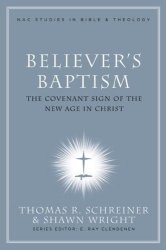
Believer’s Baptism and the Debate

Sign of the New Covenant in Christ, Click to orderRemember that debate we had around here on infant baptism vs. believer’s baptism? It was in Nov. and Dec. of 2005. (See this summary post on the debate.) Well there is a new book out which may prove helpful to anyone seriously considering the issue.

For most of my life I have just assumed believer’s baptism was correct, but when I began to seriously think and debate on the issue, I came to understand that the issue is not as hard and fast as I once thought. Part of this stems from my new understanding of Calvinism and Reformed doctrine. I am now much more open to the Reformed doctrine of infant baptism (which is not at all a baptismal regeneration view), but I remain Baptist still. However, I have determined I need to do more research in this area, and this book looks like it should be one I study.

There is an interesting interview of Tom Schreiner, one of the editors, on Justin Taylor’s blog which is worth reading if you are conversant with the debate (the comments are interesting as well). It also links to an interesting article written by Bob Stein on the subject as well.

I am going to list the chapters and contributors from the book below. Feel free to provide any feedback on the debate in general or this book in particular.

Author Preface

Foreword
Timothy George

Introduction
Thomas A. Schreiner and Shawn D. Wright

1. Baptism in the Gospels
Andreas J. Köstenberger

2. Baptism in Luke-Acts
Robert H. Stein

3. Baptism in the Epistles: An Initiation Rite for Believers
Thomas R. Schreiner

4. Baptism and the Relationship between the Covenants
Stephen J. Wellum

5. Baptism in the Patristic Writings
Steven A. McKinion

6. “Confessor Baptism” : The Baptismal Doctrine of the Early Anabaptists
Jonathan H. Rainbow

7. Baptism and the Logic of Reformed Paedobaptists
Shawn D. Wright

8. Meredith Kline on Suzerainty, Circumcision, and Baptism
Duane A. Garrett

9. Baptism in the Stone-Campbell Restoration Movement
A. B. Caneday

10. Baptism in the Context of the Local Church
Mark E. Dever [HT: Justin Taylor]

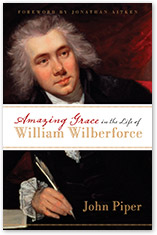
“Amazing Grace in the Life of William Wilberforce” by John Piper

I have finished Piper’s little book Amazing Grace in the Life of William Wilberforce. It was excellent! You should look into getting some for evangelistic reasons, as people will be interested when you tell them that this is the 200th anniversary of the banning of the slave trade (by Britain).

The last two chapters were most captivating, as they looked into Wilberforce’s contagious Christian joy and his beliefs on the importance of doctrine. Again, the book is available to read for free online, and it would be well worth your time.

I would like to provide some excerpts here as I can’t help but spread some wisdom from Wilberforce.

My grand objection to the religious system still held by many who declare themselves orthodox Churchmen…is, that it tends to render Christianity so much a system of prohibitions rather than of privilege and hopes, and thus the injunction to rejoice, so strongly enforced in the New Testament, is practically neglected, and Religion is made to wear a forbidding and gloomy air and not one of peace and hope and joy. [Wilberforce in response to someone expressing their mistrust of joy. (pg. 62 in Amazing Grace in the Life of William Wilberforce, by Piper)]

A Prayer during a season of darkness, when he was fighting for joy:

Lord, thou knowest that no strength, wisdom or contrivance of human power can signify, or relieve me. It is thy power alone to deliver me. I fly to thee for succor and support, O Lord let it come speedily; give me full proof of thy Almighty power; I am in great troubles, insurmountable by me; but to thee slight and inconsiderable; look upon me O Lord with compassion and mercy, and restore me to rest, quietness, and comfort, in the world, or in another by removing me hence into a state of peace and happiness. Amen. [pg. 64]

Pleasure and Religion are contradictory terms with the bulk of nominal Christians. [pg. 64]

[It is a] “fatal habit to consider Christian morals as distinct from Christian doctrines.” [pg. 72]

From Piper’s conclusion to the book:

Is it not remarkable that one of the greatest politicians of Britain and one of the most persevering public warriors for social justice should elevate doctrine so highly? Perhaps this is why the impact of the church today is as weak as it is. Those who are most passionate about being practical for the public good are often the least doctrinally interested or informed. Wilberforce would say: You can’t endure in bearing fruit if you sever the root.

…Wilberforce lived off the “great doctrines of the gospel,”….This is where he fed his joy….The joy of the Lord became his strength (Neh. 8:10). And in this strength he pressed on in the cause of abolishing the slave trade until he had the victory.

Therefore, in all our zeal today for racial harmony, or the sanctity of human life, or the building of a moral culture, let us not forget these lessons: Never minimize the central place of God-centered, Christ-exalting doctrine; labor to be indomitably joyful in all that God is for us in Christ by trusting his great finished work; and never be idle in doing good—that men may see our good deeds and give glory to our Father who is in heaven (Matt. 5:16).

This book is available for purchase at the following sites: Amazon.com or direct from Crossway.

Amazing Grace and Martin Luther King Jr. Day

Many Christians, especially strongly conservative Christians, begrudge the celebration of Martin Luther King Jr. Day. I know I did (at one time). I, along  with others, lamented that President’s Day or the birthdays of Lincoln and Washington were not given as much press and esteem as MLK Day. And I bought into  rumors concerning the underhanded tactics of King, as a way to discount any reflection on his life. And  I learned little of his life or his cause in the Christian education I received growing up.

My freshman year at college, however,  when we had two freshman black male students (which was much more than normal for our fundamentalist institution), the typical disdain for MLK Day did not go over very well. They were alarmed and incensed that us “white boys” could not or would not esteem MLK. Of course none of us white boys owned up to any degree of racist tendencies in ourselves either. We treated everyone the same, we thought, and since we were white, we never felt the truth to be otherwise.

Since leaving fundamentalist circles, I have come to appreciate the issue of racial harmony and racial justice much more. This is in large part to our church which takes a stand for racial harmony, and our pastor (John Piper) who preaches one or two messages on the topic each year around MLK day. You see, it is easy for me, a “white boy”, to go through many days without thinking of the issue at all. But for blacks, in countless  though often subtle ways, they are reminded of the issue day in and day out.

This post is not going to explore the issue any more than this. If you’d like to do so, check out the list of sermons and articles on the topic available at Desiring God. Instead this post wants to highlight a less well known hero in the matter of racial justice: William Wilberforce.

Amazing Grace in the Life of William Wilberforce by John Piper -- Click to orderWilliam Wilberforce was the man most responsible for stopping slavery in Great Britain. As a member of Parliament, he fought 20 years to end the slave trade, and then another 26 years to make slavery itself illegal. This year, we are coming up on the 200th anniversary of the ending of the slave trade in Britain. Feb. 24th 2007 it will be 200 years. In honor of this milestone, a movie will be released in February entitled “Amazing Grace: The William Wilberforce Story”. I have heard that it will be quite good and historically accurate. You can check out the movie’s website and trailer here.

John Newton, as you know, wrote that most famous of songs: “Amazing Grace”. But you may not know that at one time he was himself a captain of a slave trading ship. In fact he ended up becoming a white slave himself for a time. Newton was a friend of Wilberforce, and truly the outlawing of slavery is an act of amazing grace: hence the title for the movie.

With the day off today, I have been reading through a new book by John Piper on this very subject. It is entitled Amazing Grace in the Life of William Wilberforce. It  was timed to be available in conjunction with the movie’s release, and you can order a copy (or copies) here. You can even read it online here.

The book highlights the amazing life of Wilberforce. William was a truly evangelical Christian and he endured despite tremendous opposition for decades in his fight to end slavery precisely because he was Christian. In today’s world where Christianity is so despised, it is good to remember that the end of slavery is one of Christianity’s gifts to the world! Piper highlights what made Wilberforce tick, and the answer will surprise you. Wilberforce thought the “peculiar doctrines” of Christianity were essential for proper morals and public morality. He despised the divorcing of doctrine from Christian ethics which in his day was already becoming popular. And Wilberforce, as Piper would term it, was a Christian Hedonist. He prized the importance of a deep joy in God.

So on this Martin Luther King Jr. Day, stop and ponder the issues of racial harmony in your own life. And pause and reflect on God’s wonderful grace in Wilberforce’s life. Again, the book is available online for free (as a pdf file). So when you have some time this week give it a read (it is short, only about 75 pages).

Atonement Addendum: Grudem’s Clarifications and Cautions

We have recently been explaining (and debating) the Reformed doctrine of particular redemption, also known as definite atonement or more popularly, limited atonement. And while my post on Calvinism and evangelism follows on the heels of that post, it really was in the works before that whole debate started. But since we are talking about Calvinism in general, and limited atonement in particular (no pun intended), I felt we would do well to heed some clarification and caution from Wayne Grudem on this subject.

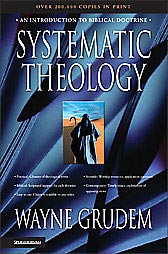
If you are unfamiliar with Wayne Grudem, he is worth getting to know. He is a very influential conservative scholar, of a breed which is sadly becoming all to increasingly rare these days! He takes firm positions on hotly debated topics: he defends God’s sovereignty against open theism, and is a prime mover in the defense of complementarian views against the egalitarian or feminist position [this is the debate over women pastors and male headship in marriage]. He also has criticized some of the more liberal translations regarding their gender neutrality, being also a principle promoter of the English Standard Version. You can learn more about him here.

Get this book!!!But perhaps his greatest contribution has been his wonderful Systematic Theology. The book is certainly technical enough to require theologians to interact with its views, yet it is designed for the average church goer, too. Grudem firmly believes that it is the call of every church member to study theology. Proper doctrine is not only for theological professionals to be concerned about. And the book does wonders for making the study of systematic theology accessible to everybody. Each chapter ends with “Questions for Personal Application” and includes a helpful index so one can find sections which cover the same material in the other major Protestant and Catholic systematic theologies. Each chapter also includes a hymn, because Grudem believes theology should move our hearts. In fact the book does just that. Doctrine is not merely analyzed in a test tube, so to speak. Application and personal involvement with the truth presented is made throughout.

Another helpful quality of Grudem’s book is its fairness to opposing views. Grudem is Reformed, but he doesn’t anathematize every other view. He quotes from first hand sources and does his best to present the chief arguments of his opponents, rather than creating a bunch of straw men. He is also careful to tread lightly at times. Rather than making bold assertions, he leans toward one view or another, while honestly acknowledging that a particular topic is open to alternative understandings.

It is just this aspect of the book which really helps us with our current discussion. Pages 601-603 provide “points of clarification and caution regarding [limited atonement]”. And from these I want to stress two points, which are pertinent for us in the discussion that is still hanging in the air concerning this doctrine.

First, we need to be careful with how we phrase things. Many a Calvinist, myself included, is comfortable with the phrase “Christ died for his people only”. But by this I actually mean (according to Grudem) “Christ died to actually pay for all the sins of his people only”. The former phrase is often interpreted or understood by non-Reformed people to be saying “Christ died so that he could make the gospel available only to a chosen few”. And since this is not the case, and we don’t want to communicate that idea, we Calvinists should opt for the more precise phrase, rather than the simpler expression.

Similarly, we should not get bent out of shape over the phrase “Christ died for all people”, because that phrase is true if it means “Christ died to make salvation available to all people” or “Christ died to bring the free offer of the gospel to all people”. Grudem claims that Scripture itself uses such language (the first phrase) in places like John 6:51, 1 Tim. 2:6, and 1 Jn. 2:2. And often when a Calvinist is speaking pastorally, he may use the former phrase rather than the latter one. Grudem goes on to deal with the objection that some Reformed people have to the indiscriminate use of the former phrase, and it is worth the read, but we will move on here.

Secondly, Grudem stresses that both sides of the limited atonement debate agree that people will not be saved without actually believing in Christ. And both sides “want to avoid implying that there might be some people who come to Christ for salvation but are turned away because Christ did not die for them.” Both sides agree the offer of the gospel is a genuine bonafide offer: all who come/believe will be saved. Therefore, we should not make too much out of this whole debate. Grudem says,

…Scripture itself never singles this out as a doctrine of major importance, nor does it once make it the subject of any explicit theological discussion….In fact, this is really a question that probes into the inner counsels of the Trinity and does so in an area in which there is very little direct scriptural testimony—a fact which should cause us to be cautious….

That is all I have from Grudem for you, but you would do well to read those pages for yourself. Since I believe that reading them might help you to convince you to buy the book yourself, let me show you a way to view those pages online. This may not work for you, but it did for me. First, go here (Google Booksearch). Second, search [in the search box on the right of the display] for the following three phrases. They will each bring up links to view the pages in question (601, 602, and 603). However, they will only let you see one page at a time. Here are the phrases (be sure to put them in quotation marks when you search): “rightly object to the way in which some advocates of particular” “unbelievers simply do not reason that way” and “ultimate cause of the atonement is found in the love”. One more note: if you click on the picture above, you will be able to order the book.

Before I go, let me recommend a fascinating interview of Wayne Grudem by Christian blogger Adrian Warnock. Here is the summary post providing links to all 9 parts and more regarding the interview.

The points gleaned from Grudem borrow heavily from pgs. 601-603 of Systematic Theology. Anything within quotes in that section is a verbatim quote from these pages.