“Legacy of Sovereign Joy: God’s Triumphant Grace in the Lives of Augustine, Luther, and Calvin” by John Piper

I recently finished John Piper’s The Legacy of Sovereign Joy: God’s Triumphant Grace in the Lives of Augustine, Luther, and Calvin.

John Piper’s biographies are written with a pastor’s eye and so are more than just the story of a famous individual. Rather, they focus on how the person ticked, and how they lived for Jesus. This book looks at 3 great men in the history of the Church, and even though each man had serious flaws, Piper points out the evidences of God’s grace and how these men were used so mightily for God.

I am going to spread this review over 3 posts and look briefly at the lives of each character. May God bless us as we see Him in these men. [Update: I only did 2 posts, this one on Augustine and one on Luther. One day I may finish this series…]

Augustine

Augustine is a difficult character to study because he has been so influential in both the founding of Roman Catholicism, with its undue emphasis on sacraments and the Church, and the birth of the Reformation, with its praiseworthy emphasis on the authority of Scripture and salvation by grace through faith. In the eyes of many historians Augustine is the most influential figure in all of Church History after Christ and Paul. Benjamin Warfield helps us with this comment, “The Reformation, inwardly considered, was just the ultimate triumph of Augustine’s doctrine of grace over Augustine’s doctrine of the Church.” (quoted in Legacy pg. 25)

Many conservative Christians can not get past Augustine’s contribution to Roman Catholicism and so they have no appreciation for his life. What many do not know is that Augustine has one of the greatest stories of conversion in the history of the Church.

Despite the prayers and pleadings of his mother, Augustine started out on a life of sin. He studied philosophy and indulged in the pleasures of a mistress or concubine, living with the same woman for 15 years. In time God moved him from Carthage to Milan where he was influenced by the Christ-centered preaching of Ambrose. He came to understand and even intellectually believe in Christianity but could not submit to Christ due to his sexual passions. It will be best to let Augustine tell his own story:

I flung myself down beneath a fig tree and gave way to the tears which now streamed from my eyes…. In my misery I kept crying, “How long shall I go on saying ‘tomorrow, tomorrow’? Why not now? Why not make an end of my ugly sins at this moment?”… All at once I heard the singsong voice of a child in a nearby house. Whether it was the voice of a boy or a girl I cannot say, but again and again it repeated the refrain “Take it and read, take it and read.” At this I looked up, thinking hard whether there was any kind of game in which children used to chant words like these, but I could not remember ever hearing them before. I stemmed my flood of tears and stood up, telling myself that this could only be a divine command to open my book of Scripture and read the first passage on which my eyes should fall.

So I hurried back to the place where Alypius was sitting… seized [the book of Paul’s epistles] and opened it, and in silence I read the first passage on which my eyes fell: “Not in reveling and drunkenness, not in lust and wantonness, not in quarrels and rivalries. Rather, arm yourselves with the Lord Jesus Christ; spend no more thought on nature and nature’s appetites” (Romans 13:13-14). I had no wish to read more and no need to do so. For in an instant, as I came to the end of the sentence, it was as though the light of confidence flooded into my heart and all the darkness of doubt was dispelled.

[quoted Legacy pg. 53 from Augustine’s Confessions pg. 177-178 (VIII, 12)]

After this experience, Augustine’s life was transformed, he submitted to baptism and eventually became a priest and then bishop of Hippo.

What Piper focuses on in this book is how Augustine said it was the superior joys of God which drove him from the “fruitless joys” of sin. God, to Augustine, was “sweeter than all pleasure”. Piper calls this the “liberating power of holy pleasure”. And even as he describes Augustine’s stalwart defense of sovereign grace against the threat of Pelagius (who denied original sin and claimed people could be saved apart from Christ), Piper highlights Augustine’s treatment of joy.

I would very much encourage you to read this book. And follow me in purposing to pick up Augustine’s Confessions and read his story from his own lips. Augustine should challenge us to be so satisfied and thrilled with God and “the joy of the Lord”, that we forsake all other joys to know Him more fully.

Let me leave you with a quote which summarizes Augustine’s joyful, God-centered theology.

A man’s free-will, indeed, avails for nothing except to sin, if he knows not the way of truth; and even after his duty and his proper aim shall begin to become known to him, unless he also take delight in and feel a love for it, he neither does his duty, nor sets about it, nor lives rightly. Now, in order that such a course may engage our affections, God’s “love is shed abroad in our hearts” not through the free-will which arises from ourselves, but “through the Holy Ghost, which is given to us” (Romans 5:5).

[quoted in Legacy 59-60]

See part 2 of this review.

This book is available for purchase at the following sites: Amazon.com or direct from Crossway.

Bobspotted Blogroll: August 25, 2007

Before we jump in to the blog posts I’ve been spotting lately, let me remind you of Bob’s Blog Finds. In my sidebar you’ll notice that I show the last 10 posts I’ve shared from my blog reading. The posts I share there don’t always make it to these blogroll posts, but they are worth a read. You can subscribe to my blog finds, or view them all in one static webpage. Then again, you can just wait for my sporadic blogroll posts!
Oh, one more thing. We still need 5 more guys for a fantasy football league. The league is open to anyone who reads and enjoys this blog. So please, join us for some football!

CALVINISM & ESCHATOLOGY

PERSEVERANCE, WARNINGS & THE GOSPEL

  • The Cross and Obedience. Tony Reinke of The Shepherd’s Scrapbook writes on how the grace and obedience work together in daily life. Excellent.
  • Essential reading on the warning passages from Expository Thoughts. Seriously this really explains why God would bother with the serious warning passages in Scripture, even though the elect are eternally secure. This is especially good in light of our man-centered Christianity series, where my next post will center on perseverance.
  • Speaking of that series, you may be interested in two excellent posts on the relationship between the Gospel and the Kingdom (part 1 & part 2). The following posts by Nahtan Mihelis are thought provoking and reveal how shallow our understanding of the gospel really is in today’s culture.
  • Living the gospel with your family always is difficult, but Tony at The Shepherd’s Scrapbook points out an excellent post on encouraging your kids. Its good reading.

BOOKS, READING & REVIEWS

ONLINE GOODIES

COMICS & MOVIES & STUFF

LEGALISM & LIBERALISM

PRAYER

EVOLUTION

MOTHER TERESA

“This book will reveal that there is a deep Christian spirituality that includes doubt and darkness and unbelief. There were times when Mother Teresa was tormented. But it doesn’t have to be that way. We can come to terms with the belief and unbelief that coexists in our lives and know that we are not alone. Our prayer is simple: Lord, I believe. Help my unbelief.”

SPORTS & MISCELLANY

Jesus’ Demands — Fear Him Who Can Destroy Both Soul And Body in Hell (#11)

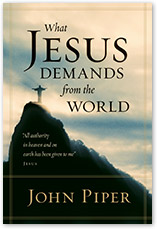
Click to orderNote: these are devotional posts based on John Piper’s new book What Jesus Demands from the World.

This post is number 11, because I started the series a while ago. If you like this post, check out the other posts in the series. But most importantly get the book (it’s also available to read online)!

Now, on the heels of demand #10 Rejoice and Leap for Joy, comes a more startling and sobering demand…

Demand #11 — Fear Him Who Can Destroy Both Soul And Body in Hell

And do not fear those who kill the body but cannot kill the soul. Rather fear him who can destroy both soul and body in hell. (Matthew 10:28)

But as for these enemies of mine, who did not want me to reign over them, bring them here and slaughter them before me. (Luke 19:27)

Then he will say to those on his left, “depart from me, you cursed, into the eternal fire prepared for the devil and his angels.” . . . And these will go away into eternal punishment, but the righteous into eternal life. (Matthew 25:41, 46)

The Awful Place Called Hell

It’s fashionable these days to downplay Hell. Many “evangelical” leaders are denying its existence, suggesting it is not eternal, or claiming there is no actual fire in Hell. Some claim it is a state of mind, or that hell is on earth.

In fact, this very Sunday, on Good Morning America, I heard an interview of an influential (former?) evangelical pastor who has changed his mind about hell, claiming it is here on earth, and a mere creation of superstitious man. ABC is going to be dedicating a 20/20 special this Friday to the topic of Hell. I can already guess their conclusions!

Sadly, these same evangelical leaders claim to be following the example of Jesus. But don’t they realize that Jesus didn’t share their view of Hell? Jesus spoke of hell more than anyone else in Scripture.

He refers to it as a terrible place to be feared. A place of “outer darkness” with “weeping and gnashing of teeth” (Matt. 8:12). He describes it as a “fiery furnace”, with “unquenchable fire” (Matt. 13:41, Mark 9:44). It is the “eternal fire prepared for the devil and his angels” (Matt. 25:41).

And worst of all, Hell is eternal. Jesus describes it as a place of “eternal punishment”. On this point let me quote John Piper,

This last description–“eternal punishment”–is especially heartrending and fearful because it is contrasted with “eternal life.” “These will go away into eternal punishment, but the righteous into eternal life.” In this contrast we hear the tragedy of loss as well as suffering and endlessness. Just as “eternal life” will be a never-ending experience of pleasure in God’s presence, so “eternal punishment” will be a never-ending experience of misery under God’s wrath (John 3:36; 5:24).

A Passive Hell ?

At this point, many a sincere believer tries to lessen the full effect of this teaching by claiming that Hell is “a mere natural consequence of bad choices”. People do consciously reject God’s free offer of salvation made in the gospel, and this choice does lead to hell. But Piper is quick to point out that such is not the whole story.

People make choices that lead to hell. But it is not the whole truth. Jesus says these choices are really deserving of hell. “Whoever says, ‘You fool!’ will be liable to [that is, guilty of, or deserving of] the hell of fire” (Matt. 5:22). That is why he calls hell “punishment” (Matt. 25:46). It is not a mere self-imposed natural consequence (like cigarette smoking leading to lung cancer); it is the penalty of God’s wrath (like a judge sentencing a criminal to hard labor).

The Biblical picture of hell, is of a just God pouring out righteous anger and wrath over sin. God sends people to hell, and Jesus is pictured in Revelation and Isaiah as the One Whose garments get stained with the blood of his enemies as He “tread(s) the winepress of the fury of the wrath of God the Almighty” (Rev. 19:15b with Is. 63:3 and Rev. 14:20).

Fear, But Don’t Fear

We are to fear God as a holy Judge indeed. So is Jesus calling us to a “life of anxiety that God is angry with us and is ready to punish us at the slightest misstep”? No! Piper highlights the very next few sentences which follow on the heels of Jesus’ admonition to fear God.

. . . Fear him who can destroy both soul and body in hell. Are not two sparrows sold for a penny? And not one of them will fall to the ground apart from your Father. But even the hairs of your head are all numbered. Fear not, therefore; you are of more value than many sparrows” (Matt. 10:29-31, emphasis added — compare also Luke 12:4-7).

Piper says,

In the same breath Jesus says, “Fear God who casts into hell” and “Do not fear because God is your Father who values you more than the sparrows and knows your smallest need.”. . . How does Jesus mean for us to experience these two truths about God–he is to be feared, and he is to be trusted? It won’t do to simply say that “fear of God” means “reverence for God” rather than “being afraid of him.” That does not fit with the words, “Fear him, who, after he has killed, has authority to cast into hell. Yes, I tell you, fear him!” (Luke 12:5) . . . The key is that God himself is the one who removes his wrath from us. Our peace does not come from our removing the God of wrath from our thinking, but from his removing his wrath from us. . . .

The Seriousness of Sin

There is a beautiful encouragement to trust God as a loving Father in this text, but there is also a serious warning about the seriousness of sin. Piper says that this demand of Jesus “teaches us to see sin as more serious than we ever dreamed”. That unforgiven sin leads to hell, makes sin serious indeed.

But I am so prone to excuse my sin, and I suspect you are too. Yet both of us enjoy casting stones at others. The key in appreciating the justness of Hell according to Piper is seeing God as He really is. Let me quote him now.

Therefore, the seriousness of sin arises from what it says about God. God is infinitely worthy and honorable. But sin says the opposite. Sin says that other things are more desirable and more worthy. How serious is this? The seriousness of a crime is determined, in part, by the dignity of the person and the office being dishonored. If the person is infinitely worthy and infinitely honorable and infinitely desirable and holds an office of infinite dignity and authority, then rebuffing him is an infinitely outrageous crime. Therefore it deserves an infinite punishment.

The Place of Fear

For us Christians, especially those of us who are conservative doctrinally, this article has so far been easy. We have applauded it from the peanut gallery. Hell is real, sinners need to fear God and accept the provisions made for them according to the Gospel. Amen.

But if you notice, Jesus is directing his remarks to his disciples. This is plain from both Matthew and Luke’s accounts. So what does this message have to speak to us?

While we don’t need to be continually fearing God as unbelievers, we do need to fear unbelief. Sin is in essence, unbelief. When we disbelieve God’s promises, we give in to the appeal of sin. The demand to fear God, is a call for us to realize how serious sin really is. Let me quote Piper at length on this point.

What then is left to fear? The answer is unbelief. For those who follow Jesus, fearing God means fearing the terrible prospect of not trusting the one who paid such a price for our peace. In other words, one of the means that God uses to keep us peacefully trusting in Jesus is the fear of what God would do to us if we did not believe. The reason we do not live in the discomfort of constant fear is because we believe. That is, we rest in the all sufficient work of Jesus and in our Father’s sovereign care. But at those moments when unbelief tempts us, a holy fear rises and warns us what a foolish thing it would be to distrust the one who loved us and gave his Son to die for our anxiety-free joy.

This message is not popular today. People would rather believe that once they commit to Christ, they are eternally secure and can coast through life. This is not necessarily true, as the abundant Scriptural warnings to persevere and “endure to the end” contest.

What trips up many on this point is that they conclude that if you believe it is potentially possible that you are not sincerely a believer, that you could possibly fall away from the faith (and thereby evidence that you never were a true believer), then the Christian life must just be all about our works. If we really have to fear God in this way, we must be continually depending on our efforts to keep believing.

It is true that some pervert the Biblical doctrine of perseverance into just such an introspective self-effort. But this is a perversion of the true doctrine. Piper says concerning fear: “This is the best effect of fear: It wakens us to our need for help and points us to the all-sufficient Redeemer, Jesus.” A true understanding of the perseverance of the saints will lead one to depend all the more on Jesus as our only sure hope of eternal life. Those who believe themselves beyond the possibility of falling (contrary to 1 Cor. 10:12), can tend to trust on their own work of believing in Christ and are tempted to not cling all the more earnestly to Christ day in and day out. For more on the idea of perseverance, check out these posts I have done on the topic.

So to conclude, we are to fear God because He can destroy us in Hell. Yet at the same time because of Jesus’ blessed sacrifice on our behalf, we don’t have to fear God as a distant and holy Judge, but we can lovingly trust him as a loving and caring Father. All praise to the Lamb for bringing us to God, and giving us such a wonderful relationship with our Heavenly Father.

—See all posts on, the Demands of JesusAddThis Social Bookmark Button

“With One Voice: Singleness, Dating & Marriage to the Glory of God” by Alex & Marni Chediak

I’ll get right to it. With One Voice: Singleness, Dating and Marriage to the Glory of God by Alex & Marni Chediak is one of the best books I’ve read in a while. Aside from skillful wordsmithing and intuitive organization, the book hits a home run when it comes to addressing the topic at hand.

There are not too many books out there which deal with how to find a mate, yet are written from a wholly Christian and Biblical perspective. And even then, some of the books which qualify as Biblical and Christian major on a specific dating (or anti-dating) method to the detriment of a well-rounded Christian philosophy of dating in general. This book provides just that: a distinctly Christian approach to the philosophy of singleness, dating, and marriage.

Alex Chediak, with the help of his wife Marni, begins the book by detailing the pervasive cultural changes which influence our view of dating. He shows how a changing job market has spread out families, and focused on the value of individuals in the marketplace. Technological and commercial advances have coupled with the increasingly personalized society to lure courtship from the parents’ front porch to the drive-in movie theater and eventually to live-in relationships. The Chediaks also highlight how the new concept of delayed adolescence gave room for today’s entertainment and me-oriented culture. One widespread result of these cultural changes is the tendency for young adults to remain single until they are almost 30. Confronted with these changes, which certainly threaten a Christian view of marriage and sexuality, Alex doesn’t just settle for an appeal to bring back the golden days of yesteryear. He calls such nostalgic responses “unwarranted and misplaced”, which often “fall short of addressing the heart issues”. Men have always been sinful. The Christian response should be to study culture with a view of applying Biblical principles in such a way as to redeem and confront it.

After setting the stage, the book goes on to emphasize that marriage should be normal. Excepting those gifted for lifelong singleness, marriage is God’s will for the Christian young person. That being the case, cross-gender relationships should not be all about fun and enjoyment, rather they should be intentionally focused on the reality of marriage. Before detailing how a single adult should go about finding a mate, Alex & Marni lay an important foundation by discussing a Biblical view of masculinity and femininity, and the concepts of leading and submitting. They do this, because one of the book’s primary themes is for singles to focus on becoming the right kind of person first, before looking for the right potential mate.

The wisdom of the Chediaks shine through in the final two chapters detailing how to “choose [a mate] wisely” and “proceed carefully” with your relationship. There is a wealth of wisdom available as they discuss objective and subjective considerations necessary in a prospective mate, and the intentional and careful progression of a relationship. There couldn’t be a more practical “how to” book for this process, yet at the same time the book gives plenty of space for a variety of methods to be used. Instead of a detailed prescription, the book offers an undergirding framework of Bibilical principles upon which to erect a healthy and successful, Biblically faithful relationship.

This book comes at the marriage issue from a Biblically faithful, conservative theology. It does not offer a theological defense of a complementarian view of masculinity and femininity. Nor does it defend the Biblical priority of marriage and denial of extra-marital sexual activity. Instead it assumes these views and aims to be very practical. This in good part forms the strength of the book. It helps you think Biblically about marriage and dating, and supports you in your quest for a godly mate. I wish I had such a book when I was thinking through my own dating philosophy. It would have saved me much time and grief in thinking through such things on my own!

There isn’t much to say by way of criticizing the book. Perhaps it could have brought up the influence of the romantic movement in the 1800s on society’s present view of dating and marriage. Also some of the statistics on page 22 are a little hard to follow. But all in all, this is a fantastic book. It is extremely easy to read, with large font and a well-written, fast moving arrangement. It is a short read, being only about 140 pages long; yet it will be an incredibly profitable read. I recommend the book to singles everywhere of any age, and also to youth pastors, pastors and parents. Indeed, there is much wisdom available even for those singles who feel especially frustrated in finding a mate. So by all means get this book, you’ll thank me later!

Note: you can learn more about the authors and the book here.

Disclaimer: This book was provided by the author. The reviewer was under no obligation to offer a positive review.

This book is available for purchase at the following sites: Westminster Bookstore, Amazon.com, or direct from Christian Focus.

Desiring God Book Sale

$5 Book Sale!I thought you all should know that Desiring God is having a special book sale for 2 days only. Tomorrow, June 27th through the 28th, every book at desiringgod.org will be priced at the incredibly low price of $5!

Just go to Desiring God’s online store to take advantage of this deal. Also, note it is an online deal only.

This is a great time to check out what Desiring God offers. Pick up one of Piper’s biography books, or order What Jesus Demands from the World. Purchase the recent ECPA Gold Medallion winning Don’t Waste Your Life. Or you can go for Piper’s earlier books, Let the Nations Be Glad and Desiring God. There are many more titles, so take advantage of the sale!