Quotes to Note 2: The Importance of Wicked Step-mothers

I recently added a books widget from GuruLib (check out my “Books I’m Reading” section in my sidebar). And one of the books I note that I’m reading is Planet Narnia: The Seven Heavens in the Imagination of C.S. Lewis by Michael Ward. I heard about the book from Justin Taylor’s blog, and the few pages I’ve read so far are fascinating.

In starting this book, I stumbled over a quote which has grabbed my attention. As a father of four daughters, the oldest being 4 (and a half), and as one who enjoys a good tale, I found this quote equally insightful and inspiring. It is from the contemporary British philosopher Alasdair MacIntyre from his book After Virtue:

It is through hearing stories about wicked stepmothers, lost children, good but misguided kings, wolves that suckle twin boys, youngest sons who receive no inheritance but must make their own way in the world, and eldest sons who waste their inheritance on riotous living and go into exile to live with the swine, that children learn or mislearn both what a child and what a parent is, what the cast of characters may be in the drama into which they have been born and what the ways of the world are. ¹

What do you think? I think he is making an important point, and stories are more important than we realize.

 ¹ Ward quotes a portion of this quote on pg. 3 in his book citing After Virtue: A Study in Moral Theory (London: Duckworth, 1985), pg. 216. My longer quote comes from a chapter by MacIntyre entitled “The Virtues, The Unity of a Human Life, and the Concept of a Tradition” in the book Memory, Identity, Community: The Idea of Narrative in the Human Sciences edited by Lewis and Sandra Hinchman (State University of New York Press: 1997) found with Google Book Search.

Quote to Note 1: Theology and Preaching

From time to time, I’ll be bringing Quotes to Note. Most often they will be quotes good enough to stand on their own two feet. And hopefully they will indeed be quotes worth noting.
Today’s concerns theology and preaching.

Theology without proclamation is empty, proclamation without theology is blind.

— Gerhard Ebeling

After providing this quote in his article “Preaching and Biblical Theology” for The New Dictionary of Biblical Theology (IVP, 2000), P. J. H. Adam elaborates:

So theologians should never be satisfied when their theology serves only the needs of the academy. Any theology, including biblical theology, must serve the Christian ministry of the word. Likewise preachers should not be satisfied when they have communicated only their own insight, the ideas of contemporary sociologists, or even current theories of Christian or church life. Nor should they be content with ritual repetition of a text of Scripture, reference to a token Bible verse, or preaching on a text to which they have not first applied Paul’s instruction to Timothy: “Reflect on what I am saying” (2 Tim. 2:7).

The dangers of the Western academic tradition are its assumptions that knowledge can be discovered only by those who share secular, naturalistic, or contemporary world views, and that knowledge is a satisfactory end in itself. These are damaging assumptions for any Christian academic to adopt, but particularly damaging for the theologian. Many preachers today, even many who know the Bible, do not use it in their preaching, or use it in a trivial way. We should not meet the challenge of postmodernism by abandoning the Bible, but by using it carefully, theologically and effectively. If we abandon theological reflection on the meaning of the text of the Bible, we will indeed be blind guides. ¹

 ¹ Pgs. 105-106, The New Dictionary of Biblical Theology, edited by T. Desmond Alexander, Brian S. Rosner, D. A. Carson, Graeme Goldsworthy & Steve Carter (Inter-Varsity Press: Downers Grove, Illinois, 2003).

 ² P. J. H. Adam is the Vicar of St. Jude’s Carlton, Melbourne, Australia. The quote by Gerhard Ebeling is from his book Theology and Proclamation (London, 1966), pg. 20.

Legacy of Sovereign Joy, cont.

This is the second part of a review of John Piper’s The Legacy of Sovereign Joy: God’s Triumphant Grace in the Lives of Augustine, Luther, and Calvin. Piper’s book is less a detailed biography and more a pastoral treatment of the lives of great saints. Augustine, Luther and Calvin—great men indeed in the history of the Church—yet each is human, and Piper shows us how they ticked, and why their lives shined for Christ.

Each of these men had flaws. We looked briefly at Augustine’s in part 1, and we cannot escape Luther’s. But God’s grace met these flawed men in such a way as to transform the world through them. With God still moving today, we can look to the lives of these men and find hope that God may stoop to use us, frail and human though we be.

Luther

Luther was a passionate and very emotional man. He lived in a harsh world, and was hounded on all sides as he helped lead one of the world’s true and great reformations. Perhaps this explains Luther’s harsh tongue. At times crude and almost vulgar, Luther knew how to use his tongue, and how to put his words down on paper. Piper does not try to explain away Luther’s tendency to be mean with his opponents, and he rightly calls “Luther’s sometimes malicious anti-Semitism” as “an inexcusable contradiction of the Gospel he preached” (Legacy, pg. 31).

Yet for all of Luther’s faults, he singlehandedly gave us the Reformation. And central to the Reformation stands the authority of the Bible, unfettered by church tradition. Luther in many ways recovered the true Scripture, which had been lost and obscured through Roman tradition and general neglect.

Luther prized Scripture since “the Holy Spirit himself and God…is the Author of this book” (quoted in Legacy, pg.78). He further said, “The Word of God is the greatest, most necessary, and most important thing in Christendom” (quoted in Legacy, pg. 79). The following comments on Psalm 119 show why Luther felt this way:

In this psalm David always says that he will speak, think, talk, hear, read, day and night and constantly—but about nothing else than God’s Word and Commandments. For God wants to give you His Spirit only through the external Word. (quoted in Legacy, pg. 78)

Piper draws from Luther’s emphasis on the Word, as well as his example of rigorous study of the Word, and encourages pastors to be students of Scripture:

The Word of God that saves and sanctifies, from generation to generation, is preserved in a book. And therefore at the heart of every pastor’s work is bookwork. Call it reading, meditation, reflection, cogitation, study, exegesis, or whatever you will—a large and central part of our work is to wrestle God’s meaning from a book, and then to proclaim it in the power of the Holy Spirit. (Piper in Legacy, pg. 79).

As one who preached often 2 or more times a day, Luther has much to say to today’s pastor. And Piper distills six primary lessons for the Pastor and his study from Luther’s life.

  1. Luther came to elevate the biblical text itself far above the teachings of commentators or church fathers.
  2. This radical focus on the text of Scripture itself with secondary literature in secondary place leads Luther to an intense and serious grappling with the very words of Paul and the other biblical writers.
  3. The power and preciousness of what Luther saw when he “beat importunately” upon Paul’s language convinced him forever that reading Greek and Hebrew was one of the greatest privileges and responsibilities of the Reformation preacher.
  4. Luther employed extraordinary diligence in spite of tremendous obstacles.
  5. For Luther, trials make a theologian. Temptation and affliction are the hermeneutical touchstones.
  6. Key to Luther are prayer and reverent dependence on the all-sufficiency of God. And here the theology and methodology of Luther become almost identical.

This last point is key. For all the emphasis on mental rigors and study, Luther remains like Augustine, dependent on a Sovereign God. Christian, faithful pastors study hard, but are often on their knees. I close with a final quote from Luther, let it encourage all of us to use this study method more often.

You should completely despair of your own sense and reason, for by these you will not attain the goal…. Rather kneel down in your private little room and with sincere humility and earnestness pray God, through His dear Son, graciously to grant you His Holy Spirit to enlighten and guide you and give you understanding. (quoted in Legacy, pg. 108)

This book is available for purchase at the following sites: Amazon.com or direct from Crossway.

Daily Devotions with Octavius Winslow

Most of you have heard of Morning & Evening by Charles Spurgeon. It is a compilation of devotional readings for morning and evening reading by the prince of preachers. While Spurgeon’s readings are excellent [I recommend the revised edition edited by Alistair Begg recently published by Crossway], he wasn’t the first to come up with the idea of a book of morning and evening devotional thoughts. Octavius Winslow (1808-1878), an English Baptist pastor, likewise published Morning Thoughts and Evening Thoughts.

Winslow (read this brief biographical sketch about him) has a gift for writing powerful, and spiritually moving devotional literature. His morning and evening thoughts are as good as Spurgeon’s if not better.

Like Spurgeon’s, Winslow’s devotions are also available for free online. You can click here for a list of all his books available online, or click these links for the specific devotional: Morning Thoughts, Evening Thoughts. For a sampling of Winslow’s writing, browse through the devotional thoughts above or click here for a collection of his best quotes.

I would encourage you to take the time to read one of Winslow’s devotional thoughts each day, even as you blog and do other things on line. I am going to try to do that, to make sure I’m feeding my soul, not just my brain. You may also find this article about Winslow and his works from The Shepherd’s Scrapbook helpful.

Let me leave you with a selection from earlier this week that I thought was especially good.

SEPTEMBER 1.

“He restores my soul.” Psalm 23:3

THE first point we would look at is the love of the Lord Jesus in restoring a wandering believer. Nothing but infinite, tender, unchanging love could prompt Him to such an act. There is so much of black ingratitude, so much of deep turpitude, in the sin of a believer’s departure from the Lord, that, but for the nature of Christ’s love, there could be no possible hope of His return. Now this costly love of Christ is principally seen in His taking the first step in the restoring of the soul: the first advance is on the part of the Lord. There is no more self-recovery after, than there is before, conversion; it is entirely the Lord’s work. The same state of mind, the same principle, that led to the first step in declension from God, leads on to each successive one; until, but for restraining and restoring grace, the soul would take an everlasting farewell of God. But mark the expression of David”””He restores my soul.” Who? He of whom he speaks in the first verse as his Shepherd”””The Lord is my Shepherd.” It is the Shepherd that takes the first step in the recovery of the wandering sheep. If there is one aspect in the view of this subject more touching than another, it is this””that such should be the tender, unchanging love of Jesus towards His wandering child, He should take the first step in restoring him. Shall an offended, insulted Sovereign make the first move towards conciliating a rebellious people?””that Sovereign is Jesus: shall an outraged Father seek His wandering child, and restore him to His affections and His house?””that Father is God. Oh, what love is that which leads Jesus in search of His wandering child! love that will not let him quite depart; love that yearns after him, and seeks after him, and follows after him through all his devious way, his intricate wanderings, and far-off departures; love that no unkindness has been able to cool, no forgetfulness has been able to weaken, no distance has been able to destroy!

Not less conspicuous is the power of Jesus in the restoring of the soul. “He restores my soul,”””He, the omnipotent Shepherd. We want omnipotence to bring us back when we have wandered; nothing less can accomplish it. We want the same power that converted to re-convert; the power that created, to re-create us: this power Jesus possesses. It was essential to the full salvation of His Church that He should have it; therefore, when praying to His Father, He says, “As You have given Him power over all flesh,”””why this power?”””that He should give eternal life to as many as You have given Him.” It was necessary that He should have power over all flesh, yes, over all the powers leagued against the Church, that He should bring to glory all that were given to Him in the covenant of grace.

Now this power is gloriously exerted in the restoring of the soul. Jesus works in the believer, in order to his recovery. He breaks down the hard heart, arrests the soul in its onward progress of departure, places upon it some powerful check, lays it low, humbles, abases it, and then draws from it the blessed acknowledgment, “Behold, I am vile; but he restores my soul.”

A Study Bible You’ll Use

If you are like me you have 2 or 3 study Bibles filed away on a bookshelf somewhere. They rarely get used; and when they do, they aren’t much help. I don’t know why, but study Bibles always seem better on the bookstore shelf than they actually are.

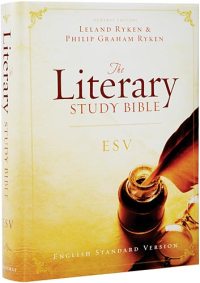
But I’ve found a study Bible I would actually use. It’s the new ESV Literary Study Bible by Leland & Phillip Graham Ryken.

I don’t own this Bible, but it is now on my wishlist. If the Bible lives up to the review Tony Reinke gave at The Shepherd’s Scrapbook, then I’m sure it is a must-have.

It stresses the literary aspect of the Bible which is so often overlooked, and it provides helpful prenotes, providing a preview of each section you are about to read.

I can do no more here than to encourage you to check out Tony’s review. Tony’s challenge is to go to your local bookstore, pick up the book and read the entire book of Job, notes and all. By then you’ll be convinced of the merits of this study Bible. He makes me want to go and do just that.