 NOTE: For an updated copy of this post, see the “Mining the Archives” post here.
Today’s popular evangelical maxim “once saved, always saved” while based in the Biblical truth of justification by faith alone has morphed into a virtual get-out-of-jail-free card for far too many. The church’s duty to make disciples of all nations has been downgraded to an optional extra. The gospel call to repent and believe has become a plea for sinners to assent to the facts of the gospel, pray a prayer, and join the cool Christian club called churchianity. Gone are the stern warnings to “watch and pray” and “endure to the end”. Gone are the bold exhortations to “make your calling and election sure” and “be diligent to be found in [Christ] without spot or blemish”. In their place are the warm assurances “since you confessed you are saved” and “since eternal life is a free gift, God cannot take it back”, and the friendly reminders “everybody makes mistakes” and “don’t sweat: remember, we’re under grace!” The old doctrine that saints must diligently make a personal effort to persevere in faith has been overshadowed by the new doctrine that saints can live just like anyone else in the world and as long as they once assented to gospel truths they are most certainly bound for heaven.
I wish I was merely exaggerating the situation. But when a nationally well known evangelical leader like Charles Stanley seriously believes and teaches that people who actually stop believing in Christ and walk out on God are still eternally secure, I can hardly be accused of overstating my case. In the article linked to above he claims, “The Bible clearly teaches that God’s love for His people is of such magnitude that even those who walk away from the faith have not the slightest chance of slipping from His hand.” He goes on to only deal with Eph. 2:4-9 and 1 Cor. 1:21, while adding in a good portion of reasoning and illustrations. In his book Eternal Security: Can You Be Sure? he makes the startling claim that salvation can be compared to receiving a tattoo. Even if moments later, you regret receiving the tattoo, it cannot change the fact that you have it! (pg. 80)
The Grace Evangelical Society exists to perpetuate such ideas. In other specters of evangelicalism, easy believism is represented by a 1-2-3-repeat-after-me approach to evangelism. A very large segment of independent fundamental Baptists (represented by literally thousands of churches and tens [if not hundreds] of thousands of members) emphasizes this approach to such excess that staggeringly huge numbers of salvations and baptisms are reported each year–which if really true, would make the Great Awakening look like a picnic. People are converted in five minutes or less–even through a rolled-down window during the duration of a stop light! One church has boasted of a milliion souls saved in the past 25 years, and yet less than 500 attend on any given Sunday.
Today no view seems criticized as much as Lordship Salvation or the Calvinistic doctrine of the Perseverance of the Saints. These views are very similar, if not synonomous and both share a strong critique. Charges of “works-salvation” or “perfectionism” are thrown mercilessly at these misunderstood views.
So how did we come to such a time and situation as this? It seems that in a mix of zeal and evangelistic fervor, popular Christianity began to move away from its confessional roots in the late 1800s. American individualism probably worsened the situation, as Sola Scriptura became the license for anyone and everyone to disregard centuries of theological formulations and church teaching and come up with a myriad of homespun theories. The lasting impact of Charles G. Finney, who rejected substitutionary atonement among other orthodox doctrines, also contributed to what became popular American revivalism. Today, people have hardly heard of many of the great Reformation confessions like the Westminster Confession or the Synod of Dort, and yet they are quick to find a proof text for a host of contradictory Biblical teachings.
Yet a misunderstanding of perseverance is not limited to Arminians and non-Calvinists today, either. Doug Wilson says it well in a recent post on Heb. 3:7-19:
Apostasy is a real sin, committed by real people. This is something that Arminians get, and that most Calvinists do not get. None of the elect can every [sic] be taken out of God’s electing and sovereign decree. This is something that Calvinists get, and that Arminians do not get. Arminians can read Romans 8 through 11 and not see the absolute sovereignty of God, which is something that never ceases to astonish me. But lest we Calvinists get on a high horse, Arminians can read though Hebrews and can see real apostasy there. There are few things more exegetically embarrassing than to hear a Calvinist talk about how the warnings are hypothetical, like “keep off the grass” signs in the middle of the Sahara. There are many things that can be said to this, but the most compelling of them is that the warnings invariably deny that they are anything like hypothetical….The sin warned against here is that of evil unbelief, pure and simple. Not only is it unbelief, it is unbelief resulting in apostasy — departure from the living God, falling away from the living God. The sin is spoken of in the sternest possible way — rebellion, hardened hearts, evil heart of unbelief, and a departure from God…..This book [Hebrews] is about the sin of apostasy. Can a Christian fall away? Yes. Can someone who is truly regenerate, elect of God, an eternal Christian, fall away? No, clearly not.
Before I go on to defend the Biblical (I believe) doctrine of perseverance, let me provide here a brief excerpt from John Piper’s book The Purifying Power of Living by Faith in Future Grace
 A few years ago I spoke to a high school student body on how to fight lust. One of my points was called, “Ponder the eternal danger of lust.” I quoted the words of Jesus–that it’s better to go to heaven with one eye than to hell with two–and said to the students that their eternal destiny was at stake in what they did with their eyes and with the thoughts of their imagination….After my message…one of the students…asked, “Are you saying then that a person can lose his salvation?”…This is exactly the same response I got a few years ago when I confronted a man about the adultery he was living in….I pled with him to return to his wife. Then I said, “You know, Jesus says that if you don’t fight this sin with the kind of seriousness that is willing to gouge out your own eye, you will go to hell”….As a professing Christian he looked at me in utter disbelief, as though he had never heard anything like this in his life, and said, “You mean you think a person can lose his salvation?”…So I have learned again and again from firsthand experience that there are many professing Christians who have a view of salvation that disconnects it from real life, and that nullifies the threats of the Bible, and puts the sinning person who claims to be a Christian beyond the reach of biblical warnings. I believe this view of the Christian life is comforting thousands who are on the broad way that leads to destruction (Matthew 7:13)….The main concern of this book is to show that the battle against sin is a battle against unbelief. Or: the fight for purity is a fight for faith in future grace. The great error that I am trying to explode is the error that says, “Faith in God is one thing and the fight for holiness is another thing….The battle for obedience is optional because only faith is necessary for final salvation.” (pg. 330-331 and 333)
Belief in perseverance does not negate the great truth that faith alone justifies and secures our eternal salvation. Rather it affirms with Martin Luther, “We are saved by faith alone, but not a faith that is alone.” Our works prove the sincerity of our faith, and are in this sense necessary. This is why so many passages teach that God will actually judge all mankind by their works. Without exception, Rom. 2:6-11 states: “He will render to each one according to his works: to those who by patience in well-doing seek for glory and honor and immorality, he will give eternal life; but for those who are self-seeking and do not obey the truth, but obey unrighteousness, there will be wrath and fury. There will be tribulation and distress for every human being who does evil, the Jew first and also the Greek, but glory and honor and peace for everyone who does good, the Jew first and also the Greek. For God shows no partiality.” The reason this does not teach works salvation is that when we come to God in faith (as a result of his work of regeneration in our hearts–John 1:13 and 1 Jn. 5:1, and his gifts of faith–Acts 3:16, 15:9, 18:27, 1 Pet. 1:21, Phil. 1:29, Eph. 1:19-20, 2 Pet. 1:1 and repentance–Acts 5:31, 11:18, 2 Tim. 2:25) he begins a good work in us (Phil. 1:6) and will be the One to complete it. He will produce good works in us as a testimony of the genuineness of our faith–Eph. 2:10, Phil. 2:13, 1 Cor. 15:10, 1 Thess. 5:23-24, Jude 24, Tit. 2:14.
In other words, true regeneration produces true fruit. This is Jesus’ teaching in Matt. 7:18-19 “A healthy tree cannot bear bad fruit, nor can a diseased tree bear good fruit. Every tree that does not bear good fruit is cut down and thrown into the fire.” In the parable of the sower, the only soil which produced fruit was the good soil. Even thought the rocky soil produced plants which looked healthier than the fruitful plants, they bore no fruit and withered away. Jesus said this represents those “who receive [the word] with joy…but…have no root: they believe for a while, and in time of testing fall away.” The clear teaching of the parable is that transient faith does not save. Only the faith that bears fruit saves.
In understanding perseverance, it is important to recognize the difference between justification and glorification. Justification is the legal pronouncement of “not guilty” which happens immediately upon our faith and is based on Christ’s substitutionary atonement. This pronouncement is a voice from heaven, so to speak, concerning our hearts. The testimony from earth (our lifestyle) does not unfalteringly reflect this. Sanctification is a slow and gradual process of the out-working of our faith and the living out of our justification. Glorification is the point when we are gloriously tranformed into Christ’s image immediately after our death. At this point salvation is final. Up until then, since we cannot enter heaven’s throneroom and hear the irreversible verdict of “not guilty” applied to us, we must trust in sanctification to prove the genuineness of our faith. The term “salvation” is most often used in Scripture to refer to our glorification and only sparingly used to refer to justification. So when we see the English words “whoever believes will be saved” it usually is teaching that whoever believes will one day ultimately be saved/glorified. The Greek tense used for “believe” most often (99% or more of the time) in such statements is the present tense which directly conveys a continual action. Literally, it is often stated, “the believing one will be saved”. If we walk away from faith and cease believing we prove to not be a “believing one”.
Perseverance is required of believers. It is our duty. But the flip side of this is the teaching that God will preserve His elect (John 10:26-30, 1 Pet. 1:5, etc.). So all of the elect–all the truly regenerate among professing believers–will persevere and it will be by God’s grace. Most reading this post already understand that God will preserve the elect, so I will not labor to prove that assertion. But what follows will conclude this post by providing a defense of my assertion that the Bible requires us (professing believers) to persevere.
The Bible speaks of our need to “examine” ourselves (2 Cor. 13:5) and to diligently “make our calling and election sure” (2 Pet. 1:10). We cannot assume that since we believed in the past or made some profession of faith, we are absolutely and inviolably secure eternally. We must make room for the Scriptural potential that our faith could be insincere or not genuine. Luke 8:13 again, speaks of those who “believe for a while, and in time of testing fall away”. Even Paul leaves it open that he might even still yet become a “castaway” (same Greek word for apostate) in 1 Cor. 9:27.
Heb. 3:12-14 (along with other warning passages in Hebrews) is emphatically clear that we might ultimately fall away, and so thus we need to daily exhort one another to continue in belief. Paul calls this the “good fight of faith” in 1 Tim. 6:12 and exhorts Timothy to “take hold of the eternal life” (6:12) and to “hold faith” (1:19), because some had already “made shipwreck of their faith” (1:20), and some have “abandoned their former faith” (5:12), and others have “swerved from the faith” (6:21). This is why he exhorts Timothy to “Keep a close watch on yourself and on the teaching. Persist in this, for by so doing you will save both yourself and your hearers.” (4:16) This is why so often Paul and other Scriptural authors do not boldly assure their readers of their personal sharing in Christ, rather they hold out before them their duty to persevere. See all the conditional statements in the following verses: Col. 1:23–“if indeed you continue in the faith, stable and steadfast,…”; 1 Cor. 15:2–“by which [the gospel] you are being saved, if you hold fast to the word I preached to you–unless you believed in vain”; Heb. 3:6–“and we are his house if indeed we hold fast our confidence and our boasting in our hope”; Heb. 3:14–“we share in Christ, if indeed we hold our original confidence firm to the end”; John 8:31–“if you abide in my word, you are truly my disciples”; Mark 13:13–“the one who endures to the end will be saved”; 2 Tim. 2:12–“if we endure, we will also reign with him”; Rom. 8:13–“if by the Spirit you put to death the deeds of the body, you will live”; Gal. 6:9–“in due season we will reap [eternal life (see 6:8)], if we do not give up”; Heb. 12:14–“holiness without which no one will see the Lord”; James 2:26 (with 14)–“faith apart from works is dead” and “can that faith save him?”
Scripture never gives us assurance of salvation based on our profession of faith (in a past time and place), rather it declares the objective reality of Christ’s work and the subjective reality of the Spirit’s work in our lives as the grounds for assurance. (And the stress in 1 John is on our subjective experience of characteristic obedience.) 1 John 2:3 states ” And by this we know that we have come to know him, if we keep his commandments.” 1 John 2:19 also gives us the key to understanding this truth. It helps us to interpret what happened when we see someone who seemed to have genuine faith fall away. It declares, “They went out from us, but they were not of us; for if they had been of us, they would have continued with us. But they weent out, that it might become plain that they all are not of us.” In other words, we should not conclude like some Arminians that all professing believers who fall away have in fact lost their salvation. Rather we should conclude that they were only professing but not possessing faith. Paul teaches this same truth when he declares belief could be in vain (1 Cor. 15:2) or could be only temporary (see 1 Thess. 3:5). Jesus also clearly taught both the reality of professors being proven to not possess faith in the scary passage of Matt. 7:21-23, and the need to persevere in Luke 21:34-36 among other places.
To sum up the teaching of perseverance, let us quote 2 passages. 2 Thess. 2:13b “God chose you as the firstfruits to be saved, through sanctification by the Spirit and belief in the truth.” Heb. 6:12b “be…imitators of those who through faith and patience inherit the promises.” Both of these passages teach that ultimate, final salvation (inheriting the promises) come to those who both believe and persevere (are sanctified/have patience).
But should this teaching result in our condemning large segments of evangelicalism and condemning many we know? Are we to judge them as not being true possessors since we may doubt their perseverance? No! Emphatically, no! Remember, justification is a heavenly sentence. We do not know, here on earth, what that sentence is. We can judge based on their fruits, but we also must be aware of the motes and beams in our own eyes. We should judge ourselves first and others much later. We can have confidence and hope in our sovereign God that there are evidences of grace in all who profess salvation. But then again, we know Biblically that this is most likely not the case. So rather than condemn one another, we should seek to edify one another and encourage them to press on, and to continue in belief (Heb. 3:2-14 and Gal. 6:1-9).
Before I close, we must revisit that popular maxim, “once saved, always saved.” If “saved” is viewed as glorification, I do not disagree at all with that statement. Nor would I if “saved” is viewed as justification. But once again, the proof of the pudding is in the eating, and the proof of justification is in your works (James 2). So even with the truth of once justified, always justified in view, we must never assume we have been justified if we have no good works to point to as Spirit-wrought proof.
In conclusion, brothers and sisters, I say with the apostle John “Watch yourselves, so that you may not lose what we have worked for, but may win a full reward.” (2 John 1:8) And remember that although Jude warns us to “Keep yourselves in the love of God, waiting for the mercy of our Lord Jesus Christ that leads to eternal life” (v. 21) he also assures us “Now to him who is able to keep you from stumbling and to present you blameless before the presence of his glory with great joy…” (v. 24). So do not lose heart. Trust in God’s great promises, and fight the good fight of faith. Above all, do not presume that you have arrived and are outside the bounds of Scripture’s warnings. Rather, “be all the more diligent to make your calling and election sure, for if you practice these qualities you will never fall.” (2 Pet. 1:10)
For a more succinct treatment of this topic, I refer you to an earlier post where I reproduce an outline by my brother Dave on Heb. 3:2-14. Also, for a Biblical look at how important mutual edification of believers is, see my post on 1 Thessalonians. And for more resources concerning this topic, check out some articles and sermons by John Piper listed here on the issue of future grace, or just read his book referenced above. [The last link above was added 2/13/06.]
For further thoughts on this topic check out a more recent post here.
picture was borrowed from here.
Like this:
Like Loading...
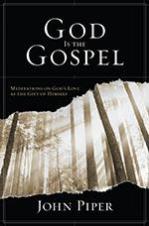 John Piper takes on this theme in his latest book God Is the Gospel: Meditations on God’s Love as the Gift of Himself. He argues that the gospel is all about God giving Himself to us for our good and His glory. The gospel trumpets God’s worth not man’s.