Selective Scholarship and Wishful Thinking: The Misinformation that Supports KJVOism

This chart is a classic example of wishful thinking and selective scholarship. I found the chart posted on the Fighting Fundamental Forums here. It is illustrative of a pervasive problem in KJVOism. The selective use of facts to present the greatest possible “defense” or “proof” of their position. After they have painted the evidence with a wide brush, then they are ready to defend their position. This is unscholarly and dishonest, but sadly it is all too common.

Take a good look at this chart, and then read my response to it that I gave in the thread on the forums mentioned above. [You will actually be able to see it easier by clicking here–where it was originally posted.]
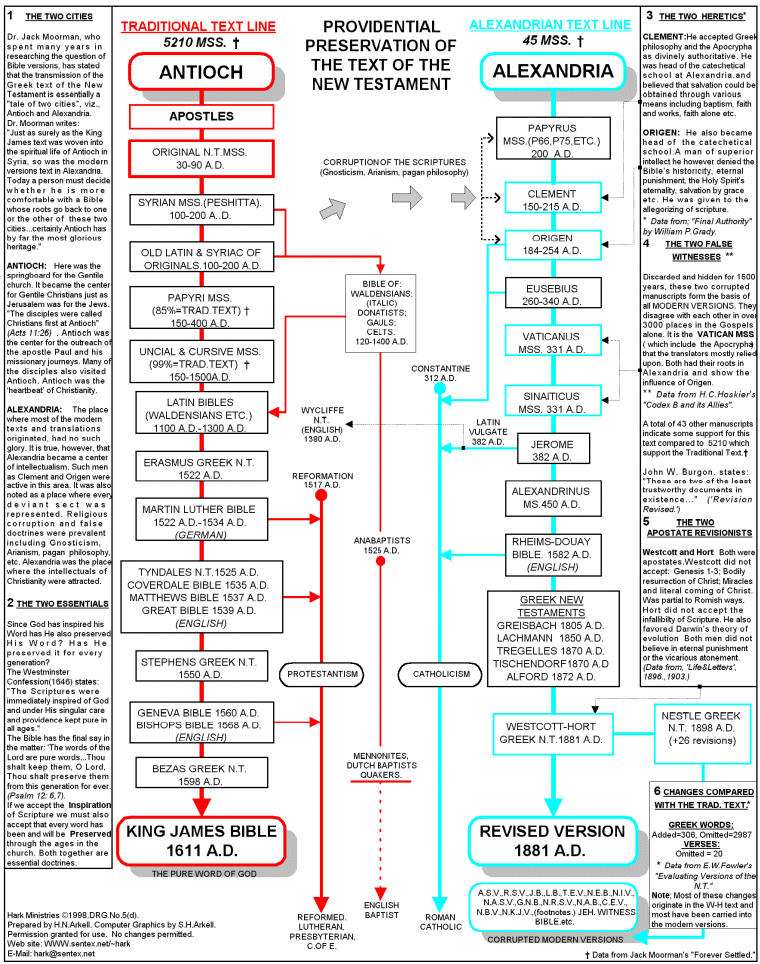
KJV Only ChartThis chart upon first study appears very scholarly. It presents a clear case for the superiority of the KJV. Most KJVO’s who see this will print it and put it in a prominent place. “Ahh!!, a key reference for future discussions or thought!” they will think. But actually, this chart is symptomatic of the problem rampant in KJVO circles–selective scholarship! The chart simply parrots facts from other KJVO books by authors who got their facts from other KJVO books whose authors got them from who knows where. The chart (or the books it is based on) picks and chooses among the facts to decide which ones to present. It sadly paints the case to make it look convincing. I want to briefly point out some inconsistencies and inaccuracies in this chart, just to showcase how the chart does not tell the whole story and does not present all the facts.

  • The chart shows 2 text families, but in reality there are three or four (or more). The Western and Cesarean families are not mentioned.
  • The chart dates the Peshitta at 150 A.D., but modern scholarship is nearly unanimous in dating the Peshitta sometime after 420 A.D. This fact is not noted in the chart, and should change the weight of that evidence. Further, the chart does not point out that the Peshitta has multiple readings which favor the critical texts over the TR. For instance it has “God” rather than “Son” at John 1:18; it has a relative pronoun in 1 Tim. 3:16 rather than the word “God”; and it lacks entirely John 7:53-8:11; Acts 8:37; I John 5:7 (and other passages found in the TR).
  • The chart counts the Greek mss but not the Latin mss. While a majority of Greek mss support the Byzantine family, a huge majority of the Latin mss favor a text more similar to the critical text of today. Further, the Latin mss outnumber Greek mss nearly 3 to 1!
  • Also, the chart oversimplifies the data by claiming 99% or so of mss clearly support the Byzantine text. It does not deal with factors such as the time period of those mss or the location. The vast majority of mss that are still extant are from the same locale and time period (9th to 14th centuries in the Easter Roman or Byzantine Empire). During this time period virtually no one else was using Greek as a language, hence no desire or need to copy the Greek mss outside of Byzantium’s general area. Fewer mss remain from other locales and time periods and the statistics for which of those other kinds of mss support the Byzantine text are much less favorable to the Majority/TR text (KJVO) postition.
  • The chart claims the Waldensian’s Bible was based on the Traditional Text. No evidence supports this. All the evidence we have indicates the Waldensian’s Bible was translated from the Latin Vulgate. KJVO-ists may wish that the Waldensian’s Bible was a Traditional Text Bible, they may even suspect it was, but with no evidence they cannot claim it was. Or worse, present it as fact, like this chart does.
  • The chart points out that the Vaticanus and Sinaiticus mss disagree over 3000 times and indicates this means they are bad mss. It fails to point out that scholars view these differences as a testimony to how significant it truly is when these two old mss agree in places. The agreement attests to a single text type much older than either of those very old mss.
  • The chart claims Westcott and Hort were apostate, but does not mention that Erasmus was not only “partial to Romish ways”, he never left the Roman church! He even publicly debated Martin Luther over his views.
  • The chart classifies the Vulgate as Alexandrian, yet it fails to mention that several readings of the TR (and KJV) come strictly from the Vulgate, like 1 John 5:7, Rev. 22:19 (“book of life”), and Acts 9:6.
  • The chart does not mention that the Byzantine/Traditional text which is the Majority, differs greatly with the TR–well over a thousand times!
  • Another inconsistency is that while the chart takes the time to mention that the Vatican mss has the Apocrypha, it does not mention that the KJV 1611 had the apocrypha also!
  • The chart ends with 1611, but the KJV was revised as late as 1769. Further, the NKJV is a translation from basically the exact same text as the KJV. Due to the NKJV’s footnotes (which are not in every edition of the NKJV), the chart relegates it to the Alexandrian column. However, the KJV 1611 had footnotes, many of which pointed out alternate readings, or pointed out that some mss do not contain certain verses. In fact, the KJV translators defend this practice of using footnotes to point out alternate readings in their preface to the KJV 1611.

Well, more could be said, I’m sure. But this should suffice for demonstrating that this is a slanted and biased presentation. It is not an honest presentation of the facts. Rather it is a work of selective scholarship.

Note: in the comment thread on the forum, Thomas Cassidy (who actually prefers the KJV) pointed out some other inaccuracies of the chart. You can read that thread here.


∼striving for the unity of the faith for the glory of God∼ Eph. 4:3,13 “¢ Rom. 15:5-7
"How Great is Your Love" (How High and How Deep) by Mark Altrogge

Last week, we sang a song I have come to treasure–“How Great is Your Love” by Mark Altrogge, which is more popularly known by the first phrase of its chorus–“How High and How Wide”. Below are the lyrics to the whole song, but let me stress the phrase which always arrests me: “Objects of mercy who should have known wrath…” This brings me to tears nearly every time I sing it. It fills me with amazement at the magnitude of God’s mercy and the greatness of His grace. May that thought, and the message of the whole song, captivate you and enthrall you that much more with the wonder of God’s great love.


How Great is Your Love

by Mark Altrogge

No eye has seen, no ear has heard,
No mind has ever conceived
The glorious things that You have prepared
For everyone who has believed
You brought us near and You called us Your own
And made us joint heirs with Your Son.

Chorus:
How high and how wide,
How deep and how long,
How sweet and how strong is Your love.
How lavish Your grace,
How faithful Your ways,
How great is Your love, oh Lord.

Objects of mercy who should have known wrath
We’re filled with unspeakable joy.
Riches of wisdom, unsearchable wealth,
And the wonder of knowing Your voice.
You are our treasure and our great reward,
Our hope and our glorious King.

CCLI# 1360011
Mark Altrogge,  ©1991 Integrity’s Praise! Music/PDI Praise


The musical score for the song is available online for 99 cents here. And for a sampling of the melody, click here and scroll down till you find the song title (How High and How Wide) and merely click on one of the links to whichever music player you prefer.


∼striving for the unity of the faith for the glory of God∼ Eph. 4:3,13 “¢ Rom. 15:5-7
The Christian Life As a Race–Heb. 12:1-17

Run the Race

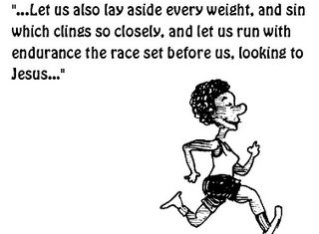
Hebrews 12:1-17 speaks of the Christian life as a race. Here are some thoughts concerning that race which were helpful in my Christian walk/race!

I. Pattern for our race.

A. OT Saints (chapter 11)

  • Ran it by faith
  • Endured hardship (self-chosen risk and external persecution)
  • Had a definite goal in view (Abraham = heavenly city; Moses = wealth/reward of Christ)

B. Christ (vs. 1-4)

  • Trusted the Father [had faith, in a sense] (“for the joy”; learned obedience)
  • Endured hardship (cross, shame, sinners, hostility, death)
  • Had a definite goal in view (joy; redeem a people for God)

II. Problem for our race.

A. We need faith

  • To see the witnesses
  • To see Jesus
  • To see the reward

B. We have obstacles

  • Weights (entanglements, see 2 Tim. 2:4)
  • Sins (besetting sins)

C. We have hardships

  • Requires endurance (v. 1)
  • Potential weariness (v. 3)
  • It is painful (v. 11)
  • Wears us out (v. 12)
  • Requires striving (v. 14)

III. Purpose of our race

A. Ultimate purpose

  • To win the prize (1 Cor. 9:24-27)
  • To gain Christ (Phil. 3)
  • To see the Lord (Heb. 12:14)

B. Progressive purposes

  • Our good (v. 10)
  • Share in his holiness (v. 10)
  • Fruit of righteousness (v. 11; Phil. 1:10-11)

IV. Perspective for our race

A. Our intensity/difficulty is really minor

  • Consider Christ (v. 3-4)

B. Our difficulty is to be welcomed not begrudged (v. 5-6)
C. No difficulty = no sonship (vs. 7-8]
D. God is working in this for our good (v. 9-10)
E. Our hardship is unpleasant but effective (v. 11)
F. Keep the pitfalls in view.

V. Pitfalls of our race

A. Potential to not see the Lord (v. 14)
B. Potential to fail to obtain grace (v. 15)
C. Potential to become or be poisoned by a “root of bitterness” (v. 15–also cf. Dt. 29:18ff. for the OT context of the phrase “root of bitterness”)
D. Potential to cross the line and be rejected finally (v. 16-17)

VI. Partners for our race

A. Brothers (and sisters) in Christ

  • Strive together (v. 14)
  • Help all (v. 15)
  • Prevent any (v. 16)
  • Also see Heb. 3:12-14 and 10:24-25

B. Christ (vs. 2)

The outline above should be sufficient for you to catch the gist of my thoughts on this passage. But let me expound on a few points so you better understand the outline. First, I take the “chastening” or “discipline” of verses 5 through 11 to be not so much God’s punishing us when we do evil as it is the whole difficulty involved in the sanctification process. What makes me conclude in this way? Well, verse 3-5 uses the concept of chastening to remind us to not view the race with a bad attitude. Verse 7 continues, “It is for discipline that you have to endure”. I see that as connected with the endurance mentioned in verse 2 and 3. In other words the whole Christian life–the race–requires endurance because it is God’s disciplining work. Verses 11-13 go back to the race metaphor again, showing that chastening should be viewed within that motif. Further, if chastening is done only to believers, and yet all the lost equally reap the bad results of their bad deeds, something different must be understood in the idea of chastening. I do not discount that an inward grief and struggle concerning sin is in view with this chastening, but it is only part of it and not the sum total of chastening.

Second, some of you may wonder what I am getting at under point number 5–the pitfalls. Feel free to consult a post dedicated strictly to this concept–the perseverance of the saints–entitled “Once Saved, Always Saved?!?!”. There I maintain that the warnings against apostasy are real and are used to help us become sanctified. In our race, we better remember that if at any time we give up, we may very well prove to have been a fake all along (1 Jn. 2:19). Only those who endure to the end will be saved, remember.

The Fullness of Jesus' Love Shown in the Lowly Act of Footwashing

Dr. Sam Storms of Enjoying God Ministries preached an excellent message for us this Sunday from John 13:1-11. Our overall theme for messages at Bethlehem Baptist during the five months our preaching pastor, John Piper, is gone has been “toward all the fullness of God through Christ” from Eph. 3:14-19 (I blogged about this series recently, so go to that post to find a link to the schedule and free mp3s/audio for each message.). After the introduction message, the first four messages have specifically focused on the fullness of the Spirit–Dr. Storms preached one of those messages for us last week [it was excellent and thought provoking, you should listen to it!]. Anyway, the next few messages center on the fullness of the love of Christ.

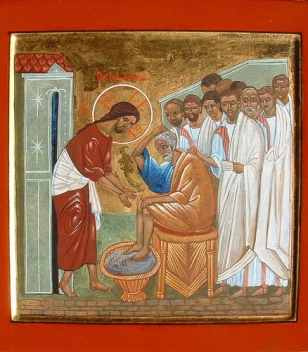
Dr. Storms chose an excellent text to highlight Christ’s love. The passage centers on Christ washing the disciples’ feet. Verse 1 stresses Christ’s love in this act and its greater context–“having loved his own who were in the world, he loved them to the end.” Dr Storms highlighted how this time in Jesus’ life was clearly a crisis. As a human he was facing his hardest hours. And while we would find it very difficult to think about and love others in such a time, our Savior did not. From this text and others we know that Jesus knew his disciples would very soon forsake him in his need, yet he lovingly served them anyway.

Dr Storms reminded us that nowhere in ancient history do we hear of any superior washing the feet of those beneath him, until Jesus. Dr Stroms then showed how the text stresses the exalted position of Christ–the glory Christ is anticipating returning to–and the extreme lowliness of serving through washing dirty and smelly feet. And he brought this all together as a wonderful portrait of Christ’s love in all its fullness for us.

He ended his message with an extended quote from Jonathan Edwards which was so good, I just had to post it. I found that it was from a sermon entitled “The Excellency of Christ” based on Rev. 5:5-6. Yet the passage Sam Storms quoted dovetails beautifully with his text, John 13:1-11. So let me provide the quote, and you can read Edward’s sermon in depth, if you like, here.

There do meet in Jesus Christ infinite highness and infinite condescension. Christ, as he is God, is infinitely great and high above all. He is higher than the kings of the earth, for he is King of kings, and Lord of lords. He is higher than the heavens, and higher than the highest angels of heaven. So great is he, that all men, all kings and princes, are as worms of the dust before him. All nations are as the drop of the bucket, and the light dust of the balance, yea, and angels themselves are as nothing before him. He is so high, that he is infinitely above any need of us, above our reach that we cannot be profitable to him, and above our conceptions that we cannot comprehend him. Pro. 30:4 “What is his name, and what is his Son’s name, if thou canst tell?” Our understandings, if we stretch them never so far, cannot reach up to his divine glory. Job 11:8 “It is high as heaven, what canst thou do?” Christ is the Creator and great Possessor of heaven and earth. He is sovereign Lord of all. He rules over the whole universe, and does whatsoever pleaseth him. His knowledge is without bound. His wisdom is perfect, and what none can circumvent. His power is infinite, and none can resist him. His riches are immense and inexhaustible. His majesty is infinitely awful.

And yet he is one of infinite condescension. None are so low or inferior, but Christ’s condescension is sufficient to take a gracious notice of them. He condescends not only to the angels, humbling himself to behold the things that are done in heaven, but he also condescends to such poor creatures as men, and that not only so as to take notice of princes and great men, but of those that are of meanest rank and degree, “the poor of the world,” Jam. 2:5. Such as are commonly despised by their fellow creatures, Christ does not despise. 1 Cor. 1:28 “Base things of the world, and things that are despised, hath God chosen.” Christ condescends to take notice of beggars (Luke 16:22) and people of the most despised nations. In Christ Jesus is neither “Barbarian, Scythian, bond nor free” Col. 3:11. He that is thus high condescends to take a gracious notice of little children, Mat. 19:14, “Suffer little children to come unto me.” Yea, which is more, his condescension is sufficient to take a gracious notice of the most unworthy, sinful creatures, those that have no good deservings, and those that have infinite ill-deservings.

Yea, so great is his condescension, that it is not only sufficient to take some gracious notice of such as these, but sufficient for everything that is an act of condescension. His condescension is great enough to become their friend, to become their companion, to unite their souls to him in spiritual marriage. It is enough to take their nature upon him, to become one of them, that he may be one with them. Yea, it is great enough to abase himself yet lower for them, even to expose himself to shame and spitting; yea, to yield up himself to an ignominious death for them. And what act of condescension can be conceived of greater? Yet such an act as this, has his condescension yielded to, for those that are so low and mean, despicable and unworthy!

Such a conjunction of infinite highness and low condescension, in the same person, is admirable. We see, by manifold instances, what a tendency a high station has in men, to make them to be of a quite contrary disposition. If one worm be a little exalted above another, by having more dust, or a bigger dunghill, how much does he make of himself! What a distance does he keep from those that are below him! And a little condescension is what he expects should be made much of, and greatly acknowledged. Christ condescends to wash our feet, but how would great men (or rather the bigger worms), account themselves debased by acts of far less condescension!

Picture above is public and was found here


∼striving for the unity of the faith for the glory of God∼ Eph. 4:3,13 “¢ Rom. 15:5-7

"I Love You, Lord"–With Additional Verses by John Piper

Last week, April 2, the song I wanted to do my weekly Musical Notes post on, was a special version of “I Love You, Lord”. What makes it special when we sing it at Bethlehem, are the two extra verses that Pastor John Piper wrote for the song. I tried finding the lyrics last week, but to no avail. I finally emailed Bethlehem’s office and they were kind enough to send me the lyrics. I hope they bless you as they have blessed me.


I Love You, Lord

by Laurie Klein (v. 1 & music)
by John Piper (v. 2, 3)

I love you, Lord, and I lift my voice
To worship you, O my soul, rejoice!
Take joy, my King, in what you hear:
May it be a sweet, sweet sound in your ear.

I love You, Lord, and I stand amazed;
My sins are gone! May Your name be praised!
Exult, my soul! And behold His face;
I will ever sing, O my King, of Your grace.

I love You, Lord, and for You I wait:
Your promises and Your power are great!
Make haste, my God, may I taste Your ways;
I will magnify Your sweet peace all of my days.

Music and Verse 1  © 1978 House of Mercy Music
(admin. by Maranatha! Music) CCLI# 130553


In case you are unfamiliar with this song, you can click here for an example of the melody. You can click here for a guitar chord sheet. And you can read the interesting story of the song (minus John Piper’s words) here.


∼striving for the unity of the faith for the glory of God∼ Eph. 4:3,13 “¢ Rom. 15:5-7