DISCLAIMER: Although I am dealing specifically with fundamentalist preaching, the problem of moralistic messages without explicit reference to the redeeming work of Christ permeates all of evangelicalism.
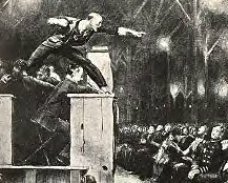 Independent Fundamental Baptists love preaching! And when I say preaching, I mean hell-fire and brimstone, Bible-waving, Satan-trouncing PREACHING! Amen? The best preaching is usually accompanined by the most screaming, hollering, spitting, snorting, and a good dose of preaching “antics”.
An example of this I’ll never forget would be the preaching of George Griffis, camp director of Camp Victory in Somerset, KY. My church made the long drive from the Detroit area to Camp Victory every summer when I was a teen. There would be various preachers, but always Bro. George would preach. When he got worked up, he would be screaming and crying at the same time. He had a knack of jumping from the edge of the platform and grabbing the rafters of the old-fashioned tabernacle, where the preaching was done. He would swing and scream with all his might! A few hundred wide-eyed teens was always the result…. He had his heart and soul involved in his preaching for sure!
 Now another aspect of the kind of preaching fundamentalists savored was what is called toe-stomping. Yes, if you are thinking of the image of someone stomping on your toes–that is what is meant. It seems the preachers job was to make us feel guilty about all of our failures. If we really felt like he had put us through the ringer, so to speak, it was thought the preacher had really done his job well. This is why a full altar meant a great sermon. When all kinds of people felt the weight of their guilt to the point of coming forward and “getting things right” with God, the preacher had done his job well. No pain, no gain! Amen?
This view of preacing had many direct and indirect results. In many spheres of extreme fundamentalism, theatrical antics, brashness, an almost uncouth mouth, and emotional manipulation became the tools of the trade for the kings of the sermon. And even among those who were not so keen on showmanship, Billy Sunday remained a hero. Still, in most IFBx churches, if one does not holler one is not really a preacher. “We need preachers not teachers”, as the saying goes. Expositional preaching does not serve this view of preaching as easily as topical preaching, and so in many spheres of fundamentalism expositional preaching was outright condemned, while in others it just became more and more rare.
While the loss of expositional preaching is great indeed, I would venture to say another result of IFBx’s view of preacing is even more troubling. I would say the tactic of heaping guilt on the hearers and calling them to reform and seek revival, has led to a kind of moralistic preaching which is most perilous indeed!
Fundamentalist preaching mirrors the fundamentalist view of sanctification by keeping rules. While not all IFBs and IFBxs claim to believe in sanctification by keeping rules, to one degree or another the fundamentalist emphasis on external conformity to standards conveys the idea that the more one adheres to these standards the more right with God he is. This results in the unconscious view that our own level of performance plays a big part in God’s acceptance of us. As I said in an earlier post,
“Often, the solution to struggling against sin was provided as merely gritting one’s teeth, and working harder. Character was the means to accomplishing my moralistic goals….IFB/IFBx churches stressed the importance of duty. But they did not address the question of human inability and depravity, so much. We all could do it, and if we didn’t we weren’t filled with the Spirit enough. Blame and guilt was applied as a means to motivate us to do right.”
What do I mean by moralism? I mean the mere attempt to be good. I have heard countless fundamentalist messages on having character, giving, being truthful, loving others, obeying one’s parents, reading the Bible, praying, going to church, courage, not quitting, leadership, and on and on the list goes. Yet many of these same virtues are extolled among people who have no true claim to the name Christian. Mormons extol family values, and Jehovah’s Witnesses are for many of the things on that list. In fact, non religious groups extol sacrifice, leadership, truthfulness, loving others, courage, even meditation, etc. These things are moral issues, and Christians do not have the market cornered on morality.
Recently, I came across another ex-fundamentalist blog called The Misadventures of Captain Headknowledge. In a few of his posts he emphasizes this very thing: how Christ needs to be central in preaching. Let me quote him in-depth from his post, “What am I Hearing in this Sermon?”, as he sums it up well.
“…the Law (what God is and does, and so what man ought to be and do) is imperative, and the Gospel (what Christ has done for sinners) is indicative.
In Christ-centered preaching, the logic will flow from indicative to imperative; from what God does, in Christ, to what man ought to do. We derive the proper motive and power to perform the imperatives of Scripture from the proclamation of the indicatives of Scripture.
Whenever the focus of the sermon is imperative, what we can or should be doing, and the indicatives of God’s work on our behalf rates as a secondary concern in the sermon, we unintentionally slip into thinking we’ll earn the indicatives (that which God grants by his grace) by performing the imperatives (that which God gave us to prove to us we must rely only on his grace). This is the danger of man-centered preaching.
Is Jesus mentioned in the sermons you hear? If he is, is he the subject of the verbs; is he the one doing the work, or is Man? If Jesus is the one doing the work, what work of his is being proclaimed? Is he proclaimed as our Problem-Solver, Example (WWJD), Therapist or Sugar Daddy? Or is he proclaimed as our Creator, Redeemer, Advocate, Mediator, Judge, Prophet, Priest or King?
The reason this matters is because ‘the gospel is the power of God for salvation to everyone who believes’ (Romans 1:16). Salvation is an all-encompassing work, including not only our justification, but also our sanctification and our glorification. Preaching on sanctification is vitally important; there is much for us to do, in dependence on God’s gracious empowerment, to grow in sanctification, but this is not achieved by majoring on detailing all the imperatives alone, but the imperatives of preaching, what we normally call ‘application’ of God’s Word, must be built on the foundation of the indicative of the Gospel preached alone.” (emphasis his)
 I believe he leans heavily on Bryan Chapell‘s book Christ-Centered Preaching. Chapell emphasizes that in every sermon one must relate the explanation of the Scripture passage to the redeeming work of God in the present. Otherwise, he insists, all you have is “simply a ‘sub-Christian’ call ‘to be’ or ‘to do’ something in one’s own strength” (quoted from an online summary of Covenant Theological Seminary‘s homiletical programs). Chapell’s book is simply a homiletical application of the Reformed approach to hermeneutics–redemptive historical interpretation, which I have discussed elsewhere. UPDATE: To listen to a message by Bryan Chapell which summarizes well his book, click here [or right click on it and select “save target as” to download it and listen to it later].
Captain Headknowledge goes on to say in another post:
“…and this is the point of my incessant howling about basing all application… in preaching on the basis of the Gospel preached…, and not only preached as an evangelistic appeal directed toward unbelievers, but preached also to the believers as the foundation and reason and source of the particular application of each and every ‘practical and relevant’ sermon. If application is preached as separate from the gospel, you have legalism. It’s not good enough to assume the listeners understand the foundation, it must be presented as a unified, package deal. It is ‘wickedness of the deepest darkness’ to preach application without explicitly basing it on the gospel. Imperative comes from Indicative; application comes from gospel; ‘do’ comes from ‘be’. Kind of like that old saying, ‘we sin (do, imperative) because we are… sinners‘. Likewise, we walk in righteousness because we are righteous, not ‘we become righteous by walking in righteousness’. How did we become righteous? Righteousness was given to us by God as a free gift of his grace (Romans 1:17; 3:24). Hello! Indicative! Followed by Imperative!” (emphasis his)
So what am I driving at? I am not concluding one should never encourage believers to obey God’s Word. Believers do need to be truthful, godly, etc. The Holy Spirit certainly may convict believers of their need to “do better”. But ultimately, we need to preach how the gospel touches each area of the believer’s life. We cannot, apart from God’s Spirit given to us based on the Gospel work on our behalf, ever be wholly truthful and godly. And even if we could, it would avail us nothing! We need to be reminded that God accepts us based on Christ and because of Christ we can obey and become all that we already are in Christ.
We don’t need more toe-stomping sermons. We need more sermons that direct sin-laden believers to feast their eyes on the glories of Christ. A greater appreciation of Him, a greater understanding of His work–these will give us hope and faith and courage to keep pressing on.
So whatever standards you hold, and whatever group you identify with, beware of moralism. Make much of Christ! Glory in the cross!
Picture of Billy Sunday borrowed from here.
∼striving for the unity of the faith for the glory of God∼ Eph. 4:3,13 “¢ Rom. 15:5-7
Like this:
Like Loading...