The Demands of Jesus—Introduction & #1

Click to orderIntroduction

Blogging can be so much more than mere fun. It can become a discipline. And it can even provide a measure of accountability.

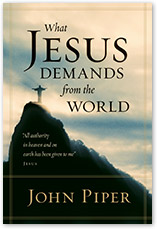
That said, I plan to embark on a new venture with this blog. I intend to blog through the 50 demands that make up What Jesus Demands from the World, the new book by my pastor John Piper. I want to post devotional thoughts on each of these demands and intend to use the chapters in my personal Bible time. As such, I may post a demand a day. I can’t guarantee that this series will be finished in 50 days, however. I don’t want these posts to take away from my other blogging goals. But I think we will find them encouraging and challenging. But this series will be mostly for me—a discipline to post devotional thoughts regularly from my reading and meditating in God’s Word.

A word about the book, before I begin is in order. The chapters in the book are written in such a way as to be easy to read in one setting each. Thus they provide a perfect format for a devotional reading. With this book, Desiring God already has the entire book available to be read online for free! I would highly encourage you to read the introduction as it provides a great overview of the Gospel mission of Christ.

Today, there is a push to redefine the heart of the Gospel around the commands of Jesus to love God and your neighbors. Piper makes it clear, however, that the shadow of the cross is stamped all over the Gospels, and that Christ does not intend his commands to be able to impart life apart from a recognition of the centrality of the cross-work of Christ. So Piper tries to look behind each command and see the motivations given for it and the connection it has to the Gospel news of Christ’s substitutionary death and resurrection on our behalf. And as such, he hopes to show how the commands of Jesus are given to accomplish 2 purposes. These purposes are captured well in this quote: “The obedience he demands is [1] the fruit of his redeeming work and [2] the display of his personal glory.” So on now to…

Demand #1 — You Must Be Born Again

Jesus answered him, “Truly, truly, I say to you, unless one is born again, he cannot see the kingdom of God.” Nicodemus said to him, “How can a man be born when he is old? Can he enter a second time into his mother’s womb and be born? Jesus answered, “Truly, truly I say to you, unless one is born of water and the Spirit, he cannot enter the kingdom of God. That which is born of the flesh is flesh, and that which is born of the Spirit is spirit. Do not marvel that I said to you, ‘You must be born again.’ The wind blows where it wishes and you hear its sound, but you do not know where it comes from or where it goes. So it is with everyone who is born of the Spirit.” (John 3:3-8)

First, notice that without the new birth, no one can even see the kingdom of God. My Reformation Study Bible says it this way: “Without the grace of God, sinners cannot find the door, let alone force their way in.” Then notice that Jesus is amazed that Nicodemus did not understand what Jesus was meaning with the phrase “new birth”. This points us to look back to the Old Testament, in which Nicodemus would have been an expert, to find a reference to the new birth. We find such a reference in the new covenant promised blessing of a “new heart”.

I will sprinkle clean water on you, and you shall be clean from all your uncleannesses, and from all your idols I will cleanse you. And I will give you a new heart, and a new spirit I will put within you. And I will remove the heart of stone from your flesh and give you a heart of flesh. And I will put my Spirit within you, and cause you to walk in my statutes and be careful to obey my rules. You shall dwell in the land that I gave to your fathers, and you shall be my people, and I will be your God. (Ezek. 36:25-28; see also Is. 44:3)

The phrase “born of water and of the Spirit” describes the one new birth. This is clear because it is parallel to “born again” in vs. 3. Unless you are “born again” and unless you are “born of water and the Spirit” you cannot “see” or “enter” the kingdom of God. In light of the parallel to Ezek. 36 and also a similar parallel to Titus 3:5, we should see the water as referring to cleansing from sin and the spirit as the infusing of a new heart and spirit which accompanies the presence of the Holy Spirit in our lives now. Some try to make water refer to physical birth, but this is not how first century people would understand that. Others make it refer to baptism, and they are partly correct. Baptism is a rite which includes water. This hearkens back to the cleansing rituals in the OT ceremonial law. As Ezek. 36 shows (see also Is. 44:3), water is symbolic of cleansing. And Baptism is just that as well—symoblic of the spiritual cleansing we receive at the new birth.

To be born of the Spirit involves a dying to the past, and therefore it is only the Spirit that is spoken of in the subsequent verses; but it is essential that our past be recognised as needing cleansing and forgiveness. These two factors, water and spirit, are not strictly co-ordinate. Water is not an actual spiritual agency in the second birth; it is only a symbol. But in every true second birth there is a negative as well as a positive side, a renunciation of the past as well as a new life created. [quoted from Marcus Dods, “The Gospel of St. John”, The Expositor’s Greek Testament, vol. 1, ed. W. Robertson Nicoll (Hendrickson reprint, 2002) pg. 713]

Having looked a little closely at some of the parts, let us pause to take in the whole. Jesus says you need to be born. How many babies birth themselves? This is a passive action. Verse 8 indicates that the Spirit performs this new birth in a mysterious way, just as wind is mysterious. This new birth is referred to in John 1:12-13 where it is stressed that the birth happens: “not of blood, nor of the will of the flesh nor of the will of man, but of God.” In short, the new birth is an impartation of spiritual life which happens on the inside of our hearts and which only God can perform. Upon receiving this spiritual life we will believe in Jesus Christ as the rest of John 3 up to verse 21 shows. For a closer look at regeneration check out this earlier post.

To conclude, we are to be born again, yet we are unable to “just do it”, Nike style. This demand of Jesus indicates to us that we are sinful people in need of cleansing and rebirth which only God can provide. The good news is that Jesus came to enable us to see that kingdom and to purchase on the cross a grace to enable new birth to come to all who will believe. We can’t birth ourselves, but we can look to Jesus and be aware of our need for rebirth. We can follow on to know more of Jesus teaching, and this will culminate in spiritual rebirth.

To those of us who profess Christ, may this command remind us of our lowly estate apart from Christ. May it remind us that each day we depend on the Spirit to be continually blowing life on our dry dead bones, and that we need the Spirit’s work in us to be able to really see and appreciate the glorious realities of the Kingdom.

—See all posts on, the Demands of Jesus


∼striving for the unity of the faith for the glory of God∼ Eph. 4:3,13 “¢ Rom. 15:5-7

So Many Books…So Little Time

Do you like books? Most of my readers probably do. Regardless of your taste in books, you probably share my problem. You have a bookshelf full of wonderful titles as yet unread.

As much as I love books, I find it hard to stick to my reading plans. I pick one up then lose interest as another catches my eye. I am reading through several as we speak, but I have been making progress. I actually read a book in these last two weeks cover to cover! And then I finished another book I have been working on, and by the end of today will have finished a booklet.

Well, I came across an interesting article on reading. It offers practical tips on pushing through and actually reading the book. But it offers more than that, it encourages “mastering” the book rather than just reading it. The pointers in this article seem like they will help me to take on one book at a time and master it, in a relatively short amount of time. Perhaps this will help me get to all of those editions which are still beckoning to me!

I refer you to this link to read the helpful article entitled “Why Settle for Merely Reading a Book When You Can Master It? How to Read Less More, and Twice as Fast” by Gregory Koukl of Stand to Reason. (I forgot who pointed me to this blog post, sorry.) A brief version of this same article is available here.


∼striving for the unity of the faith for the glory of God∼ Eph. 4:3,13 “¢ Rom. 15:5-7

“Sex, Romance, and the Glory of God” by C.J. Mahaney

This post finishes my review of Sex, Romance, and the Glory of God, by C.J. Mahaney, which I started here. I highly recommend this book, with but one caveat.

In Mahaney’s eagerness to use Song of Solomon as a Biblical description and instruction of marital intimacy, he falls prey to a wrong approach to interpreting that book. He pits an allegorical interpretation, which sees Christ and his Church as the key players in that song, against a “literal” interpretation, which sees Solomon talking about the joys of marital love. I am aware that some who used an allegorical interpretative scheme in approaching this book did so in such a way as to negate any application of what the song teaches about marital love. However, Mahaney’s approach, which is widespread and pervasive today, errs to an opposite extreme: in applying what the song says directly about marital love it denies any typographical use of the book. I see a third option, one which affirms that the book clearly praises the joys of marital love yet which also recognizes that Solomon’s Song is written within the framework of a redemptive history that the Bible records for us. And just as other Biblical stories foreshadow and describe the redemption Christ accomplished for His people, thereby enhancing our understanding of and appreciation of the Gospel (for instance Gal. 4:24ff.; 1 Cor. 10:4ff.; Rom. 15:4; Luke 24:27, 44-45ff.; and the obvious typography of the Tabernacle and offerings–whole book of Hebrews; see this category of posts for more information), so too the Song of Solomon may rightly be seen to describe the anti-type of which marriage is only a picture. Indeed all marriages are a picture of the abiding covenant love and joyful relationship between Christ and His Bride, the Church (Eph. 5:31-32); and hence it would be proper to see Christ and His Church as ultimately referred to in this beautiful love poem.

Let me not fail to stress here that this really is an absolutely wonderful book on marriage. You need to get it and read it, especially if you are a husband—and even more so if you have already been married for some time. Below I will mention some specific points in the  book which I appreciated, beyond what I have already written. But before I do, I should refer you to a more competent review that what you will see here. Tim Challies has a good review at DiscerningReader.Com; however he may not agree with my caution concerning Mahaney’s interpretational approach to Song of Solomon. Now on to my excerpts and comments on the last four chapters of the book.

More than “The Act”

Most of the book teaches us men how to romance our wives and how to communicate effectively our love to them. Yet it purports to be a book about sex. Mahaney stresses that this is no contradiction: sex is more than just “the act”.

You see, what we express…and how we behave toward our wives in the days and hours before we make love is actually far more important than what we do when the clothes come off…Everything I say to my wife teaches her something about how I value her. Every touch, every kiss on the cheek, every note and gift, every brief phone call—as well as every act of selfish neglect—expresses something about my heart….So, to talk about romantic communication and creativity is not to delay talking about sex. It is to talk about what makes for the best sex.

Communication and sex are inseparable. It’s not as though sex is one thing and communication is something else. Life doesn’t divide into neat little compartments like that, especially when it comes to the oneness of marriage. It’s all one thing. (58-59)

Carefully Composed Words

I found Mahaney’s chapter on “The Language of Romance” to be very interesting. I was challenged to be more intentional in how I communicate with my wife, and to stop neglecting poetry as a means of arousing her love. I used poetry frequently before we were married, I should therefore use it even more, now that we are. Listen to Mahaney on this point:

…[Song of Solomon shows us] a category of communication set apart from the stuff of daily life….It is highly intentional, creative, provocative, erotic language. It’s purpose is to arouse romantic passion—to inflame slowly and intentionally, all the while honoring and delighting one’s spouse….Long before they begin to enjoy one another’s bodies, they excite one another’s minds with tender, creative speech. They model for us what it means to feel sexual passion and to articulate that passion. The language is highly poetic, romantically expressed, and exceptionally creative and imaginative. It is also unmistakably sexual.

The best sex begins with romance, and the best romance begins with the kind of speech we read in the Song of Solomon. It begins with carefully composed words….

Far from scorning carefully composed words, I should accept the lesson of Solomon’s Song and learn how to use them. Poetic language is a gift from God that can help me promote godly romance with my wife!

…How many times in the past week or month have you spoken to your wife in ways that she found to be romantically and perhaps erotically arousing? (60, 69-70)

Does Natural mean Not Spiritual?

Should lovemaking within marriage be considered a fundamentally spiritual activity? I believe the answer is an unqualified yes.

Is there a case to be made from Scripture that lovemaking is any less important to a marriage than praying together, studying the Bible together, or even attending church together? I don’t think so….

…let’s not see sex as merely a permissible part of marriage or something to be tolerated. Sex in marriage is mandatory and something to be celebrated! (See 1 Corinthians 7:35; Ephesians 5:31) Sex was created for marriage, and marriage was created in part for the enjoyment of sex. (74-75)

A Realistic Approach

…I am confident that a consistently God-glorifying approach to marital intimacy can improve any couple’s sex life significantly. But let’s keep in mind that we’re human, with limitations….On the subject of sexual expectations, Douglas Wilson has pointed out that while some meals are steaks, and some are macaroni and cheese, both are enjoyable. That’s wise counsel. So let your expectations be realistic, and enjoy. (87)

The Love Behind the Sex

Mahaney pointed out something about Song of Solomon that I had never considered. He stressed that Song of Solomon, while highly erotic, is a book about marital love. And he draws some important conclusions from that seemingly inconsequential point.

It’s remarkable how Solomon’s language, while obvious in its intent, is never biologically specific in a way that could be considered vulgar or clinical….that fact is itself full of meaning. Although sexual intercourse is certainly an ultimate expression of a married couple’s erotic encounter, it is not the outstanding central feature of this book. What is dominant in the Song is not any particular physical act. The book is not about sexual intercourse. Rather, it is about the remarkable nature of the couple’s overall relationship—in all its romance, yearning, desire, sensuality, passion, and eroticism….they do not desire to be together simply so they can experience sexual gratification. They want to be together because they are in love, albeit a powerful one…. (88-89)

A Word to Wives

I wanted lastly to mention that there is a great “word to wives” section written by C.J’s wife Carolyn. It is for the most part a reproduction of chapter 7 in her book Feminine Appeal. I read that section, too, and was impressed by Carolyn Mahaney’s wisdom. It like the entire book, is not so much a manual on how to make love, as it is an encouragement to have a deep and lasting joyful relationship with your mate which includes a proper valuing and enjoyment of sex.

This book is available for purchase at the following sites: Amazon.com or direct from Crossway.

"Still the Cross" — FFH

I am beginning a new series of posts here about music. I will probably continue to post occasionally on great modern worship songs we are singing at church, but this series will focus on the songs I am listening to throughout the week.
Fundamentalists often assume that virtually all Contemporary Christian Music (CCM) is worthless. They think it is all shallow and sensual. When I first started listening to CCM I was constantly shocked by the good quality of the songs, both in message and music. Now I do believe that there is a lot of CCM which is shallow and some which could be termed sensual. But there are many great songs and many groups which consistently produce worshipful, deep, Biblical, and hence God-honoring songs.

By sharing these songs with you, my readers, I hope to encourage you about the state of Christian music today. And beyond that, I want to encourage you spiritually with the message of these songs. Many of them are very moving and are a great boon to my spiritual life, and I trust might be for yours.

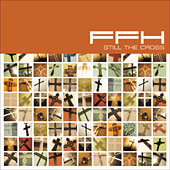
I begin with a great song about the cross. “Still the Cross” is one of my favorites, bar none. I haven’t been too impressed with some of FFH’s most recent songs, but this one from their 2004 album by the same name is really good. The message is superb and the music is extremely fitting, in my opinion. It is a “power anthem”. That means it is a big moving song. About 2/3 of the way into the song a choir joins the group and the effect adds to the building movement of the song as it ascends toward a climax. One thing you will learn in these posts is that I am not well versed in how you describe contemporary music all that much. But bear with me, and be sure to listen to samples of the music. (By the way you can usually preview entire songs at Christian bookstores without deciding to buy the music.)


Click to Order Still the Cross

Sometimes it seems the world’s unraveling around us
We fear it all may one day come undone
We can’t forget the One who came before us
To forgive the past and bring hope for what’s to come

When it all comes crashing down
The cross still stands alone
And on this our faith is built
And our courage is made strong

Chorus:
When the world falls apart
And you fear for your heart
There’s a tower of peace
It’s still the cross
So bring your sick and your poor
And your longing for more
To the place of relief
It’s still the cross

Bridge:
There is hope for the lost
It’s still the cross

Sometimes it seems that I have been forgotten
I don’t know how I will make it on my own
But the One who said I will never be forsaken
He still hears my prayer and I will never be alone

When it all comes crashing down
The cross still stands alone
And on this my faith is built
And my courage is made strong

Chorus

Though the world may not confess
You and Your holiness
One day all will see
You in all Your majesty
And the cross will stand alone
As the place where You made known
Your love for all mankind
Till then in it we’ll hide

Chorus / Bridge / Chorus and Bridge

Jeromy Deibler, Scott Williamson, Donna Smith /  © 2004 New Spring Publishing, Inc. / co-pub TBD / ASCAP (both adm. by Brentwood-Benson Music Publishing, Inc.) / Scott Williamson / ASCAP / Donna Smith Publishing Designee. All rights reserved. Used by permission.

There is not much more to say about the lyrics of this song. It is a powerful message and when matched with the music it is a great song. To listen to the song, click on the link at the bottom of this post. You might be interested in watching a video about FFH and the making of their CD “Still the Cross”. The clip opens with some of the title song in the background, and then the last two minutes or more are devoted to the song. For more info on the group FFH (or Far From Home), check out their official website. You may find this review and this one helpful as well. I will close by quoting the Jeromy Diebler’s brief story concerning this song (found here).

This is really our theme right now. After all the years we’ve been together and everything we’ve been through, this is still what it’s all about. My aunt Donna wrote a lyric for a song called “˜It’s Still the Cross’ and gave it to me two years ago. I wrote the rest of the song and played it for the band, but it didn’t really fit for us at the time. Later, when we were looking for a really strong Christian anthem, Scott Williamson and I began working again on this song and completely rewrote it all, but kept the title. As we began to pull songs for this album, we played this one and people really gravitated towards it. I think if there’s a statement we want to make right now, it’s this one… about Jesus.

Still The Cross by FFH

Loving and Serving Both Wife and Family

I’m terrible with books. I pick one up and put one down. I start one, two, three and take forever to finish them. I haven’t finished the books showcased  on my sidebar yet, and already have begun others. That is the way I am, and I am trying to get better.

Anyway, I recently picked up the book Sex, Romance, and the Glory of God: What Every Christian Husband Needs to Know by C.J. Mahaney. I was planning on giving it to someone for a wedding gift, and then I started reading it for myself. It is very quick reading and I’m already almost half way done. Since posts around here have been too rare lately, I thought I could post some thoughts about what I’ve been thinking as I have started this book.

About the Book.

Yes, as the title indicates, the book is about sex. And it focuses on Song of Solomon. But I have read 50 pages and still have not come to the sex part. While I would not say sex is not important and good, I was not looking for a sex manual or anything. And this book is certainly not that. It really only contains 2 chapters which deal with that subject. No, this book is more of a theology of marriage which provides just the right backdrop for a look at how Solomon deals with sex.

I haven’t read the whole thing yet, but it looks like one of the best books I have read on the topic. It sets sex in the proper and Biblical context in which God intended it to be so great. And it calls men—Christian men—to love and romance their wife. It calls us to lead in deepening our marriages and strengthening the love we share with our wives.

The Purpose of Marriage.

Mahaney reminded me afresh of the true purpose of marriage. Ephesians 5:31-32 says, “‘Therefore a man shall leave his father and mother and hold fast to his wife, and the two shall become one flesh.’ This mystery is profound, and I am saying that it refers to Christ and the church.” So marriage then is intended to be a picture of how Christ relates to his Church. Let me quote Mahaney at this point, since his words are much more adequate than mine:

Please don’t think of this as merely a helpful illustration or an interesting perspective. It’s much more than that. This is the essence of marriage. This is the divine purpose for your marriage….

So we see that there is a purpose in marriage that goes beyond personal fulfillment. Something of the selfless love, care, and sacrifice that Jesus shows toward the Church is supposed to be evident in you as you relate to your wife. Something of the respect, submission, and devotion that the Church shows toward Jesus is supposed to be evident in your wife as she relates to you. That’s the purpose for your marriage. That is why God has given her to you, and you to her. [pp. 23-25; underlined emphasis was italic in original]

Romancing Your Wife.

The part of the book which has been most helpful and most challenging so far has been its call for men to romance their wives. Mahaney encourages us to plan and work at delighting our wife in any number of small yet meaningful ways. He provides practical pointers and suggestions and strongly encourages a weekly date of some kind.

The truth he wants us to remember, if nothing else from this book is this: “In order for romance to deepen, you must touch the heart and mind of your wife before you touch her body.” [emphasis his, page 28]

In this section he provides a must-ask question: “Do you feel more like a mother or a wife?” [pg. 29]

Concerning this point he continues:

There can be a selfish, sinful tendency among husbands to view their wives as a goal that, once achieved, is then taken for granted. That is how a wife with children comes to feel primarily like a mother. And that is why the very idea of asking a question like this can cause many husbands to swallow hard and consider going off to watch a little TV. But please don’t—I want this to be an encouragement to you.

…A variety of legitimate activities may consume huge quantities of your wife’s time….But whatever your situation, if you make it a priority to love and care for your wife as Christ does the Church…God will touch her heart so that, even when surrounded by diapers, dishes, and diseases, she can answer that question with joy: “I feel more like a wife.”

…Motherhood is exceptionally important. It calls for immense sacrifices and deserves great honor. But I can say with full conviction that according to Scripture, motherhood is never to be a wife’s primary role. In fact, I think the most effective mothers are wives who are being continually, biblically romanced by their husbands. [pg. 30]

Loving and Serving Your Family.

Finally, I wanted to quote just a brief story Mahaney shares which was a challenge and encouragement for me to remember that I am to love and serve my wife and family as Christ serves and loves the Church.

When our first two children were still quite young, I realized that my commute home in the evening was functioning as little more than a review of my day. As far as I was concerned, by the time I got in that car, my responsibilities were pretty much over until the next morning. I saw my home as a refuge, a place where the emphasis, for me, was on being served rather than on leading and serving with Christlike love.

In God’s mercy, he showed me the selfish motivation I was bringing home each evening. I saw that my commute could be best utilized as a time of transition, so that I might be prepared to finish the day by loving and serving my family well.

So I made a practice of pulling the car over a few blocks from my home so I could take a couple of minutes to make an effective transition in my soul. There on the side of the road, I meditated on Ephesians 5 as well as on some other passages. I confessed to God my sinful tendency to be selfish and sought to prepare my heart to serve my wife and children when I arrived home. In this way I learned to see my home as the context where I have my greatest privilege and opportunity to serve…. [pp. 50-51]

Read part 2 ofthis review.